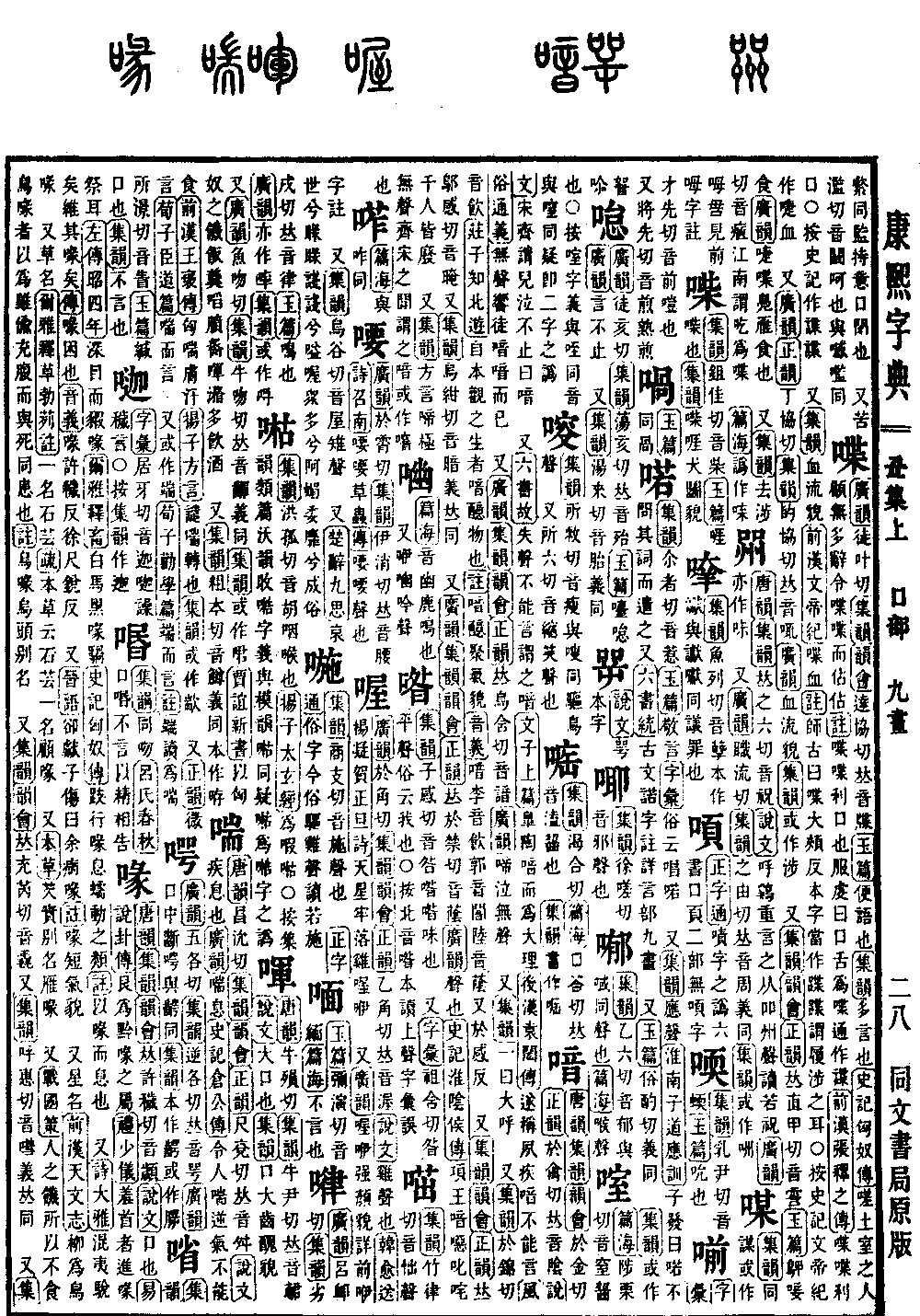
Chou Collection, Upper Volume
Radical: Mouth (kǒu)
Kangxi strokes: 12
Page 198, Entry 01
Broad Rhymes (Guangyun): Pronounced die
Collected Rhymes (Jiyun), Rhyme Compendium (Yunhui): Pronounced die
Jade Chapters (Yupian): Fluent speech.
Collected Rhymes (Jiyun): To speak much.
Records of the Grand Historian (Shiji), Account of the Xiongnu: Alas, the people of the earth houses, naturally they do not have many words, causing them to chatter and stammer.
Commentary: Chatter refers to a glib mouth. Fu Qian says: Mouth and tongue are called die. It is commonly written as a variant form (die).
History of the Former Han (Qian Hanshu), Biography of Zhang Shizhi: Chatter, a glib mouth. Note: In the Records of the Grand Historian, it is written as a variant form (die).
Also, Collected Rhymes (Jiyun): The appearance of blood flowing.
History of the Former Han (Qian Hanshu), Annals of Emperor Wen: Blood-splattered.
Commentary: Shigu says: Die, pronounced die, the original character should be written as a variant form (die). Die means to tread or wade through. Note: In the Records of the Grand Historian, Annals of Emperor Wen, it is written as a variant form (die).
Also, Broad Rhymes (Guangyun), Correct Rhymes (Zhengyun): Pronounced die
Collected Rhymes (Jiyun): Pronounced die
Broad Rhymes (Guangyun): The appearance of blood flowing.
Collected Rhymes (Jiyun): Sometimes written as a variant form (she).
Also, Collected Rhymes (Jiyun), Rhyme Compendium (Yunhui), Correct Rhymes (Zhengyun): Pronounced zha
Jade Chapters (Yupian): To eat greedily.
Broad Rhymes (Guangyun): Feeding, as ducks and geese eat.
Also, Collected Rhymes (Jiyun): Pronounced qie
In the Jiangnan region, stuttering is called die.
Sea of Compendiums (Pianhai): Erroneously written as a variant form.