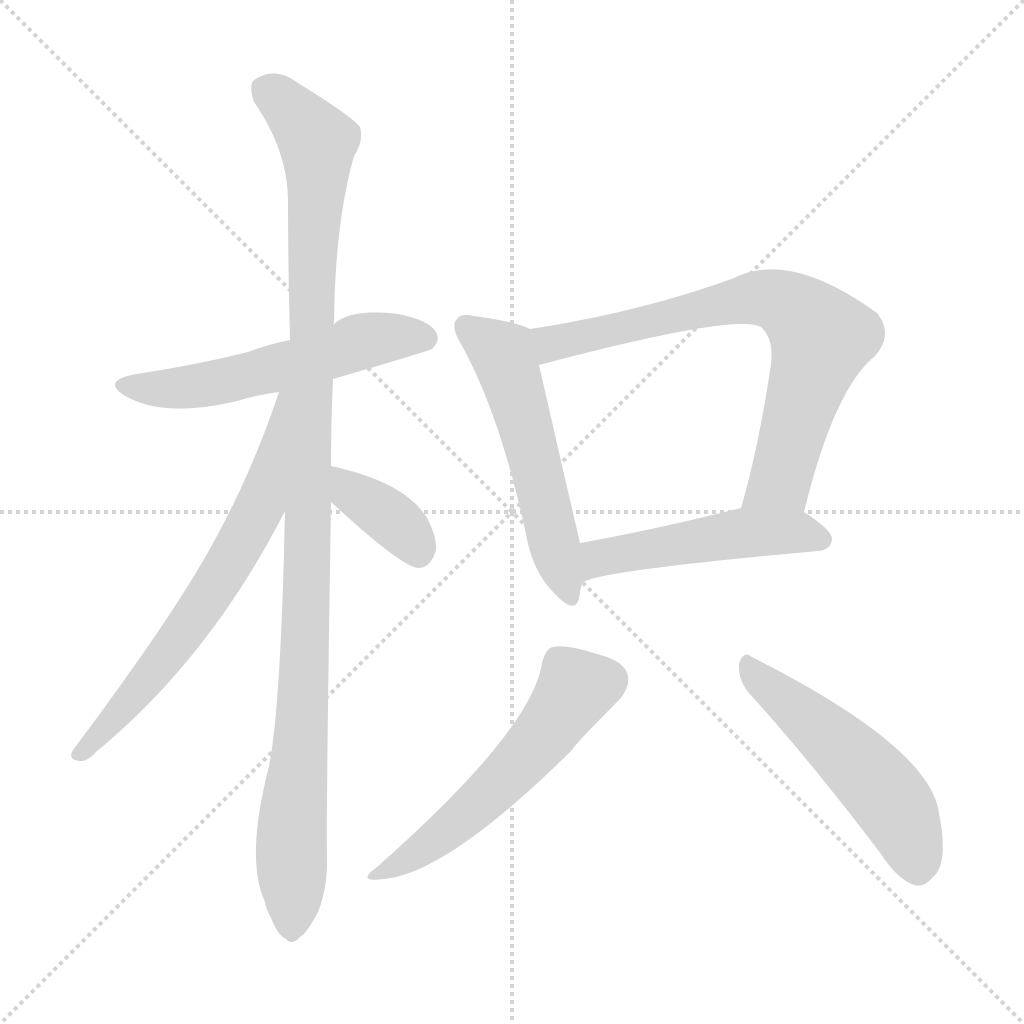
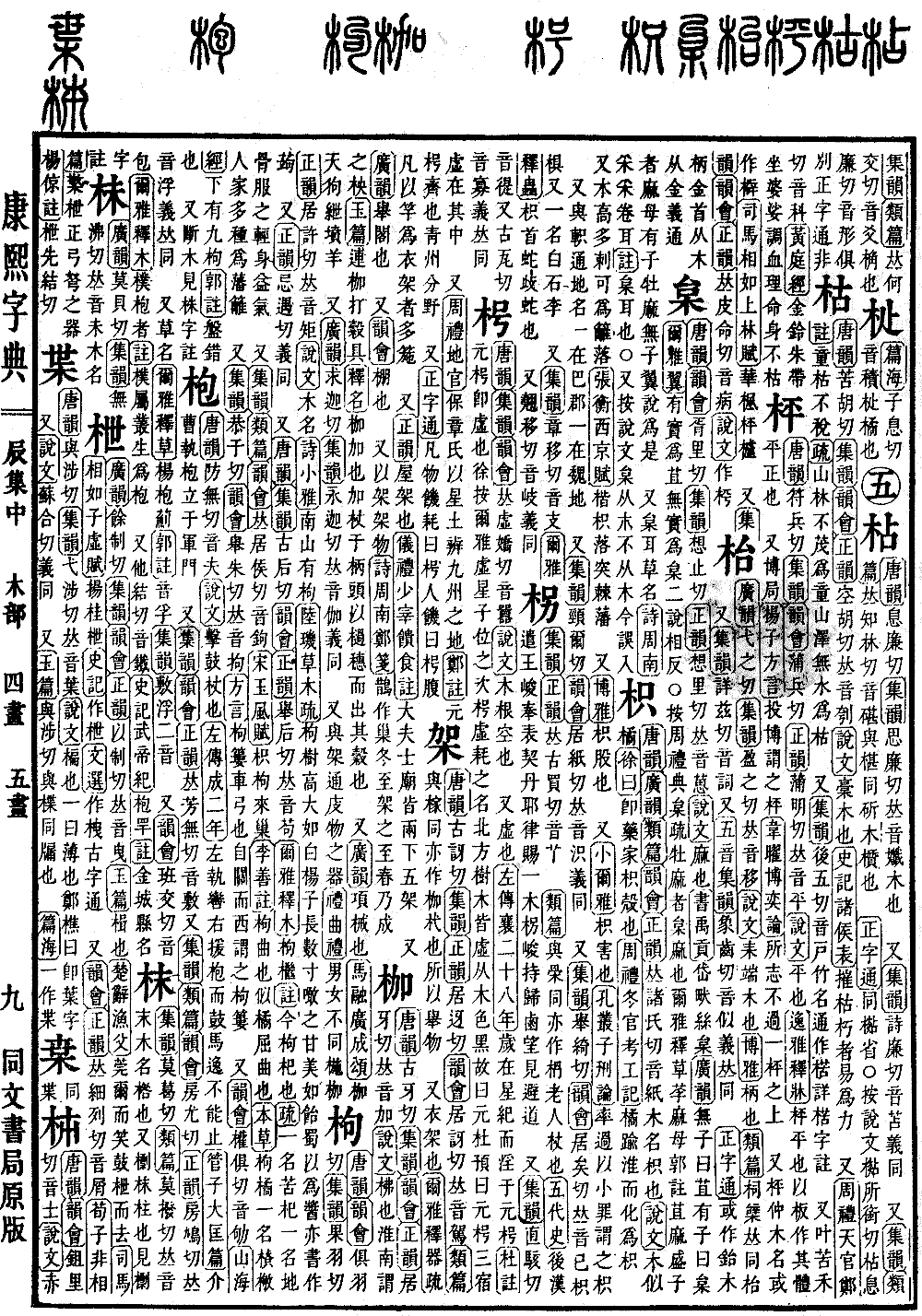
Chen Collection, Middle Volume. Radical: Tree (mù). Character: Zhi. Kangxi stroke count: 9. Page 517, Entry 07.
Pronounced zhi (rising tone). Name of a tree. It is a thorny tree. In the Shuowen Jiezi dictionary it says the wood resembles a tangerine tree. Xu says it is the plant used in medicine known as zhiqiao. In the Rites of Zhou (Zhouli), Book of Winter Officials (Dongguan Kaogongji), it states that a tangerine tree when moved across the Huai River to the north becomes a zhi tree. It is a tall tree with many thorns, suitable for making fences. In the Western Capital Rhapsody (Xijingfu) by Zhang Heng, it mentions the sharp thorns of the zhi fence.
Also, in the Guangya dictionary, zhi means thigh.
According to the Xiao Erya dictionary, zhi means to harm. In the Kongcongzi, it states that leading people into error with minor crimes is called zhi.
Also interchangeable with zhi. A place name. One is located in Ba Commandery, another in the territory of Wei.
Pronounced zhi (rising tone). The meaning is the same as above.
Pronounced yi (rising tone). Refers to the Japanese raisin tree (zhiju).
Also known as white stone plum.
Pronounced zhi. In the Erya dictionary, section on insects, it mentions the zhi-headed snake, which is a bifurcated snake.
Pronounced qi. The meaning is the same as above.
Textual research: In the Rites of Zhou (Zhouli), Book of Winter Officials (Dongguan Kaogongji), the text states that a tangerine tree when moved across the Huai River is transformed into a zhi tree. This has been corrected to reflect the original text, which uses the word north.