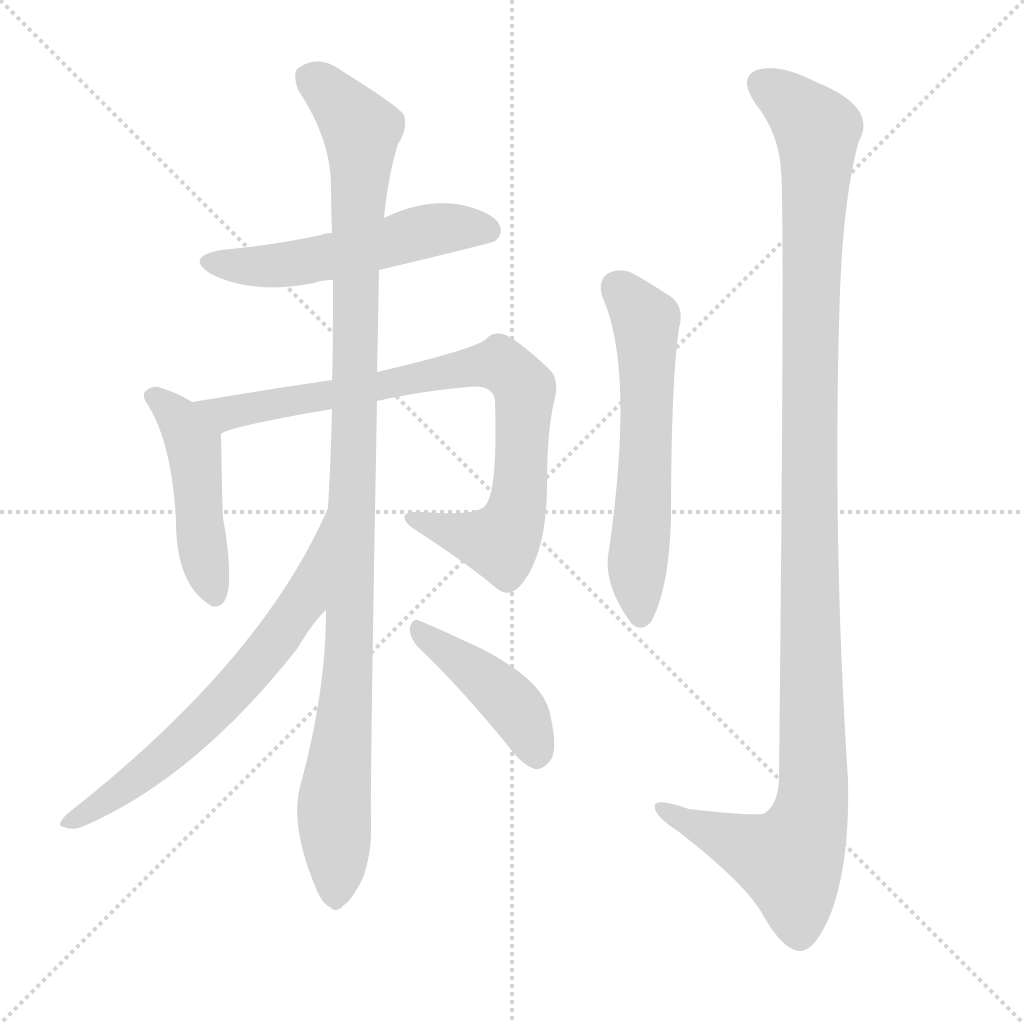
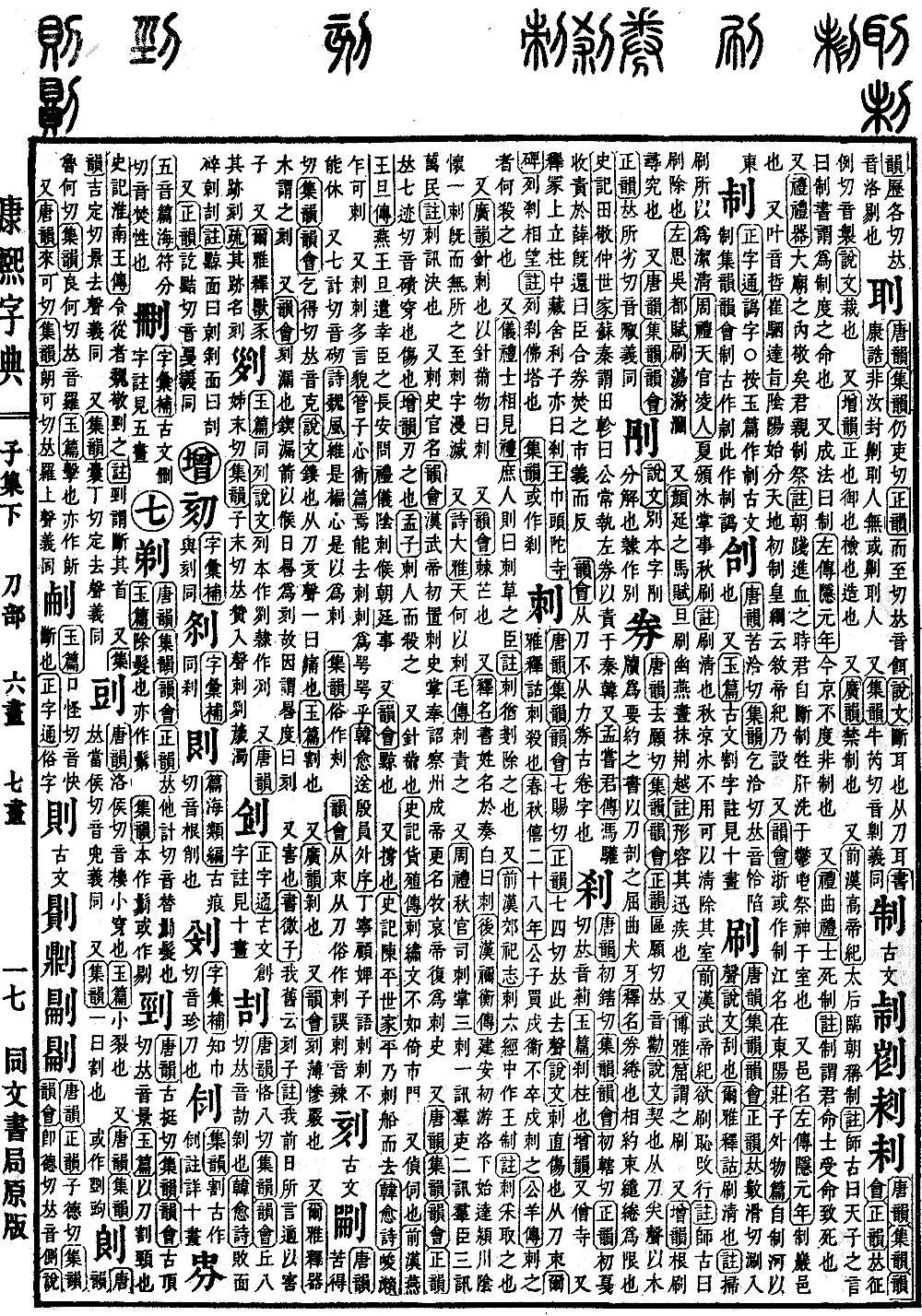
Zi Collection, Page Position: Lower Radical: Knife (dao) Ci Kangxi Stroke Count: 8 Page 139, Position 13
According to the Tang Rhymes (Tangyun), the Collected Rhymes (Jiyun), and the Rhyme Assembly (Yunhui), the pronunciation is qi-ci. According to the Correct Rhymes (Zhengyun), the pronunciation is qi-si. It is read in the departing tone.
The Explaining Graphs and Analyzing Characters (Shuowen Jiezi) explains: Ci means to directly stab and wound. The character form is composed of knife (dao) and bundle (shu).
Approaching the Refined (Erya) says: Ci means to kill.
The Spring and Autumn Annals (Chunqiu) records in the twenty-eighth year of Duke Xi: Prince Mai guarded the state of Wei, but because he did not complete his garrison duty, he was assassinated.
The Gongyang Commentary (Gongyang Zhuan) explains: What does ci mean? It means to kill.
The Ceremonies and Rites (Yili) records: A commoner refers to himself as a servant who clears the grass. The commentary explains: Ci has a meaning like weeding or eradicating.
The Book of Han (Hanshu) records in the Treatise on Sacrifices: Selecting content from the Six Classics to compile the Royal Regulations. The commentary explains: Ci means to select or adopt.
The Expanded Rhymes (Guangyun) explains: A needle prick. Using a needle to sew things is called ci.
The Collected Rhymes explains: The sharp point of a thorn or bramble.
The Explanation of Names (Shiming) explains: Writing one's name on a memorial or a calling card is called ci.
The Book of the Later Han (Houhanshu) records: At the beginning of the Jian'an era, Ni Heng traveled around the Luoyang area. When he first arrived in Yingchuan, he kept a calling card in his robe, but because he found no place to present it, the characters on the card eventually wore away.
The Book of Odes (Shijing) says: Why does Heaven send down punishment? The Mao Commentary (Maozhuan) explains: Ci means to blame or criticize.
The Rites of Zhou (Zhouli) records: The Minister of Interrogation oversees three methods of investigative questioning: first, questioning the various officials; second, questioning the various ministers; and third, questioning the common people. The commentary explains: Ci means to interrogate and decide.
Furthermore, Cishi is the name of an official post. The Collected Rhymes records: Emperor Wu of Han first established the Regional Inspector (Cishi) to oversee and inspect the various provinces by imperial decree. During the reign of Emperor Cheng, the title was changed to Regional Governor, and during the reign of Emperor Ai, it was restored to Regional Inspector.
According to the Tang Rhymes, Collected Rhymes, Rhyme Assembly, and Correct Rhymes, it is also pronounced qi-ji, similar to the sound of qi. It means to penetrate or wound.
The Supplemented Rhymes (Zengyun) explains: To stab and kill with a blade.
Mencius (Mengzi) says: To stab a person and cause their death.
It also refers to needlework and sewing. The Records of the Grand Historian (Shiji) says: Embroidering patterns is not as good as relying on the marketplace to make a living.
It also refers to secret investigation. The Book of Han records: King Dan of Yan sent close ministers to Chang'an to inquire about etiquette and secretly investigate court affairs.
The Collected Rhymes explains: The punishment of tattooing the face.
It also refers to punting or poling a boat. The Records of the Grand Historian records: Chen Ping then poled the boat away. A poem by Han Yu says: The turbulent waters suddenly allow for a boat to be poled across.
The term cici describes the appearance of being talkative. Master Guan (Guanzi) says: How can one abandon incessant chatter and become silent? Han Yu's Preface to Sending Off Official Yin says: Repeatedly instructing the maidservants, talking loquaciously without stopping.
It is also pronounced qi-ji, similar to the sound of qi.
The Book of Odes says: It is precisely because the heart is narrow that this poem is written to satirize.
The Collected Rhymes records: Commonly written in a variant form pronounced ci.
The Rhyme Assembly records: The character form is composed of thorn (ci) and knife (dao). Writing it as a different form of ci is an error. The character la is pronounced la.