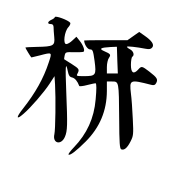
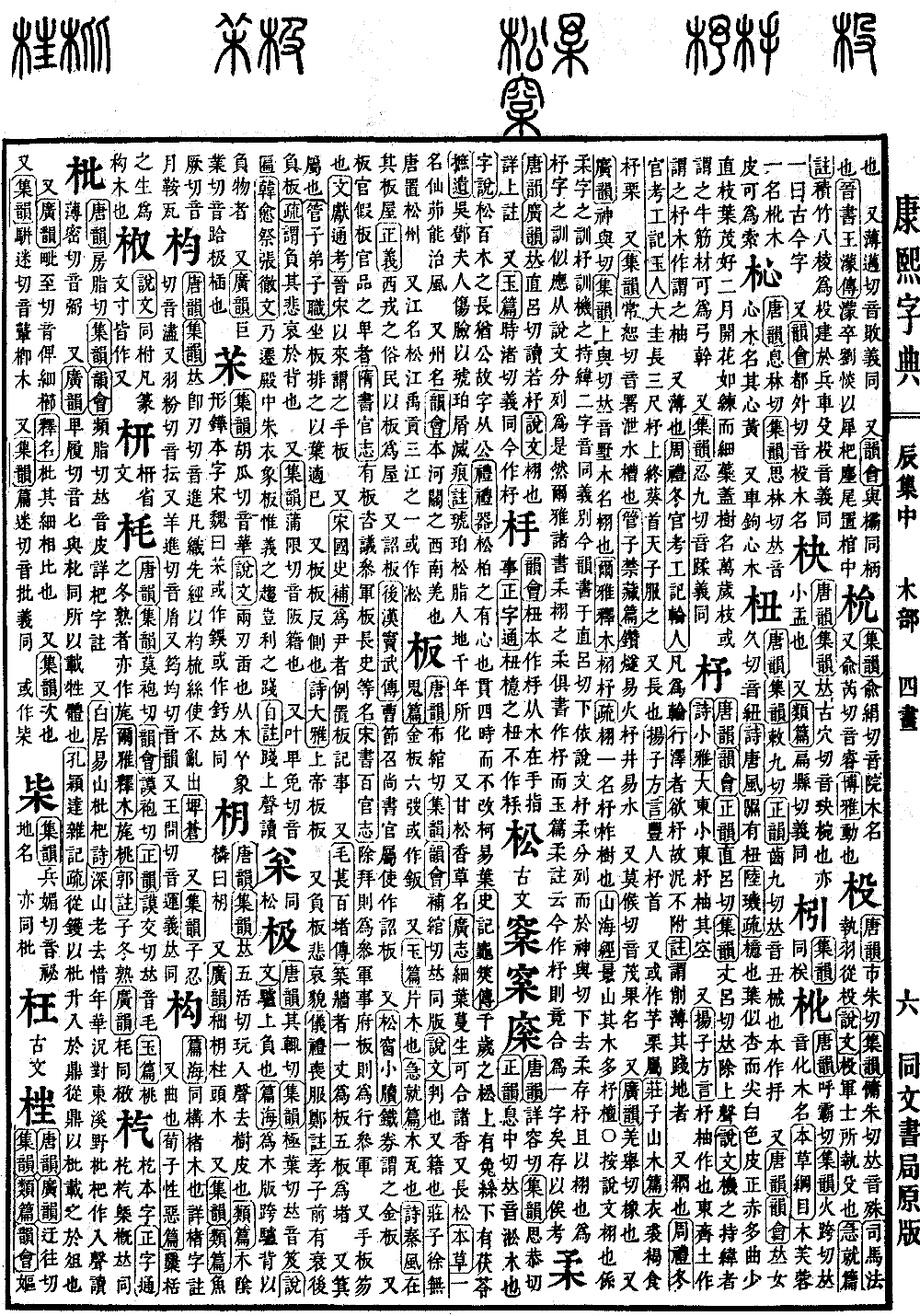
Chen Collection, Middle Volume. Radical: Tree (mù).
Entry: Ji.
Kangxi Strokes: 8.
Page 514, Entry 23.
Ji is a simplified graphic form. It is written under the Radical: Open/Even (jiān) in some instances.
According to Tang Rhymes (Tangyun), it is pronounced gu (level tone). According to Collected Rhymes (Jiyun) and Rhyme Collection (Yunhui), it is pronounced jian (level tone). The pronunciation is similar to ji.
Explanation in Explaining Graphs and Analyzing Characters (Shuowen Jiezi): It refers to the dougong (bracket sets) of a house.
Xu Kai states: It refers to the horizontal wood above a pillar that supports the beams, shaped like a hairpin.
Commentary on Er Ya, Explanation of Palaces (Er Ya, Shigong zhu) states: The bracket sets on a pillar are also called ji. It is further stated that the square wood at the top of a pillar is also this.
Additionally, according to Collected Rhymes (Jiyun), Rhyme Collection (Yunhui), and Orthodox Rhymes (Zhengyun), it is pronounced jing (level tone). The pronunciation is similar to jian. It is sometimes also written in a variant form.
Additionally, according to Five Tone Collected Rhymes (Wuyin Jiyun), it is pronounced qing (level tone). The pronunciation is similar to qian. The meaning is the same.