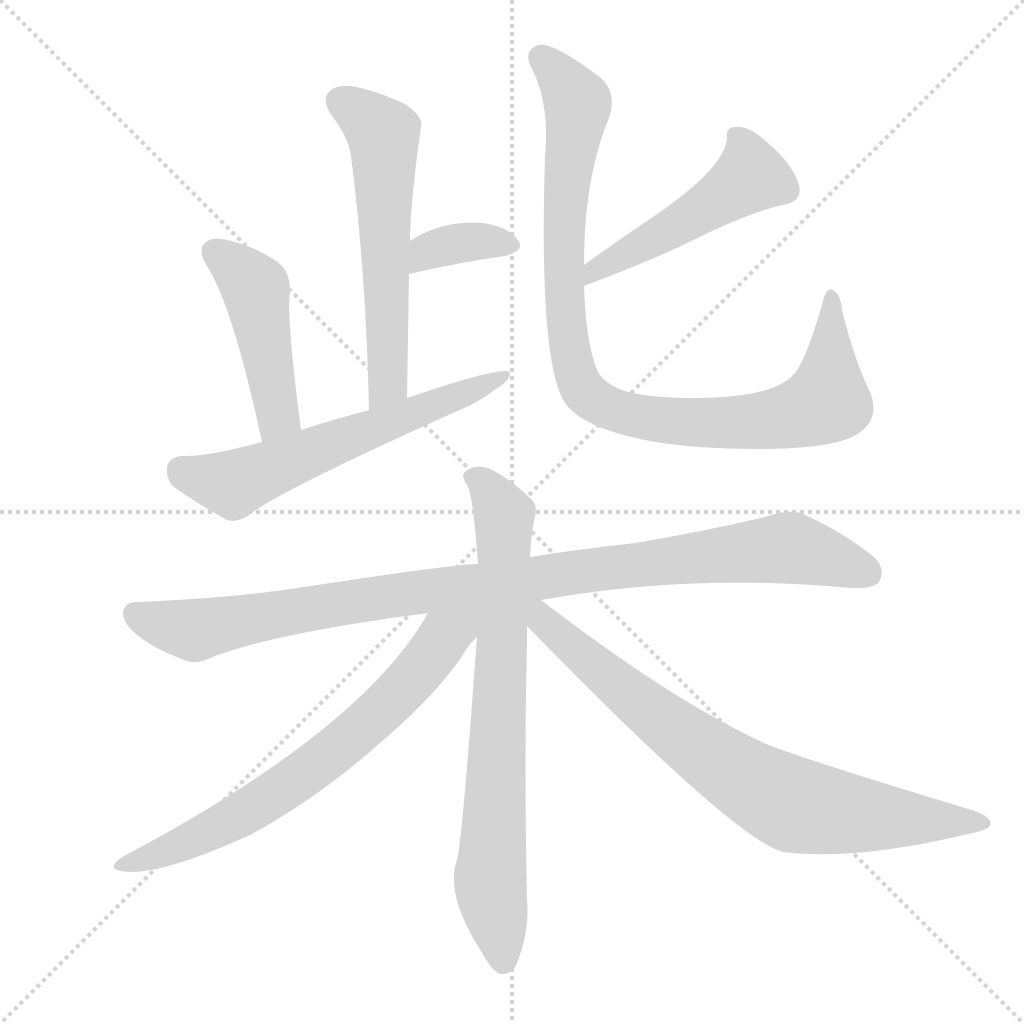
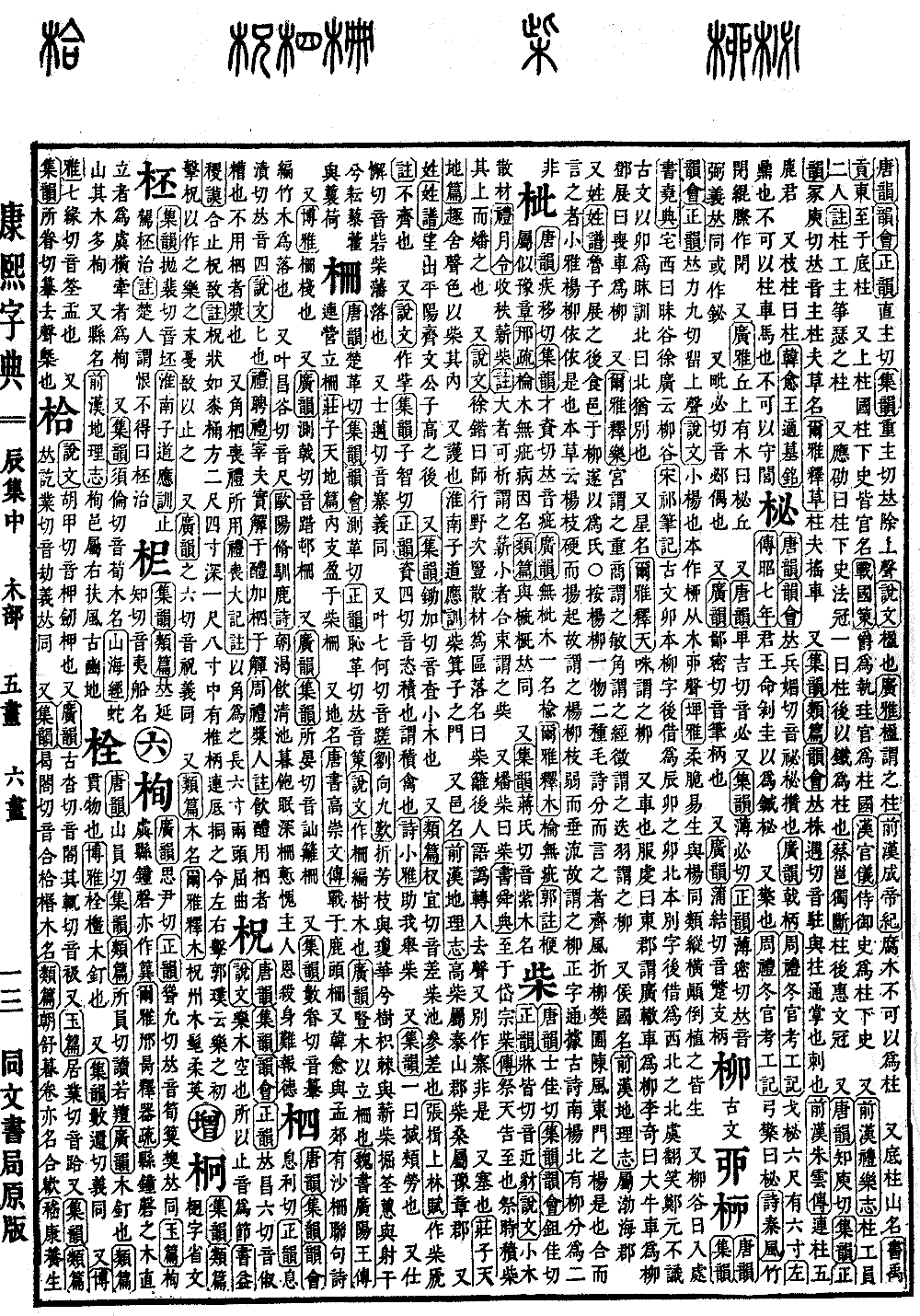
Chen Collection, Middle Volume. Radical: Wood (mù). Kangxi stroke count: 9. Page 521, Entry 06.
Pronounced chai.
According to the Explaining Graphs and Analyzing Characters (Shuowen Jiezi), it refers to small, scattered pieces of wood. In the Book of Rites (Liji), specifically the Monthly Ordinances (Yueling) section, it says to collect firewood and brush. The commentary notes that pieces large enough to be split are called fire logs, while smaller pieces bundled together are called firewood (chai). Also, a burnt offering is called chai. In the Book of Documents (Shujing), specifically the Canon of Shun (Shundian), it refers to reaching Mount Tai to perform the chai sacrifice. The commentary explains that this is a ritual to announce arrival to heaven, where fuel is piled up and burned.
According to Xu Kai in his commentary on the Explaining Graphs and Analyzing Characters, when an army travels and camps in the wilderness, they stand up scattered wood to form a barrier, which is called a chai fence. Later generations corrupted the pronunciation to the departing tone (qu). It is also written as zhai, which is incorrect.
It also means to block. In the Zhuangzi, specifically the Heaven and Earth chapter, it mentions blocking one's inner nature with the pursuit of tastes, sounds, and colors.
It also means to protect. In the Huainanzi, specifically the Dao Ying Xun chapter, it mentions guarding the gate of Jizi.
It is also the name of a settlement. In the History of the Former Han (Qianhan Shu), specifically the Treatise on Geography, it notes that Gaochai belongs to Taishan Commandery, and Chaisang belongs to Yuzhang Commandery.
It is also a surname. According to the Register of Surnames (Xingpu), the prominent clan originates from Pingyang, descending from Duke Gao of Qi.
Pronounced cha. Refers to small wood.
Pronounced cha. Appears in the term chaichi, meaning irregular or uneven. In Zhang Yi's Shanglin Fu, it is written as chaisi, which the commentary explains as meaning not uniform.
Pronounced zi. To pile up; specifically, to pile up game. In the Book of Odes (Shijing), specifically the Minor Odes (Xiaoya), it mentions helping to lift the pile of game.
Also means to rub, meaning to tire the cheeks.
Pronounced zhai. Refers to a wooden fence or barrier.
Pronounced zhai. The meaning is the same as above.
Pronounced cuo (rhyming variant). In Liu Xiang's Nine Laments (Jiutan), it says to snap the fragrant branches and jade flowers, to plant thorns and firewood, to dig up sweet herbs and leopard lily, and to weed the pigweed and ginger.