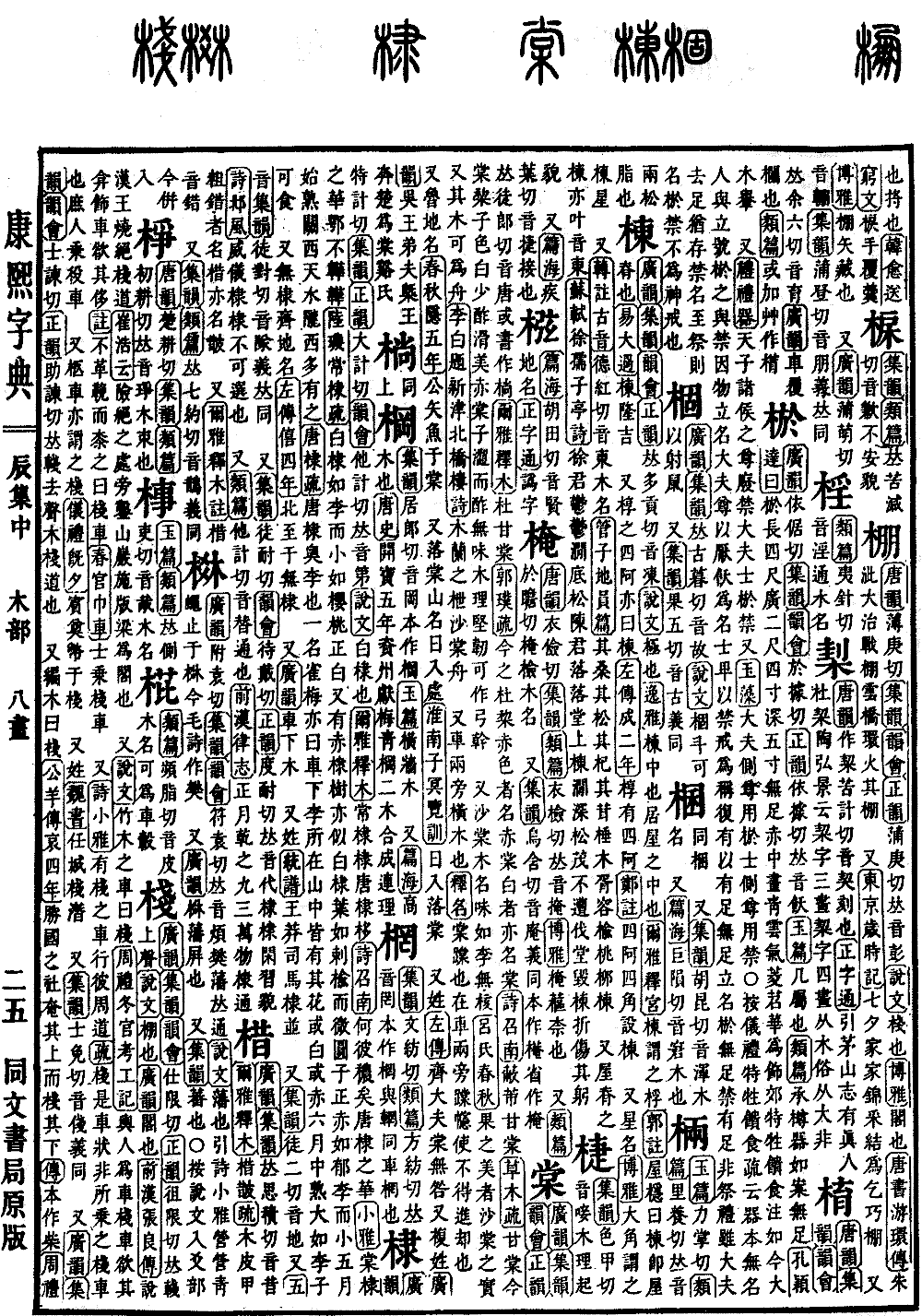
Chen Collection, Middle Volume. Radical: Tree (mù). Kangxi stroke count: 12. Page 533, Entry 18.
Pronounced di (falling tone).
According to the Explaining Graphs and Analyzing Characters (Shuowen Jiezi), it refers to the white cherry tree.
According to the Erya (Erya: Explaining Trees), the Changdi is a type of cherry tree. The Tangdi is known as the Yi.
In the Book of Odes (Shijing: Zhounan), it is written: "How abundant are the flowers of the Tangdi." In the Minor Odes (Xiaoya), it is written: "The flowers of the Changdi, how brilliant are the calyxes."
Lu Ji in his commentary on the Changdi states: The white cherry tree resembles the plum but is smaller; it is like a cherry tree but pure white. There is also the red cherry tree, which resembles the white one; its leaves are like those of the Japanese zelkova but slightly rounder. Its fruit is pure red, like the dwarf flowering cherry but smaller; it ripens at the beginning of the fifth month and grows abundantly in the Tianshui and Longxi regions west of the pass.
According to the commentary on the Tangdi: The Tangdi is the Aoli. It is also known as the sparrow plum and is sometimes called the carriage-base plum. It grows on mountains everywhere. Its flowers may be white or red; it ripens in the middle of the sixth month, is the size of a plum, and is edible.
It also refers to Wudi, a place name in the State of Qi. In the Zuo Tradition (Zuo Zhuan: Year 4 of Duke Xi), it is written: "In the north, it reached as far as Wudi."
Also pronounced as in the carriage-base wood.
It is also a surname. According to the Comprehensive Genealogies (Tongpu), Wang Mang had an official named Sima Di.
Also pronounced di (falling tone).
Also pronounced dui (falling tone). The meaning is the same.
Also pronounced dai (falling tone). Didi describes a refined, composed, and tranquil manner. In the Book of Odes (Shijing: Beifeng), it is written: "With a composed and tranquil demeanor, beyond measure."
Also pronounced ti (falling tone). It means to penetrate or reach through. In the Book of Han (Qianhan: Treatise on Pitch Pipes), it is written: "In the first month, the nine-three line of the Qian hexagram, all things penetrate and reach through."
Textual Research: In the Minor Odes (Xiaoya) citation, Tangdi has been corrected to Changdi in accordance with the original text.