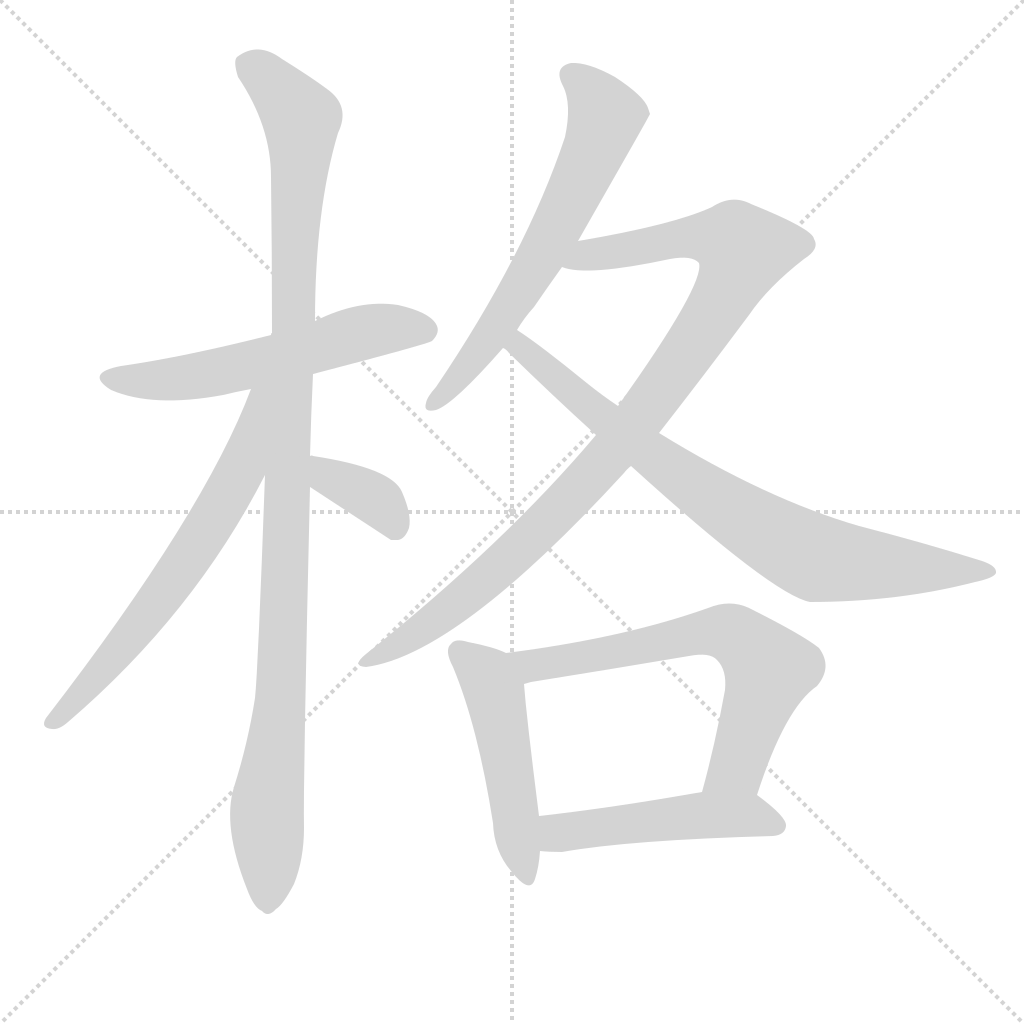
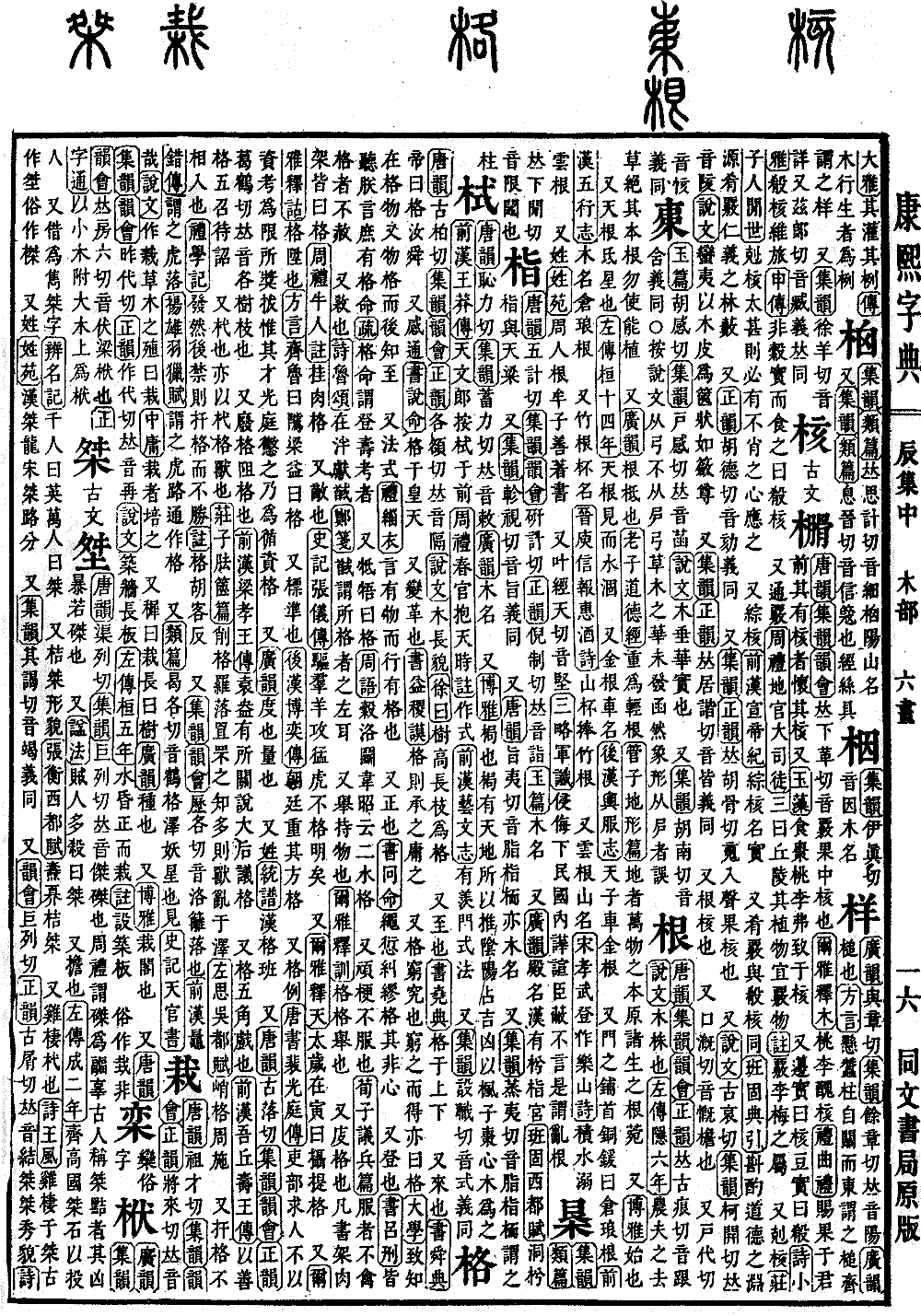
Chen Collection, Middle Volume
Radical: Tree (mù)
Kangxi Strokes: 10
Page 524, Entry 11
Pronounced ge.
According to the Explaining and Analyzing Characters (Shuowen Jiezi), it refers to the appearance of a tree growing long. Xu states that a tree with tall branches is called a ge.
It also means to arrive. From the Book of Documents (Shujing): Arriving at the high and low.
It also means to come. From the Book of Documents (Shujing): The Emperor said, come here, you, Shun.
It also means to inspire or communicate with. From the Book of Documents (Shujing): Responding to the August Heaven.
It also means to change or reform. From the Book of Documents (Shujing): If there is reform, then accept it and employ it.
It also means to investigate thoroughly. To investigate until understanding is attained is also called ge. From the Great Learning (Daxue): The extension of knowledge consists in the investigation of things. And: when things are investigated, then knowledge is complete.
It also refers to laws or standards. From the Book of Rites (Liji): Words should have substance, and conduct should have a standard.
It also means to correct. From the Book of Documents (Shujing): To restrain errors and correct mistakes, and to rectify the wayward heart.
It also means to ascend. From the Book of Documents (Shujing): All of you listen to my words, may you all have a successful life. The commentary states: a successful life refers to those who ascend to a long old age.
It also means to struggle or resist. From the Discourses of the States (Guoyu): The Gu and Luo rivers fought. Wei Zhao states: the two waters struggled against each other.
It also refers to being stubborn and disobedient. From the Xunzi: Those who surrender are not killed; those who resist are not pardoned.
It also refers to the left ear of the killed in battle. From the Book of Odes (Shijing): In the泮, offering the left ears. The Zheng commentary says: The left ears refer to those cut from those who resisted.
It also means to lift or hold things. From the Erya: Ge-ge means to lift.
It also refers to a frame. Shelves for books or meat are all called ge. From the Rites of Zhou (Zhouli): A frame for hanging meat.
It also means to be a match for or to equal. From the Records of the Grand Historian (Shiji): Driving a flock of sheep to attack a fierce tiger, it is clear they cannot match it.
Also, from the Erya: When the Tai Sui (Grand Year) is in the position of Yin, it is called Sheti-ge.
Also, from the Erya: Ge means to ascend. According to the Fangyan: In the regions of Qi and Lu it is called gao, and in the regions of Liang and Yi it is called ge.
It also refers to standards or criteria. From the Book of the Later Han (Hou Hanshu): The court valued his standards.
It also refers to regulations. From the Old Book of Tang (Tangshu): The Ministry of Personnel did not limit the selection of people based on seniority; they rewarded and promoted based on talent. Pei Guangting corrected this and established a system of seniority.
Also, pronounced ge. It means to measure or weigh.
Also, a surname. From the Tongpu: Ge Ban of the Han Dynasty.
Also, pronounced ge.
It refers to tree branches.
It also means to abolish or obstruct. From the Book of the Former Han (Hanshu): Yuan Ang had matters to present, and the Empress Dowager discussed obstructing them.
It also refers to Ge-wu, a board game. From the Book of the Former Han (Hanshu): He was summoned to be a waiting scholar for his skill in the game of Ge-wu.
It also means a wooden stake. It is also used to use a stake to block or spear animals. From the Zhuangzi: When the knowledge of snares, nets, and traps is great, then animals will be in chaos in the marshes. From the Wu Capital Rhapsody (Wu du fu): The steep stakes are arranged all around.
It also refers to the term han-ge, meaning not fitting together. From the Book of Rites (Liji): If one forbids only after the behavior has occurred, then there will be resistance and incompatibility.
Also, pronounced luo.
It refers to a fence or trellis. From the Book of the Former Han (Hanshu): It is called a tiger-trap. From the Feather Hunt Rhapsody (Yu lie fu): It is called a tiger-path. It is also written in the variant form ge.
Also, pronounced he.
Ge-ze is a baleful star. Found in the Records of the Grand Historian (Shiji), Treatise on the Celestial Offices.