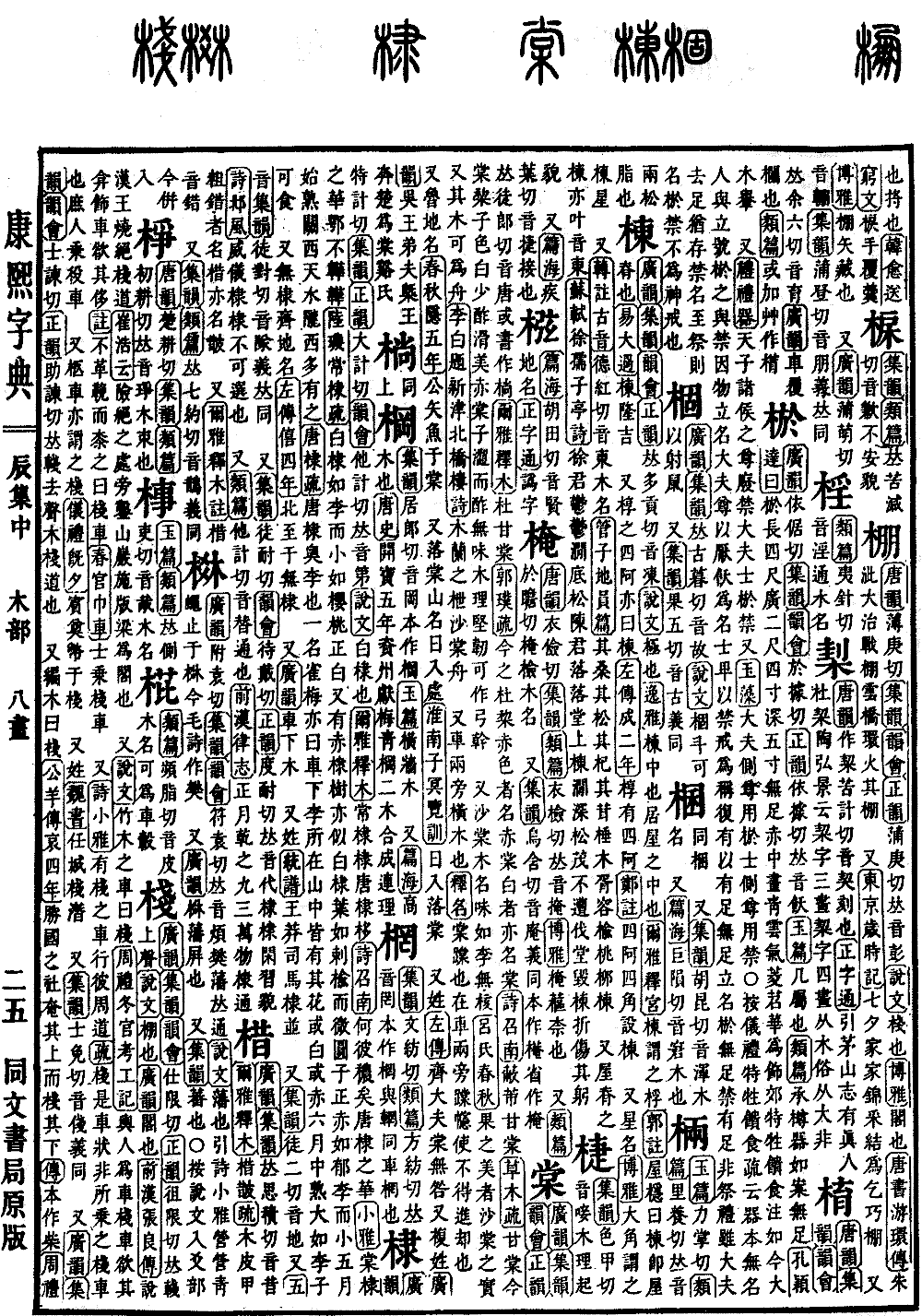
Chen Collection, Middle Volume
Radical: Wood (mù)
Zhan
Kangxi stroke count: 12
Page 533, Entry 06
Pronounced shan (rising tone).
Shuo Wen Jie Zi (Explaining Graphs and Analyzing Characters) defines it as a scaffold.
Guang Yun (Broad Rhymes) defines it as a storied structure.
Biography of Zhang Liang in the Book of Former Han (Hanshu) states: Persuaded the King of Han to burn and destroy the wooden plank roads.
Cui Hao remarks: In treacherous and steep locations, one chisels into the mountain cliffs and lays down planks and beams to create a storied passage.
Also, Shuo Wen Jie Zi states: A carriage made of bamboo and wood is called a zhan.
Rites of Zhou (Zhouli), Office of Spring, Ministry of Carriages: Scholars ride in zhan carriages, which are not covered in leather, but are lacquered.
In the Artificers' Record (Kaogongji) of the Office of Winter: When the carriage-maker builds a carriage, the zhan carriage should be narrow, while ornamental carriages should be wide.
Book of Odes (Shijing), Xiao Ya: A zhan carriage, traveling upon the Zhou road.
Commentary: The zhan refers to the shape of the carriage; it is not the same as the zhan carriage mentioned above. Commoners ride in service carriages.
Also, a hearse is also called a zhan.
Book of Etiquette and Ceremonial (Yili), Jixi: The guest places silk offerings upon the hearse.
Also a surname.
Book of Wei (Weishu): Zhan Qian from Rencheng.
Also, according to Jiyun: Pronounced jian (falling-rising tone). The meaning is the same.
Pronounced jian (falling tone).
Refers to a wooden plank road.
Also, woven wood is called a zhan.
Gongyang Zhuan (Gongyang Commentary), Year 4 of Duke Ai: For the altars of destroyed states, cover the top and build a wooden frame (zhan) at the bottom.
Commentary: Originally written as chai (brushwood).
Rites of Zhou, Funeral Priest, Zheng Commentary: Cites it as zhan.
Also, a horse stall, also made of woven wood.
Guanzi, Xiao Wen Chapter: I, Yiwu, was once a groom; cleaning horse stalls is very difficult.
Zhuangzi, Horse Hooves Chapter: Woven with stable racks (zao zhan).
Also zhan-yan, an appearance of being high and steep.
Zhang Heng, Western Capital Rhapsody (Xijing Fu): The jagged peaks and steep, narrow paths.
Also zhan incense.
Plants of the Southern Regions (Nanfang Caomu Zhuang): The honey-scented tree, its trunk is zhan incense.
Also a type of tree.
Erya, Explaining Trees: The zhan tree is the gan tree.
Commentary: It is the jiang tree, known in the Jiangdong region as mugu.
Commentary: Another name is the gan tree.
Pronounced zhan (falling-rising tone).
Erya, Explaining Music: A large bell is called a yong; a small one is called a zhan.
Also, a small bridge is called a zhan.
Pronounced zhen (level tone).
Describes a dense and flourishing appearance.
Biography of Xi Fu Gong in the Book of Former Han (Hanshu): Thickets of thorny bushes (zhan zhan).