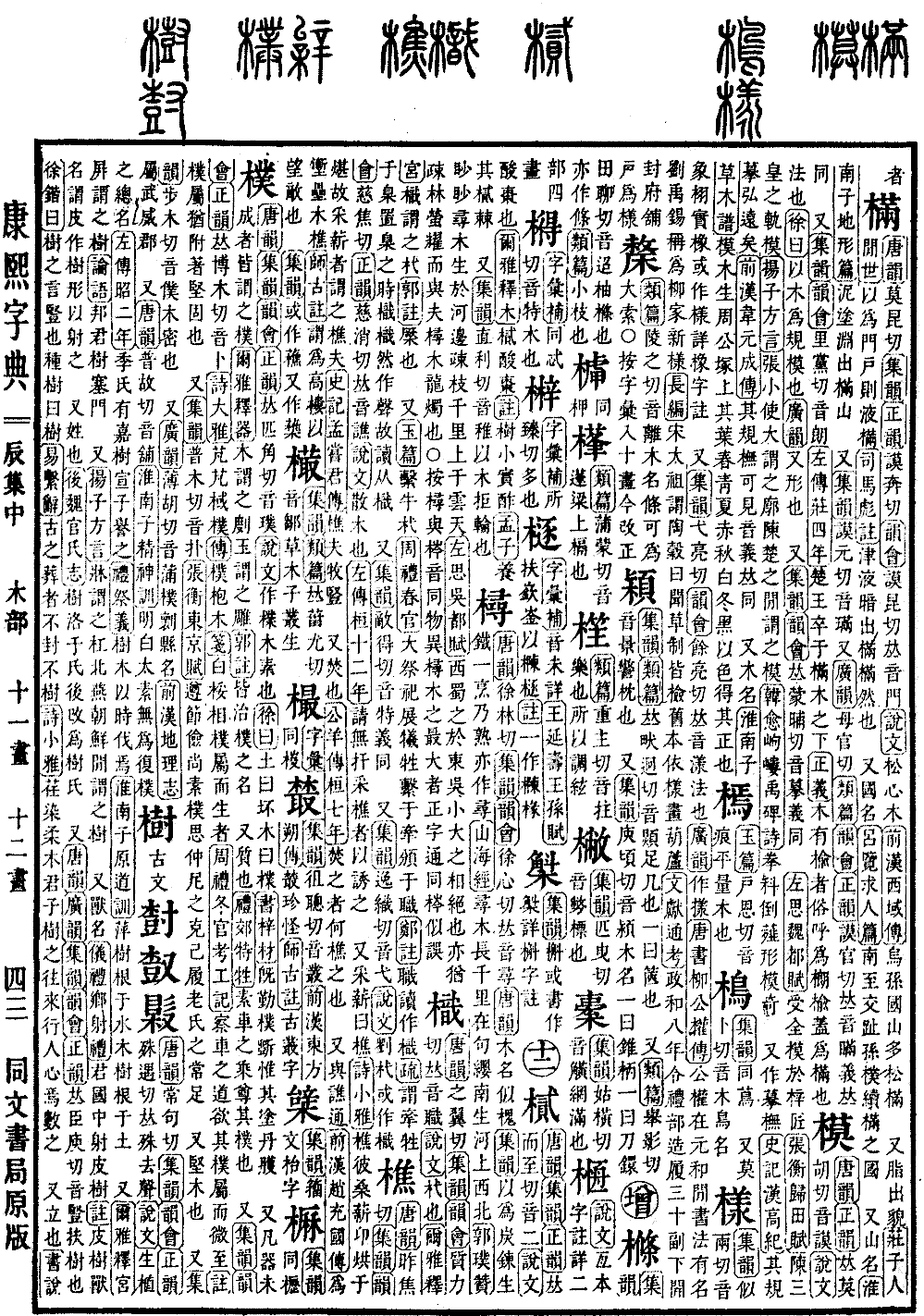
Chen Collection, Middle Volume
Radical: Tree (mù)
Page 551, Entry 16
Ancient text. Pronounced shu. According to Tang Rhyme (Tangyun), Ji Rhyme (Jiyun), Rhyme Compendium (Yunhui), and Correct Rhymes (Zhengyun), it is pronounced shu with a departing tone. Explanation of Script and Elucidation of Characters (Shuowen Jiezi) defines it as the general term for plants that grow and are cultivated. Zuo Commentary (Zuozhuan), Year 2 of Duke Zhao: The Ji family had a fine tree, and Xuanzi praised it. Book of Rites (Liji), Sacrificial Meanings: Trees should be felled according to the season. Huainanzi, Original Way (Yuandao Xun): Duckweed has its roots in the water, and trees have their roots in the soil.
Also, in Erya, Explanation of Palaces (Shigong), a screen is called a shu. Analects (Lunyu): The ruler of a state places a screen at the gate.
Also, in Yangzi, Regional Speech (Fangyan), a bed is called a gang. In the regions of Northern Yan and Korea, it is called a shu.
Also, the name of a beast. Ceremonial and Ritual (Yili), Village Archery Rites: When the ruler of a state performs archery within the city, he uses a pi-shu as a target. Annotation: A pi-shu is the name of a beast. It refers to using skin to make a target in the shape of a tree to shoot at.
Also, a surname. Records of the Latter Wei, Official Surnames (Houwei Guanshizhi): There is the Shuluoyu clan. Later changed to the Shu clan.
Also, according to Tang Rhyme (Tangyun), Broad Rhymes (Guangyun), Ji Rhyme (Jiyun), Rhyme Compendium (Yunhui), and Correct Rhymes (Zhengyun), pronounced shu, with the same sound as shu. This means to support or to stand upright. Xu Kai states: The meaning of shu is like standing upright. Planting trees is called shu. Book of Changes (Yijing), Appended Remarks (Xici): In ancient times, when burying the dead, they did not pile earth into a mound, nor did they plant trees. Book of Odes (Shijing), Lesser Odes: The supple tree, the superior man plants it. Travelers passing by, in their hearts they all judge it.
Also refers to establishing or setting up. Classic of History (Shangshu), The Charge to Yue (Shuoming): Establish the Son of Heaven and the feudal lords, and below them, appoint the great officers and teachers. Great Declaration (Taishi): In establishing virtue, strive for growth; in removing evil, strive to root it out. Bi's Charge (Biming): Commend virtuous conduct, hate evil conduct, and establish good customs and reputation.
Also, the legal heir of a feudal lord, confirmed by the command of the Son of Heaven, is called a shuzi. Guliang Commentary (Guliangzhuan), Year 9 of Duke Xi: Do not change the shuzi who has already been established.
The common usage of this character with an added component is incorrect.
Textual verification: In Ceremonial and Ritual (Yili), Village Archery Rites, regarding the ruler in the state capital shooting at a pi-shu. Following the original text, add the character then before pi, and add the character zhong after shu.