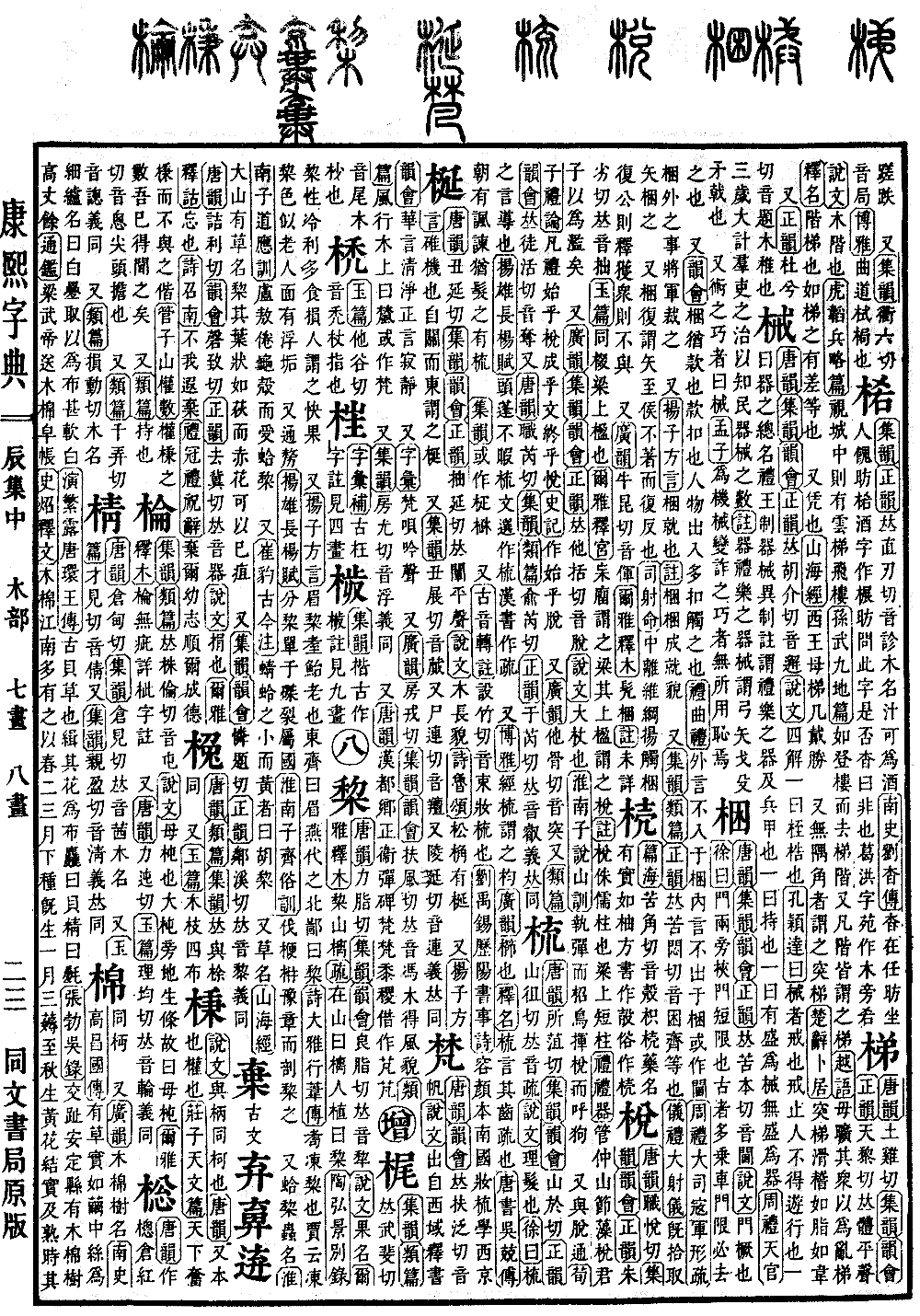
Chen Collection, Middle Volume
Radical: Tree (mù)
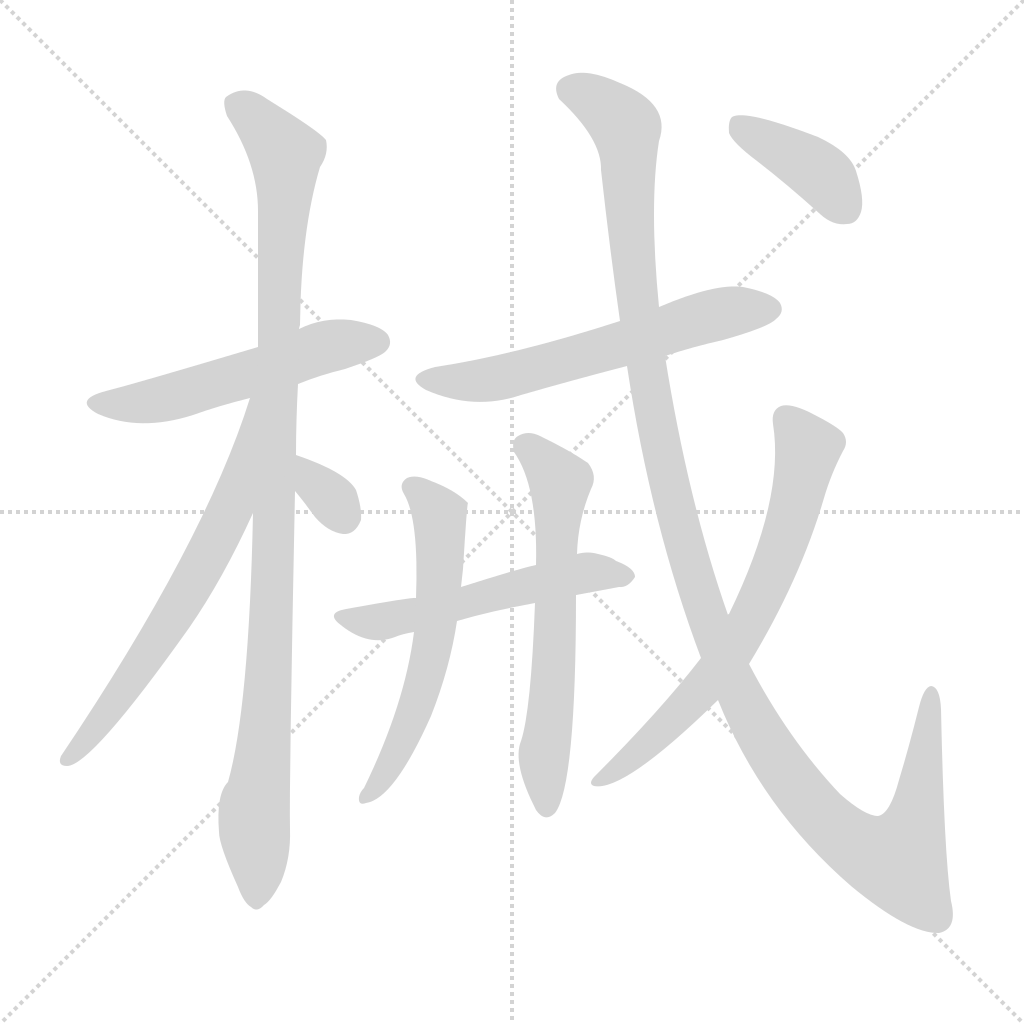
械
Kangxi stroke count: 11
Page 531, Entry 03
Pronounced jie (falling tone), same pronunciation as xie (falling tone).
Shuowen Jiezi (Dictionary of Explaining Graphs and Analyzing Characters) provides four interpretations:
1. It refers to fetters (shackles and handcuffs).
2. According to Kong Yingda, the term xie implies to warn or restrain, serving to prevent individuals from moving freely.
3. It refers to a general term for implements. The Book of Rites (Liji), section on Royal Regulations (Wangzhi), records that the forms of implements differ. The commentary states that this refers to instruments used for rituals and music, as well as weaponry and armor.
4. It implies to hold or grasp.
5. Some define items with containment vessels as xie and those without as qi.
Rites of Zhou (Zhouli), section on Bureau of Records (Sishu): Every three years, officials' administrative achievements are evaluated on a large scale to determine the quantity of implements held by the populace.
Commentary: Qi refers to instruments of ritual and music. Xie refers to weaponry such as bows, arrows, ge-halberds, shu-staves, spears, and ji-halberds.
It also refers to ingenious methods, known as xie.
Mencius (Mengzi): Those who utilize mechanical stratagems and crafty schemes have no place for a sense of shame.
Textual research: In Rites of Zhou (Zhouli), section on Heavenly Offices (Tianguan), it is recorded that every three years, officials' administrative achievements are evaluated on a large scale to determine the quantity of implements held by the populace. The commentary states that qi refers to instruments of ritual and music, while xie refers to weaponry such as bows, arrows, ge-halberds, shu-staves, spears, and ji-halberds. We have carefully corrected the original text by changing Heavenly Offices to Bureau of Records and changing Commentary to Sub-commentary.