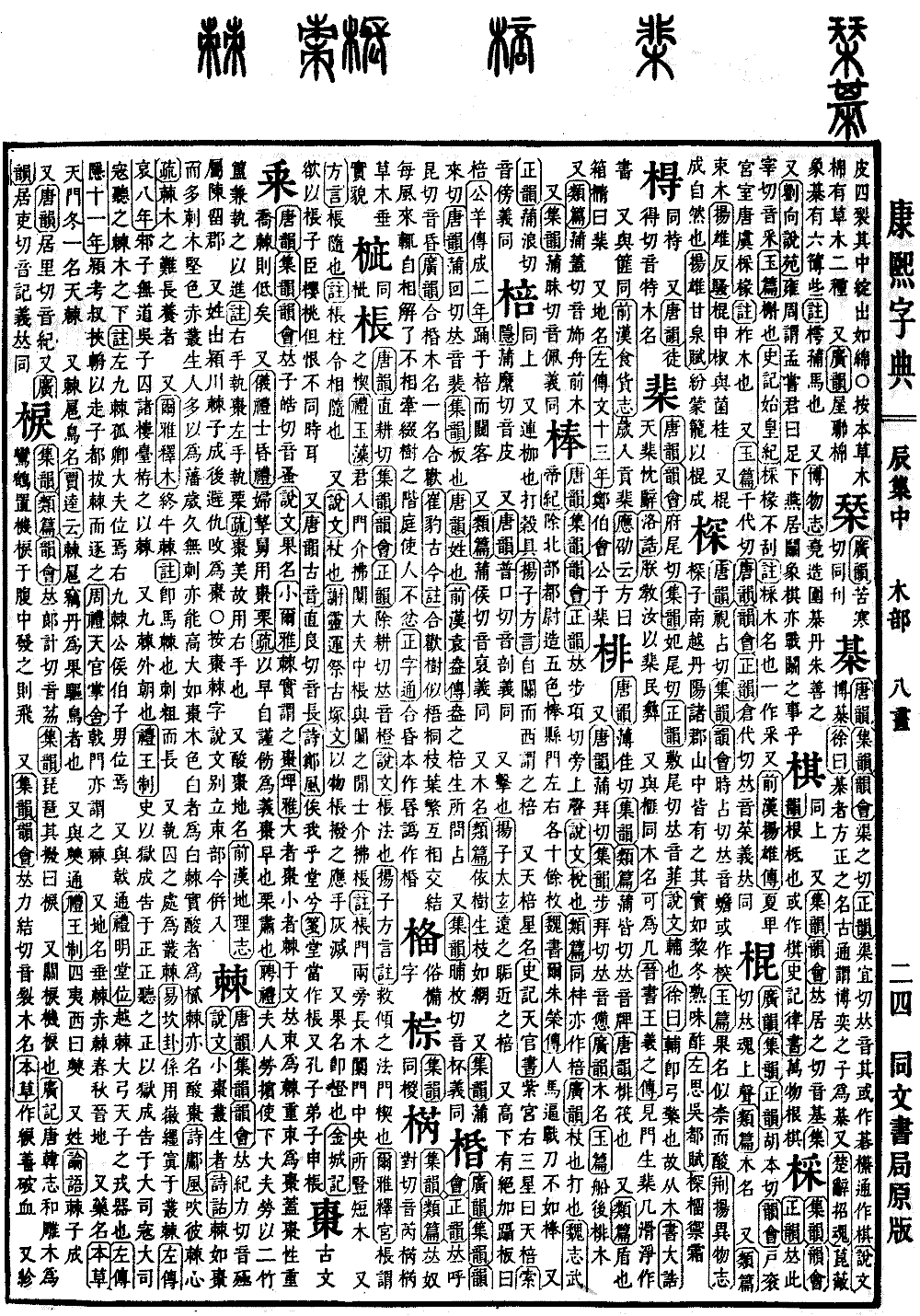
Chen Collection, Middle Volume
Radical: Tree (mù)
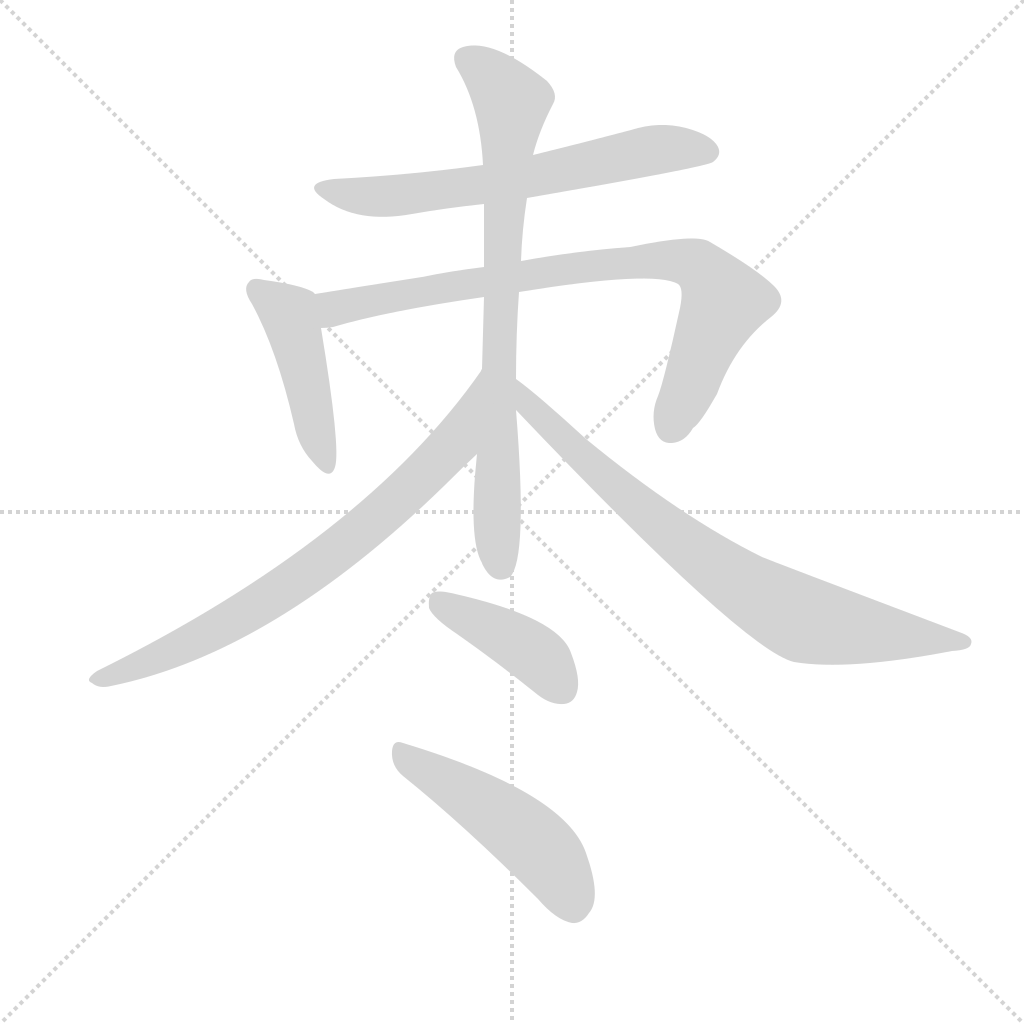
Entry: Date (zǎo)
Kangxi Strokes: 12
Page 532, Entry 01
In ancient texts, according to the Tang Rhyme (Tangyun), Collection of Rhymes (Jiyun), and Collection of Rhymes (Yunhui), the pronunciation is zǎo. According to the Explaining Graphs and Analyzing Characters (Shuowen), it is the name of a fruit. The Lesser Erya (Xiao Erya) states that the fruit of the jujube thorn is called a date. According to the Amplification of the Erya (Piya), the large ones are called dates and the small ones are called jujube thorns. In terms of orthography, the character for thorn (cì) represents the jujube thorn, and two such characters stacked represent the date; the date tree is tall, whereas the jujube thorn is low.
Also, according to the Ceremonial Rites (Yili), in the chapter on the marriage rites of the gentleman, it is noted that a wife uses dates and chestnuts as a formal gift for her father-in-law. The commentary explains this is meant to signify being early and cautious. Date represents early, and chestnut represents solemnity. In the Rites of Invitation (Pinli), it states that when the wife arrives, the lower officials are sent to offer gifts in two bamboo vessels. The commentary notes that the right hand holds the dates and the left hand holds the chestnuts. The sub-commentary explains that dates are considered more precious, hence they are held in the right hand.
Also, Suanzao is the name of a place. According to the History of the Former Han (Qianhan), Geography Treatise, it belongs to Chenliu Commandery.
Also a surname, descended from the family of Ji Zicheng of Yingchuan, who changed their surname to Date (Zao) to avoid enemies. Regarding the characters for date and jujube thorn, the Explaining Graphs and Analyzing Characters (Shuowen) originally established a separate radical for thorn (cì), but it is now combined into this radical.