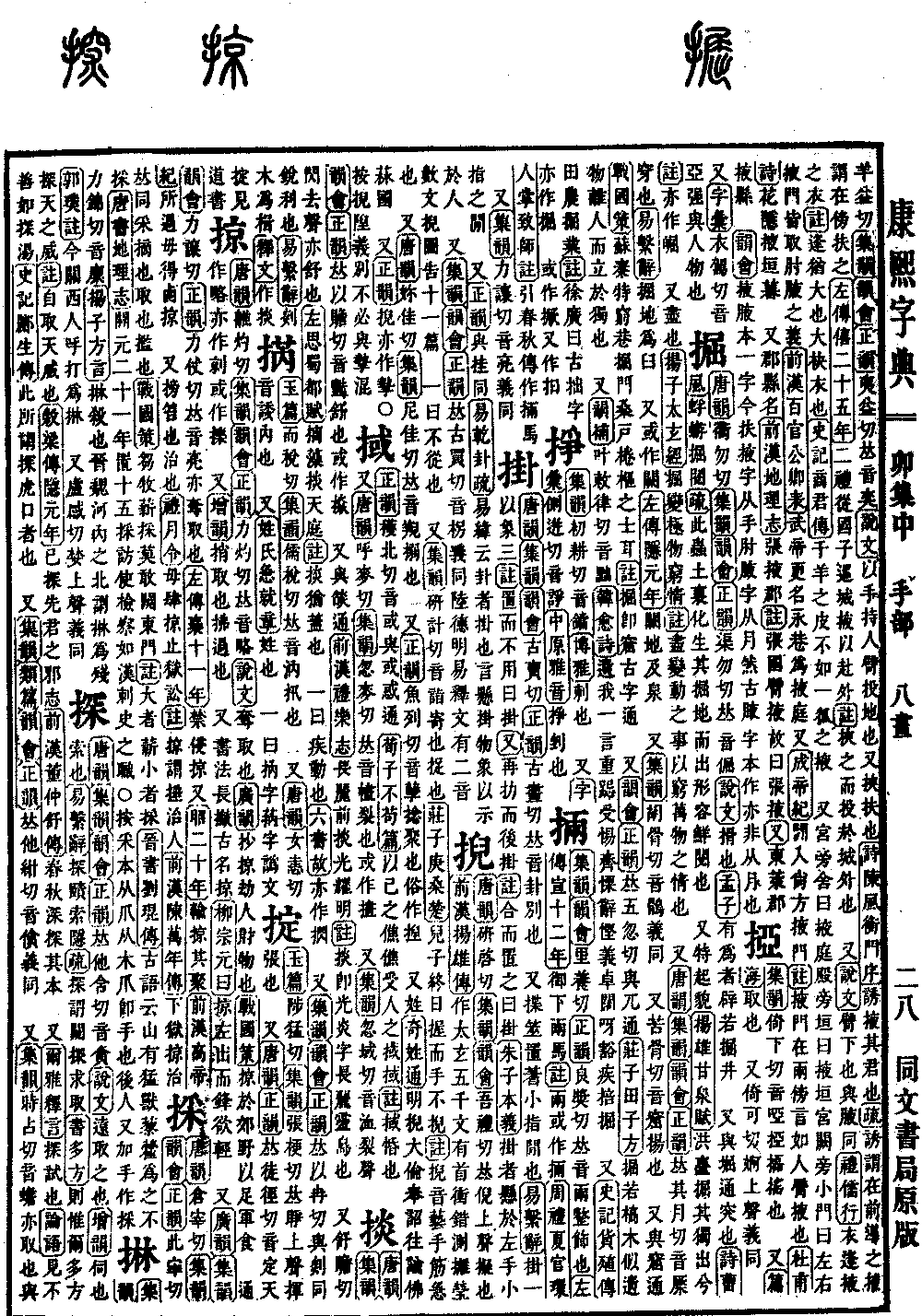
Mao Collection, Middle Volume
Radical: Hand (shǒu)
Kangxi Strokes: 12
Page 438, Entry 14
Pronounced tan. In the Explanation of Graphs (Shuowen), it means to take from a distance. In the Augmented Rhymes (Zengyun), it means to watch for or to search for. In the Book of Changes (Yijing), in the Appended Remarks (Xici), it says to explore the mysterious and search for the hidden. The sub-commentary states that exploring means to examine, seek, and take. In the Book of Documents (Shujing), in the Many Regions (Duofang) chapter, it says then all of you in the many regions provoke the majesty of Heaven. The commentary notes this means to bring Heaven’s majesty upon oneself. In the Guliang Commentary (Guliang zhuan), for the first year of Duke Yin, it says he has already probed the evil intentions of the former lord. In the History of the Former Han (Qianhanshu), in the Biography of Dong Zhongshu, it says the Spring and Autumn Annals deeply probe their origins. Also, in the Erya (Er ya), in the Explanation of Words (Shiyan), it says to probe means to test. In the Analects (Lunyu), it says to see something not good is like probing boiling water. In the Records of the Grand Historian (Shiji), in the Biography of Li Sheng, it says this is what is called probing the tiger's mouth.
Pronounced dan. The meaning is the same.
Pronounced chan. Also means to take. It is synonymous with the character for pulling out (xian). In the Explanation of Graphs (Shuowen), it was originally written as a variant form. Modern texts write it as探. In the Rites of Zhou (Zhouli), it is written as a variant form (tan). See the note under the variant character (tan) for further reference.