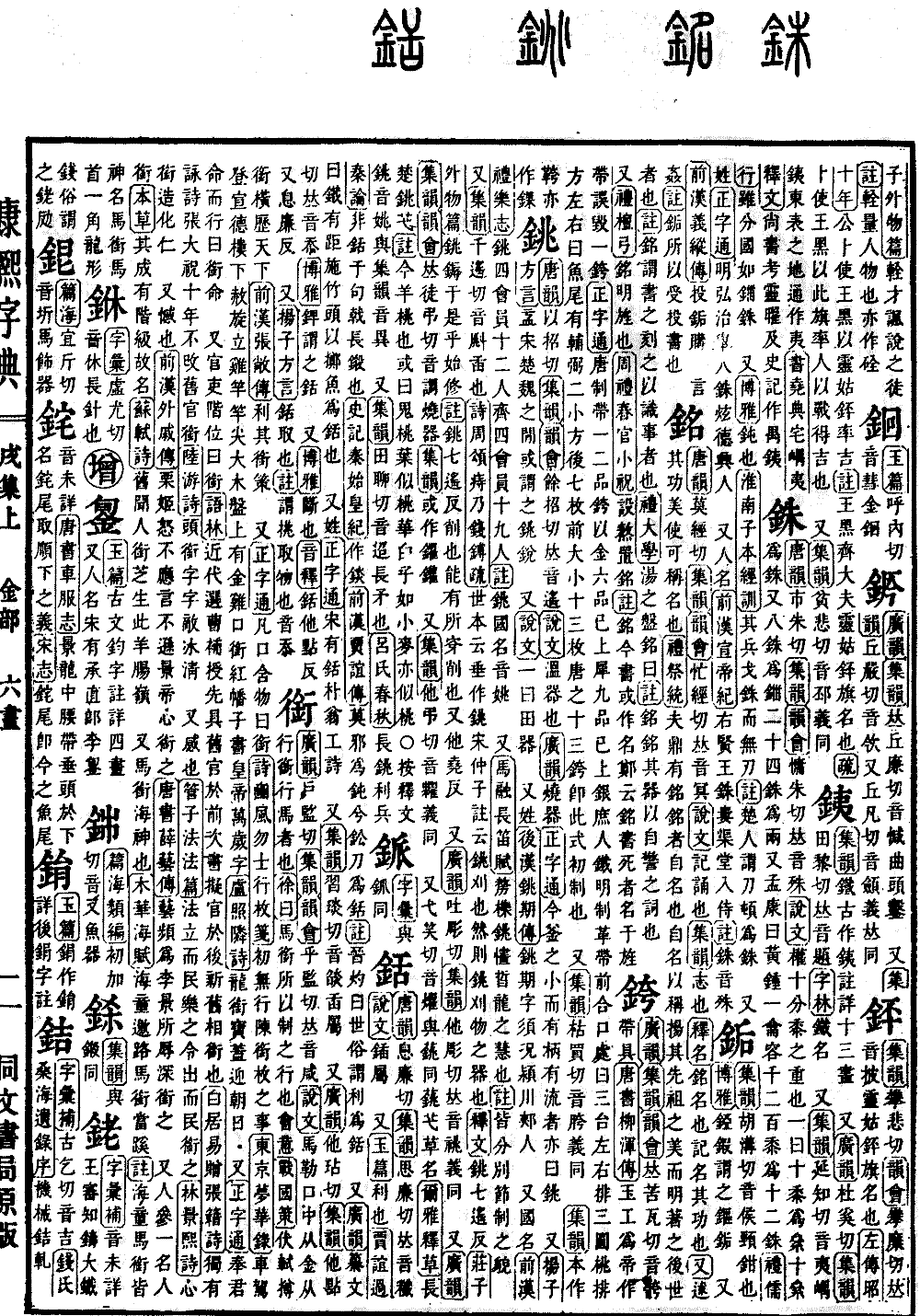
Xu Collection, Upper Volume
Radical: Metal (jīn)
Page 1305, Entry 14
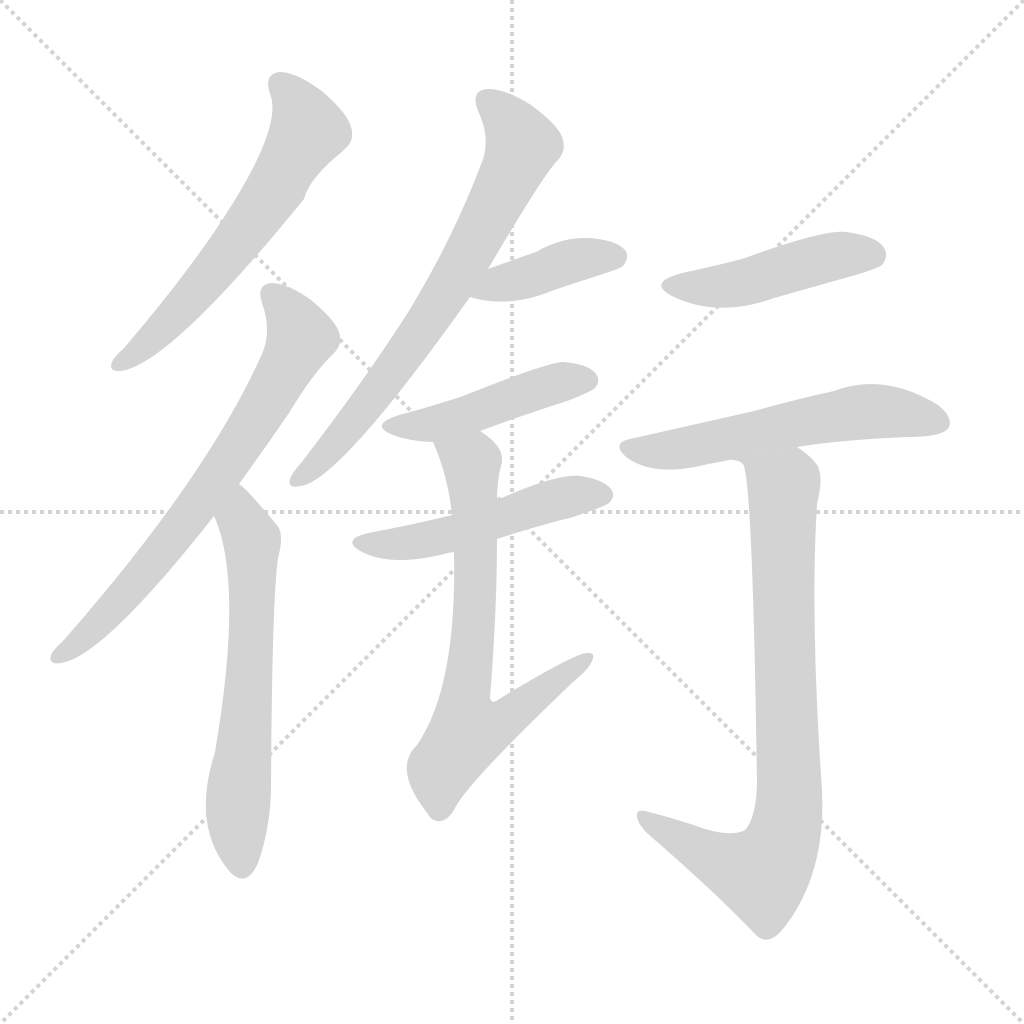
Pronounced xian.
According to the Explaining and Analyzing Characters (Shuowen Jiezi), it refers to a horse bit placed in the animal's mouth. The character is composed of the elements for metal and to go. It is a device used to control the movement of a horse. Xu Shen states that the bit is used to control the horse's gait. It is an ideogram.
Strategies of the Warring States (Zhanguo Ce): Leaning on the crossbar of the chariot, holding the reins, and traversing the world.
History of the Former Han Dynasty (Qianhan Shu), Biography of Zhang Chang: Utilizing its bit and whip.
According to the General Guide to Characters (Zhengzitong), anything held in the mouth is called xian.
Book of Odes (Shijing), Bin Feng: Formerly, there was no custom of placing wooden bits in the mouths of soldiers while on the march.
Eastern Capital: A Dream of Splendor (Dongjing Menghua Lu): The Emperor ascended the Xuande Gate tower to issue an amnesty. A tall pole with a wooden disk at the top was erected, featuring a golden rooster holding a red banner in its beak, inscribed with "Long Live the Emperor."
Lu Zhaolin's Poetry: A dragon-shaped ornament holds the magnificent canopy in its mouth to welcome the rising sun.
According to the General Guide to Characters (Zhengzitong), to carry out an imperial mandate is called xianming (receiving a mandate). Official ranks are also called guanxian (official titles).
Yulin: In recent times, when selecting officials for appointment, their previous position is listed first, followed by the newly proposed position, linking the old and new titles together.
Bai Juyi, Poem to Zhang Ji: Only Zhang Dazhu, who loves to write poetry, has not changed his official title for ten years.
Lu You's Poetry: Every character in the official title is as pure and cold as ice.
It also means to feel gratitude or to engrave in the heart.
Guanzi, Law of Laws: When laws are established, the people are happy to follow them; when commands are issued, the people hold them in their hearts.
Lin Jingxi's Poetry: Grateful in my heart for the benevolence of heaven and earth.
It also means to harbor resentment.
History of the Former Han Dynasty (Qianhan Shu), Biography of the Consorts: Consort Li was angry and refused to agree, speaking rudely; Emperor Jing of Han harbored resentment against her in his heart.
Book of Tang (Tang Shu), Biography of Xue Yi: Xue Yi was repeatedly humiliated by Li Jing and harbored deep resentment toward him.
It is also an alternative name for ginseng. According to the Materia Medica (Bencao), its growth follows distinct layers, hence the name.
Su Shi's Poetry: Previously heard of ginseng growing on these sheep-gut-like winding mountain ridges.
Maxian is also the name of a sea deity.
Mu Hua, Sea Rhapsody (Haifu): The Sea Child blocks the path, and Maxian obstructs the way. The commentary notes that the Sea Child and Maxian are both names of deities. Maxian has a horse's head, one horn, and the body of a dragon.