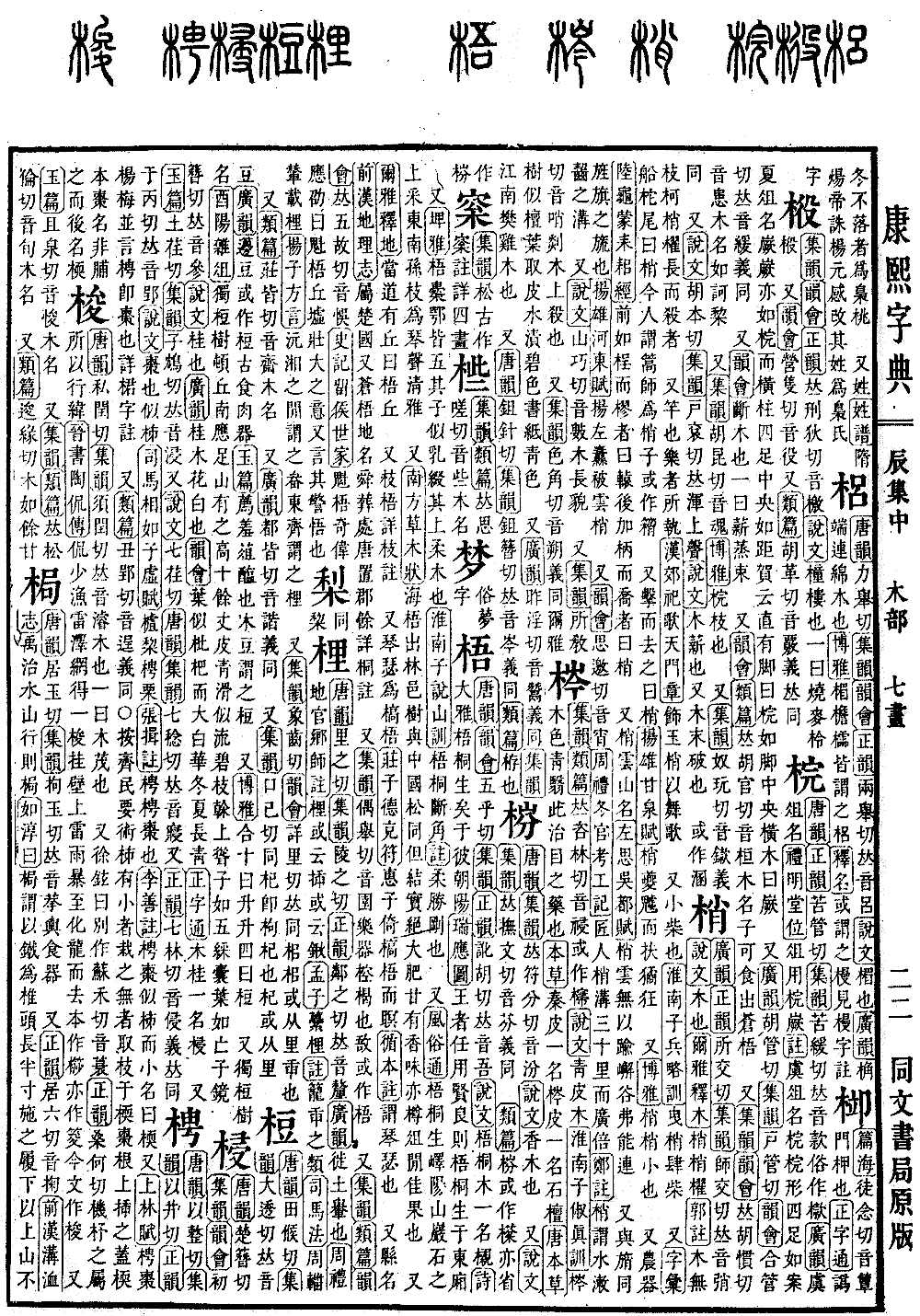
Chen Collection, Middle Volume. Radical: Tree (mù). Kangxi stroke count: 11. Page 530, Entry 11.
Tangyun and Yunhui dictionaries state it is pronounced wu. Jiyun and Zhengyun dictionaries state it is pronounced wu. The pronunciation is the same as the character for I (wu).
Shuowen Jiezi dictionary defines it as the wu-tong tree (phoenix tree), also known as chen.
Book of Odes (Shijing), Greater Odes (Daya) records: The wu-tong tree grows on the side of the sunny slope.
Ruiying Tu treatise states: When a ruler employs virtuous people, the wu-tong tree will grow by the eastern wing of the house.
Piya glossary records: The leaves and calyxes of the wu-tong tree are in groups of five, and its fruit hangs from the branches like drops of milk; it is a tree with soft wood.
Huainanzi, Explaining Mountains (Shuoshun) states: The wood of the wu-tong tree can sever an ox horn.
Commentary explains: This is an example of softness overcoming hardness.
Fengsu Tong records: The wu-tong tree grows on the rocks of Mount Yiyang; if one harvests the new branches growing toward the southeast to make a zither, the sound produced is clear, bright, and refined.
Nangfang Caomu Zhuang records: The sea wu-tong originates in Linyi; the shape of the tree is the same as the pine trees of China, but it bears very large fruit that is rich, sweet, and fragrant, serving as a delicacy at banquets.
Erya, Explaining Geography (Shidi) records: An earthen mound located in the middle of a road is called a wu-qiu.
Regarding the term zhi-wu, see the entry for the character zhi.
Zithers (qin and se) can also be referred to as gao-wu.
Zhuangzi, Sign of Virtue Complete (Dechongfu) records: Huizi leaned against the withered wu-tong tree to close his eyes and rest.
Xunben commentary states: Here, this refers to a zither.
It is also the name of a county.
Book of the Former Han (Qian Hanshu), Treatise on Geography records: It belonged to the state of Chu.
There is also Cangwu, a place name where Emperor Shun was buried; the Tang dynasty established a prefecture there. For the remainder, see the commentary under the character tong.
Jiyun dictionary states it is pronounced yu. It refers to a type of musical instrument, specifically a percussion instrument similar to the kong or jie. The character yu is sometimes written in a variant form (wu).
Jiyun, Leipian, and Yunhui dictionaries state it is pronounced wu.
Records of the Grand Historian (Shiji), House of the Marquis of Liu, describes Zhang Liang as kui-wu and exceptional in appearance. Ying Shao notes: Kui-wu is a description of a tall and imposing physique. Another interpretation suggests it describes a person who is alert and intelligent.
Textual research: In the original text of Zhuangzi, Sign of Virtue Complete (Dechongfu), which reads Huizi leaned (yi) against the withered wu-tong tree to rest, the character yi has been corrected to ju (to lean or rest upon) based on reliable editions.