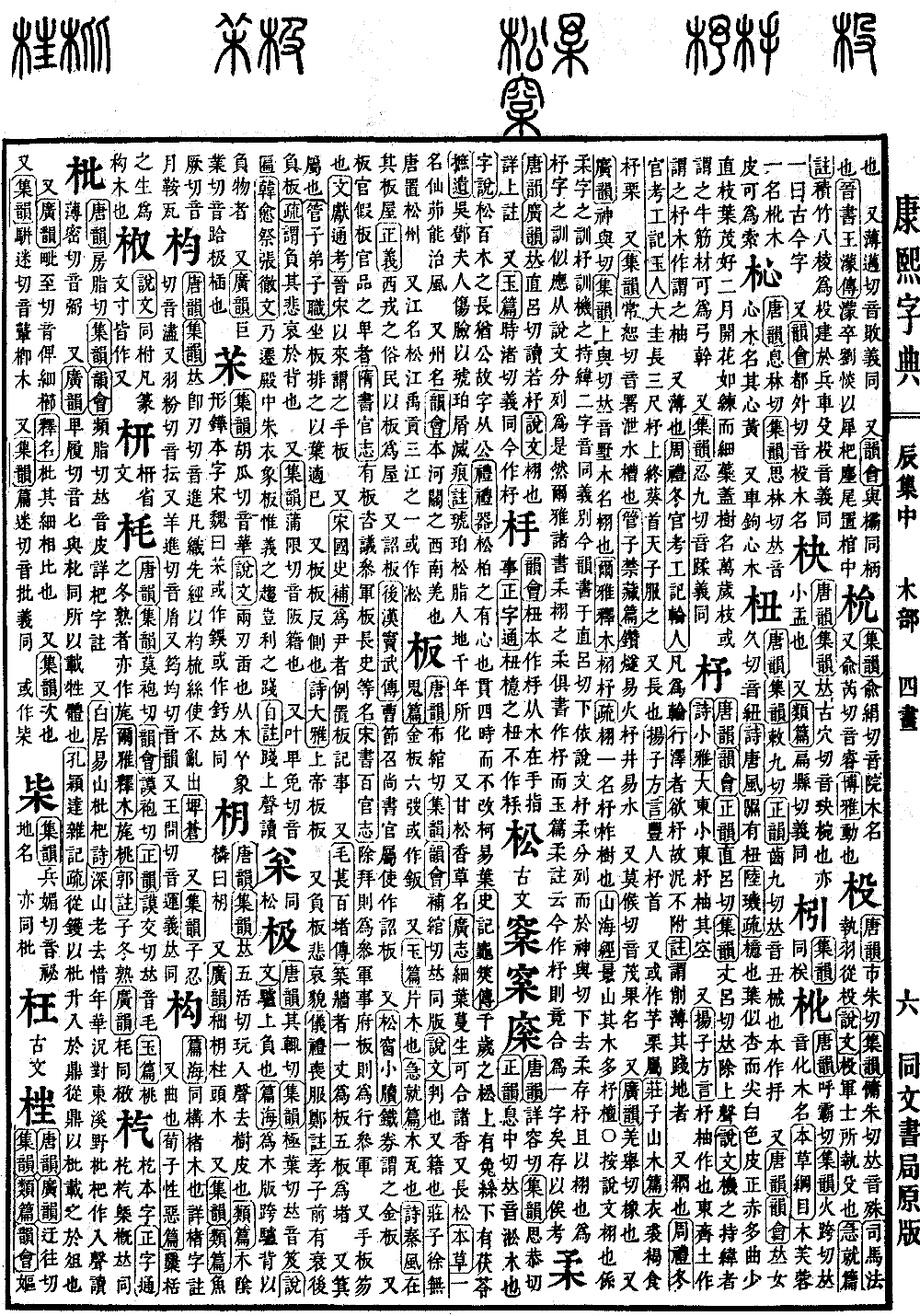
Chen Collection, Middle Volume
Radical: Tree (mù)
Page 514, Entry 08
Pronounced chu (rising tone).
Explaining the Components (Shuowen Jiezi): A component on a loom used to pull the weft thread.
Book of Odes (Shijing): In the poems of Lesser Odes (Xiaoya), regarding the regions of Xiaodong and Dadong, the shuttles and spools are empty.
Also, in the Dialects (Fangyan) by Yang Xiong (Yangzi): Shuttle and spool refer to production. In the eastern Qi region, earthen vessels are called zhu, and wooden vessels are called you.
Also refers to thinning or shaving down.
Rites of Zhou (Zhouli): In the chapter Records of Examination of Craftsmen (Kaogongji) of the Winter Offices: Generally, when making wheels, those used for passing through marshes should be made thinner so that mud will not adhere.
Commentary: Refers to shaving thin the part of the wheel that makes contact with the ground.
Also refers to paring down or reducing.
Rites of Zhou (Zhouli): In the chapter Records of Examination of Craftsmen (Kaogongji) of the Winter Offices: The great jade scepter is three feet long, with the upper part shaved thin into a cone shape, used by the Son of Heaven.
Also refers to length.
Dialects (Fangyan) by Yang Xiong (Yangzi): People of the Feng region have long heads.
Sometimes written in a variant form (yù), referring to a plant in the chestnut family.
Zhuangzi: In the chapter Mountain Tree (Shanmu): Wearing coarse cloth garments and eating chestnuts.
Also, in the Collected Rhymes (Jiyun), pronounced shu. Refers to a water drainage channel.
Guanzi: In the chapter Prohibitions and Accumulations (Jincang): Drill wood to change the fire, and clear the water wells to replace stagnant water.
Also pronounced mao. Refers to the name of a fruit.
Also, in the Expanded Rhymes (Guangyun), pronounced qiang. Refers to an oak tree.
Also, in the Expanded Rhymes (Guangyun) and Collected Rhymes (Jiyun), pronounced shu. Refers to a type of tree, the sawtooth oak.
Erya: In the chapter Explaining Trees (Shim), the sawtooth oak is defined as zhu.
Commentary: The sawtooth oak is also known as zhu, which is the oak tree.
Classic of Mountains and Seas (Shanhaijing): On Mount Jing, the trees are mostly sawtooth oaks and sandalwood trees.
Note: According to Explaining the Components (Shuowen Jiezi), the definition of the sawtooth oak belongs to a different character, while zhu is defined as the loom component. The two characters have the same pronunciation but different meanings. Current rhyme books list them separately under the pronunciation chu according to the Shuwowen, but under the pronunciation shu, they omit the other character and retain only zhu, defining it as the sawtooth oak. It seems that listing them separately according to the Shuowen would be correct. However, in texts such as the Erya, the sawtooth oak is written as zhu, and the Jade Compendium (Yupian) notes that it is currently written as zhu, meaning the two characters have been merged. This is recorded here pending further verification.
Verification: In the Book of Odes (Shijing), Lesser Odes (Xiaoya), it is written as Large East and Small East; this has been corrected to follow the original text: Small East and Large East.