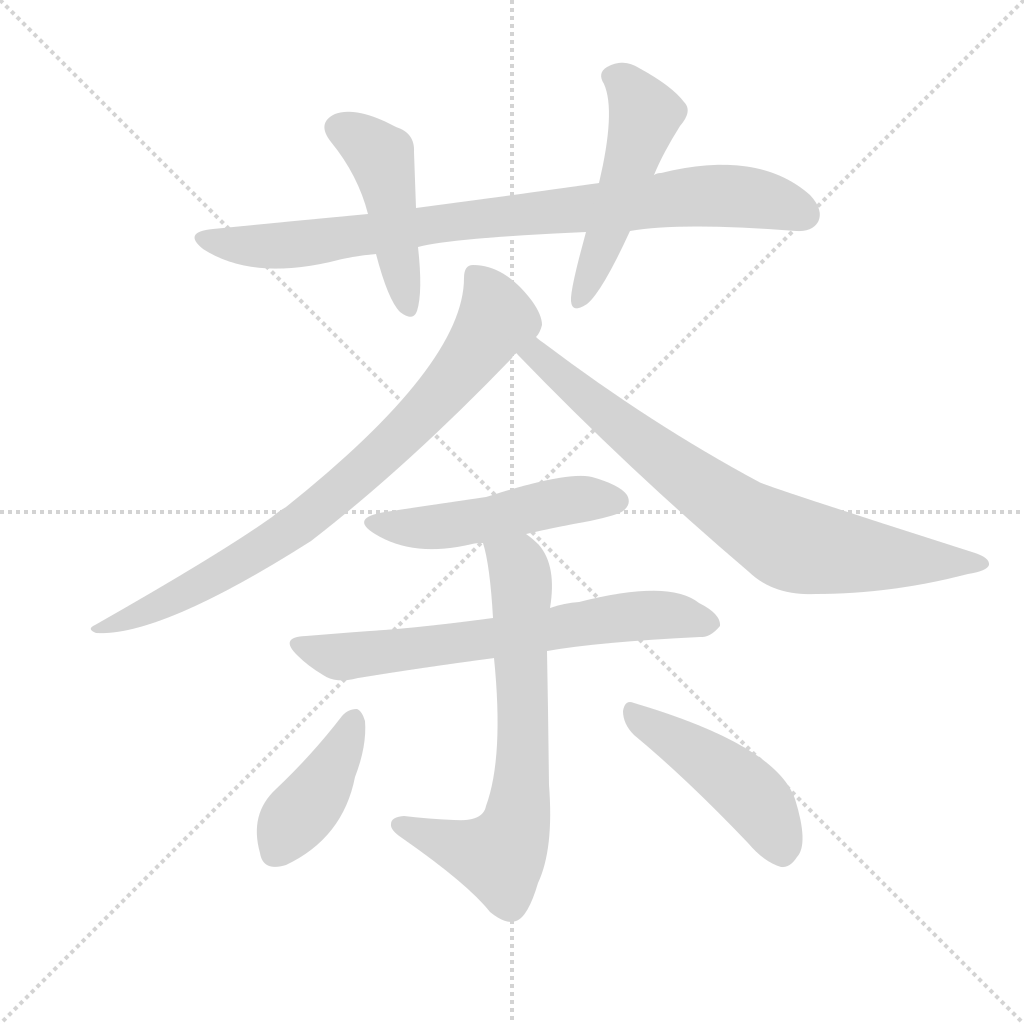
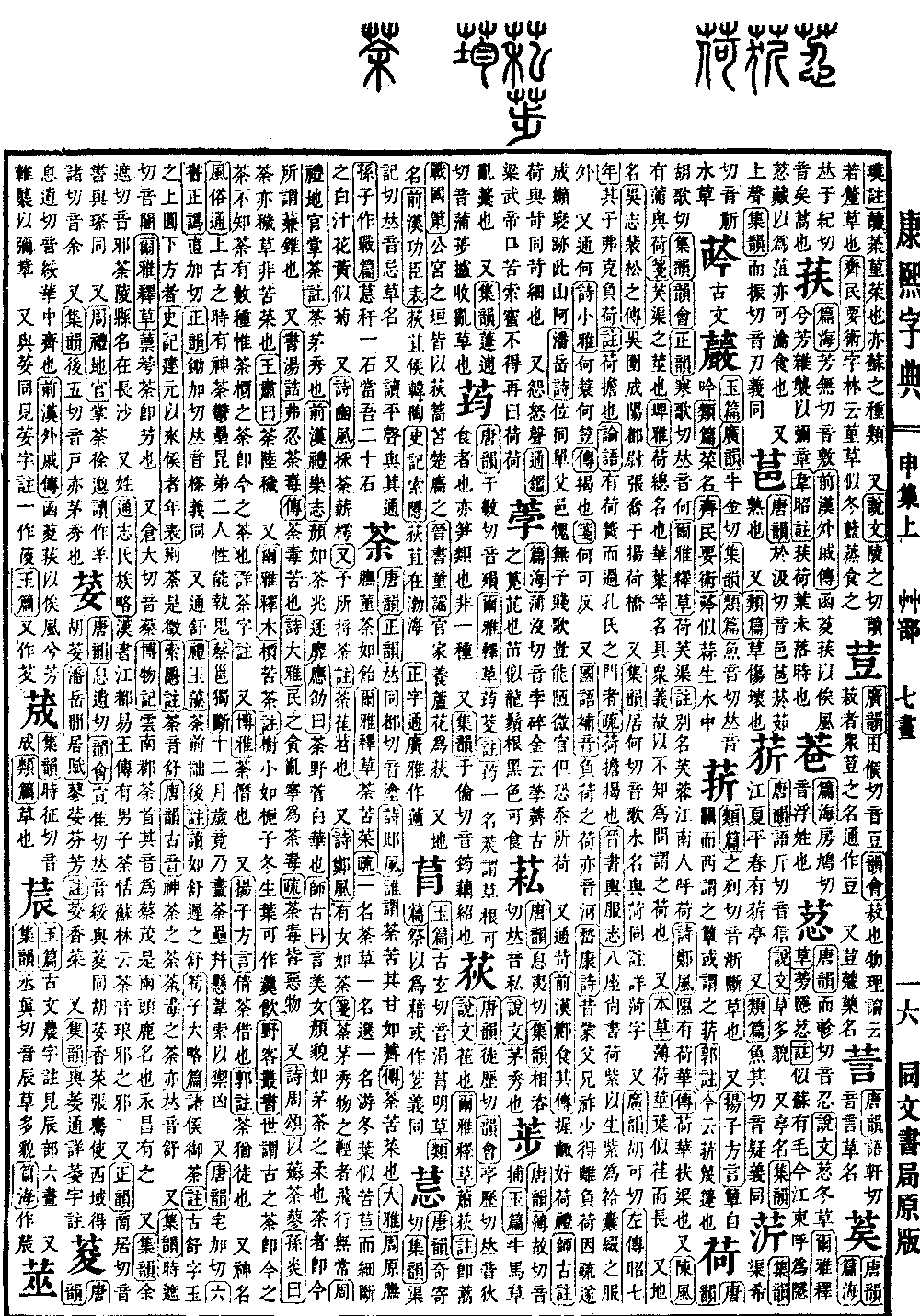
Shen Collection, Upper Volume
Radical: Grass (cǎo)
Kangxi Strokes: 13
Page 1032, Entry 21
Pronounced tu. Book of Odes (Shijing), Odes of Bei: Who says the bitter vegetable (tu) is bitter? Its sweetness is like shepherd's purse. Commentary: Tu is a bitter vegetable. Book of Odes (Shijing), Greater Odes: The plains of Zhou are rich and fertile; violet and tu are as sweet as honeyed cakes. Erya (Erya), Interpretation of Grasses: Tu is a bitter vegetable. Commentary: Also known as tu grass, xuan, or youdong. Its leaves resemble those of endive but are finer; when broken, they yield a white sap, and the flowers are yellow like a chrysanthemum.
Also, Book of Odes (Shijing), Odes of Bin: Gathering tu and firewood. Also: What I have plucked is tu. Annotation: Tu is the flowering reed (huan-tiao).
Also, Book of Odes (Shijing), Odes of Zheng: There is a maiden like the tu. Annotation: Tu refers to the flowering reed (mao-xiu), a light object that flies about without resting. Book of Rites (Zhouli), Offices of Earth, Overseer of Tu annotation: Tu is the flowering reed. Book of Han (Hanshu), Treatise on Rites and Music: A face like tu, a manifestation of graceful movement. Ying Shao says: Tu is the white flower of the wild sedge. Yan Shigu says: It means the beauty's face is as soft as the flowering reed. Tu is what is now called the reed spike (jian-zhui).
Also, Book of Documents (Shujing), Announcement of Tang: Do not endure the suffering (tu-du). Commentary: Tu-du means suffering. Book of Odes (Shijing), Greater Odes: The people are greedy for disorder; would they rather endure suffering? Commentary: Both tu and du refer to noxious things.
Also, Book of Odes (Shijing), Eulogies of Zhou: To weed out the tu and liao. Sun Yan says: Tu is also a weed, not the bitter vegetable. Wang Su says: Tu is a land weed.
Also, Erya (Erya), Interpretation of Trees: Jia is bitter tea. Annotation: The tree is small, like a gardenia, grows in winter, and its leaves can be made into soup or drink. Yeke Congshu (Yeke Congshu): The world claims ancient tu is modern tea, but one does not realize that tu has several varieties; only the tu of jia-tu is modern tea. See the entry for Tea.
Also, Guangya (Guangya): Tu means to overstep.
Also, Yang Xiong, Dialect (Fangyan): Qian-tu means to borrow. Guo annotation: Tu is similar to tu.
Also, names of deities. Fengsu Tongyi (Fengsu Tongyi): In ancient times, there were two brothers, Shen-tu and Yu-lei, who had the ability to control ghosts. Cai Yong, Exclusive Decisions (Duduan): At the end of the twelfth month, they would paint Shen-tu and Yu-lei and hang reed ropes to ward off evil.
Pronounced tu. Meaning is the same.
Also, synonymous with shu (slow). Book of Rites (Liji), Jade Pattern: The lords have the tu. Annotation: Read as the shu in shu-chi (leisurely). Xunzi (Xunzi), Extensive Outline Chapter: The lords command the tu. Annotation: This is the ancient character for shu, referring to a piece of jade that is rounded at the top and square at the bottom. Records of the Grand Historian (Shiji), Chronological Table of Marquis Since the Jianyuan Era: The Jing-tu are to be conquered. Suoyin annotation: Tu is pronounced shu. Tangyun Guyin (Tangyun Guyin): The tu in Shen-tu and the tu in tu-du are also pronounced shu.
Also, pronounced she. Erya (Erya), Interpretation of Grasses: Biao-fu and tu are the same as tu.
Also, pronounced cai. Bowu Ji (Bowu Ji): In Yunnan Prefecture there is the tu-shou, whose sound is cai-mao; these are the names of two-headed deer found in Yongchang.
Also, pronounced ye. Tu-ling is the name of a district in Changsha.
Also a surname. Tongzhi (Tongzhi), Clans and Tribes: Book of Han (Hanshu), Biography of King Yi of Jiangdu, mentions a man named Tu Tian. Su Lin says: Tu is pronounced ye as in Lang-ye.
Also, pronounced shu. Identical to the character tu (a type of jade).
Also, Book of Rites (Zhouli), Offices of Earth, Overseer of Tu: Xu Miao reads it as yu.
Also, pronounced hu. Also refers to the flowering reed.