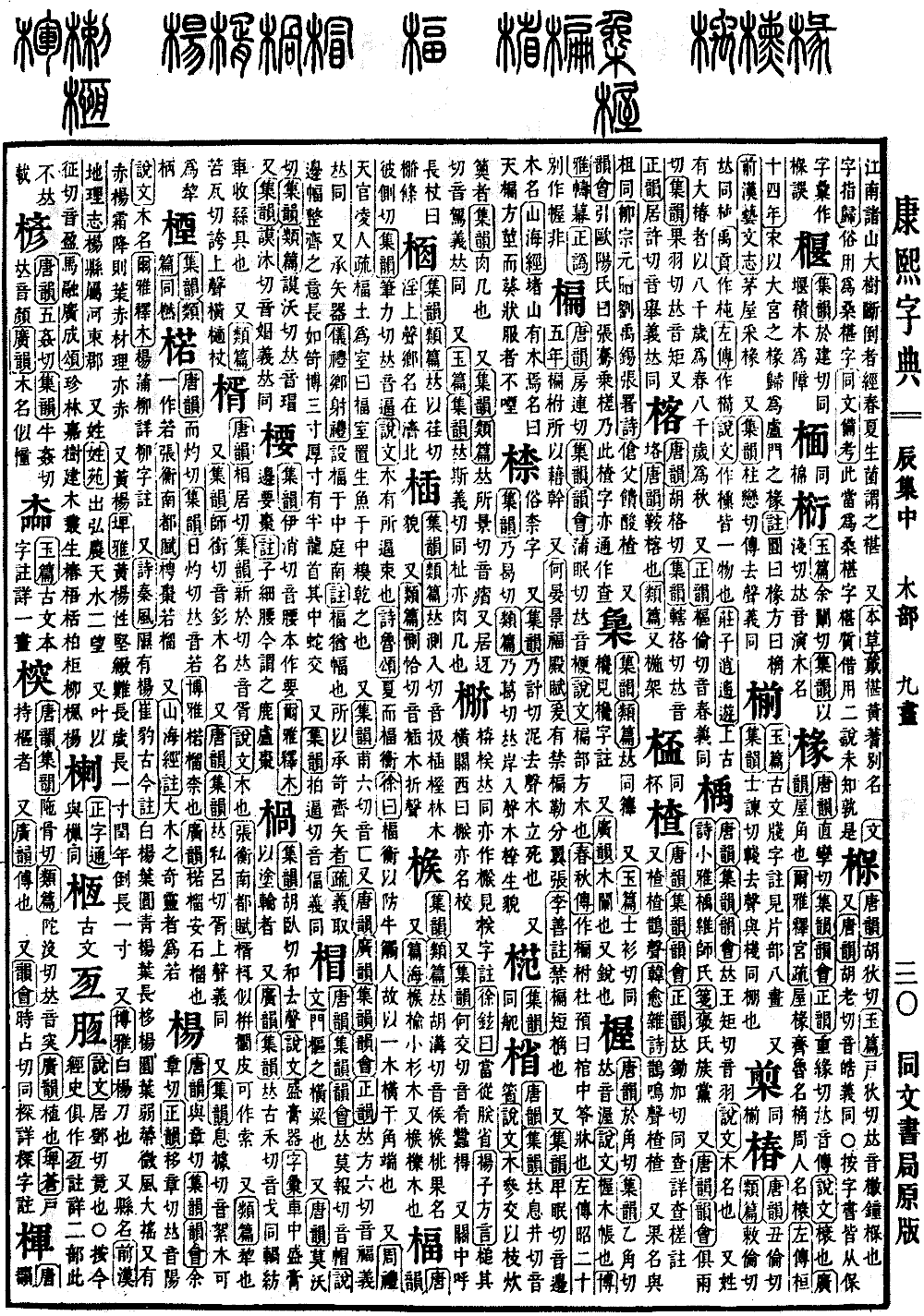
Chen Collection, Middle Volume. Radical: Tree (mù). Kangxi stroke count: 13. Page 538, Entry 06.
Pronounced yang.
According to the Explaining Graphs and Analyzing Characters (Shuowen Jiezi), it is the name of a tree. In the Approaching Elegance (Erya), specifically the chapter Explaining Trees, it is identified as the pǔliǔ willow. See the commentary under the entry for the character for willow.
Also found in the Book of Odes (Shijing), in the section Odes of Qin: In the wetlands there are yang trees. Cui Bao, in his Notes on Past and Present (Gujin Zhu), states that the white yang tree has round leaves, the green yang tree has long leaves, and the yí yang tree has round leaves with weak stems that shake violently in a slight breeze. There is also the red yang tree, whose leaves turn red at the first frost, and its wood grain is also red. There is also the boxwood (huángyáng). The Compendium of Animals and Plants (Piya) notes that the boxwood is firm and fine-grained, grows slowly, increasing in height by one inch each year, but in a leap year, it grows in reverse by one inch.
Also, according to the Expanded Elegant Dictionary (Boya), it refers to a white yang blade.
Also, the name of a county. According to the Geography Chapter of the History of the Former Han (Qian Han Shu), Yang County was under the jurisdiction of Hedong Commandery.
Also a surname. According to the Garden of Surnames (Xingyuan), it originates from the two prominent clans of Hongnong and Tianshui.
Also pronounced ying. In Ma Rong’s Eulogy on Guangcheng (Guangcheng Song): Rare forests and auspicious trees, the building-wood grows in thickets. Ailanthus, paulownia, pine, and cypress, along with Japanese cedar, willow, maple, and yang.