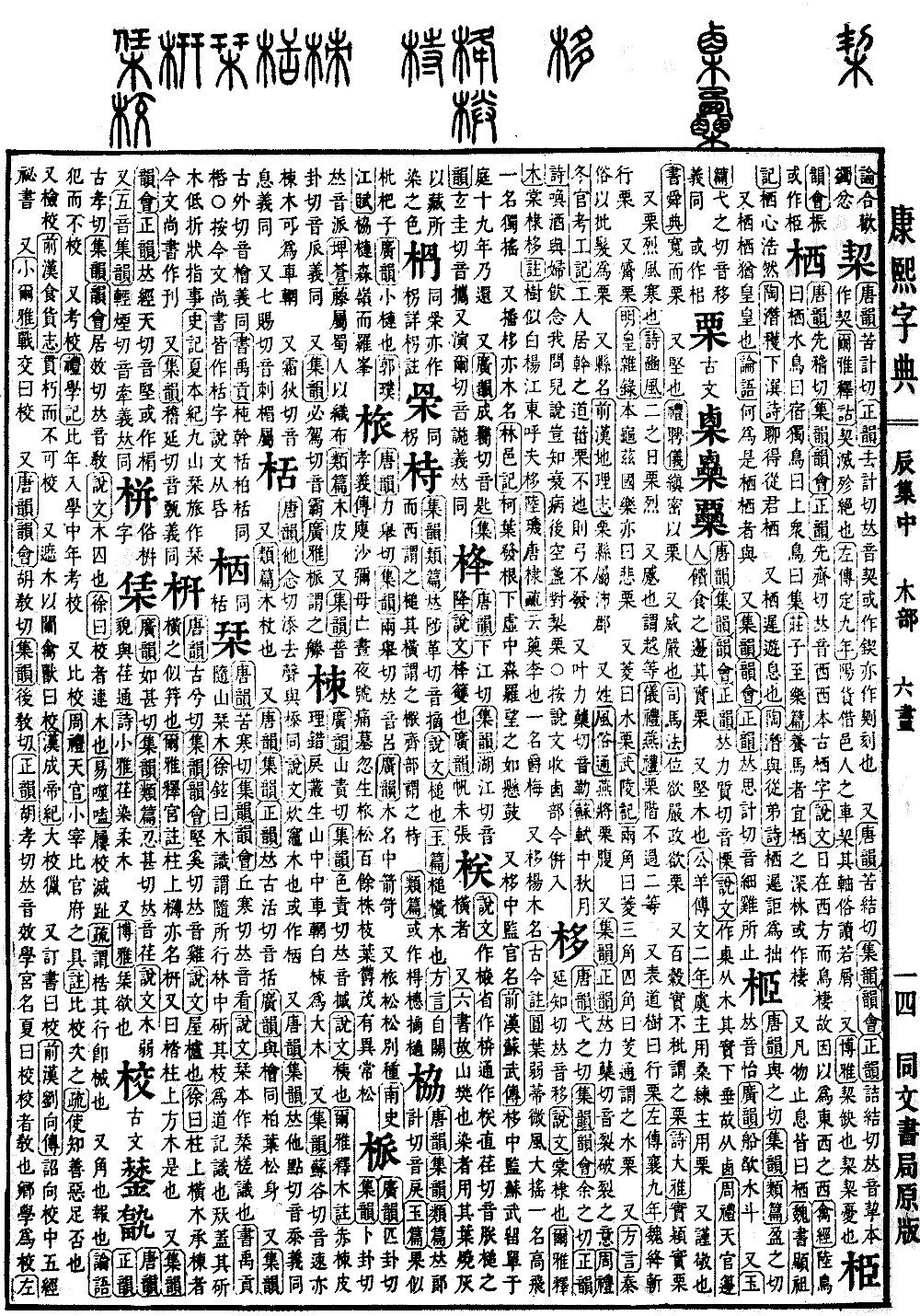
Chen Collection, Middle Volume
Radical: Tree (mù)
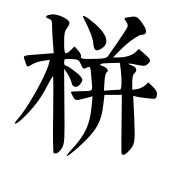
Entry: 栟
Kangxi stroke count: 10
Page 522, Entry 23
This is the common variant form of the character.
According to the Tang Dynasty Rhyme Dictionary (Tangyun), it is pronounced fěng. According to the Collected Rhymes (Jiyun) and the Rhyme Collection (Yunhui), it is pronounced yíng. According to the Corrected Rhymes (Zhengyun), it is pronounced bǐng. These pronunciations are equivalent to the character pronounced bìng.
The Explaining Graphs and Analyzing Characters (Shuowen Jiezi) explains that the term indicates the palm tree.
The Corrected Meaning (Zhengzitong) describes the palm tree as standing one or two zhang tall, with leaves resembling a cattail fan; the underside of the leaves has hairs similar to a mane, which is why it is called a mane-palm. It is also written as palm (zōnglǘ).
Zhang Heng mentions in the Rhapsody on the Southern Capital (Nandu Fu) the phrase "spices and palm trees."
Li Shan notes that the bark of the tree can be used to make ropes.
The History of the Tang Dynasty (Tangshu), Record of the Southern Barbarians, records that in the country of Kaling, even large houses are roofed with palm leaves. It is also written as bìng.
The Records of the Grand Historian (Shiji), Biography of Sima Xiangru, contains the phrase "areca and palm trees." This refers to the palm tree.