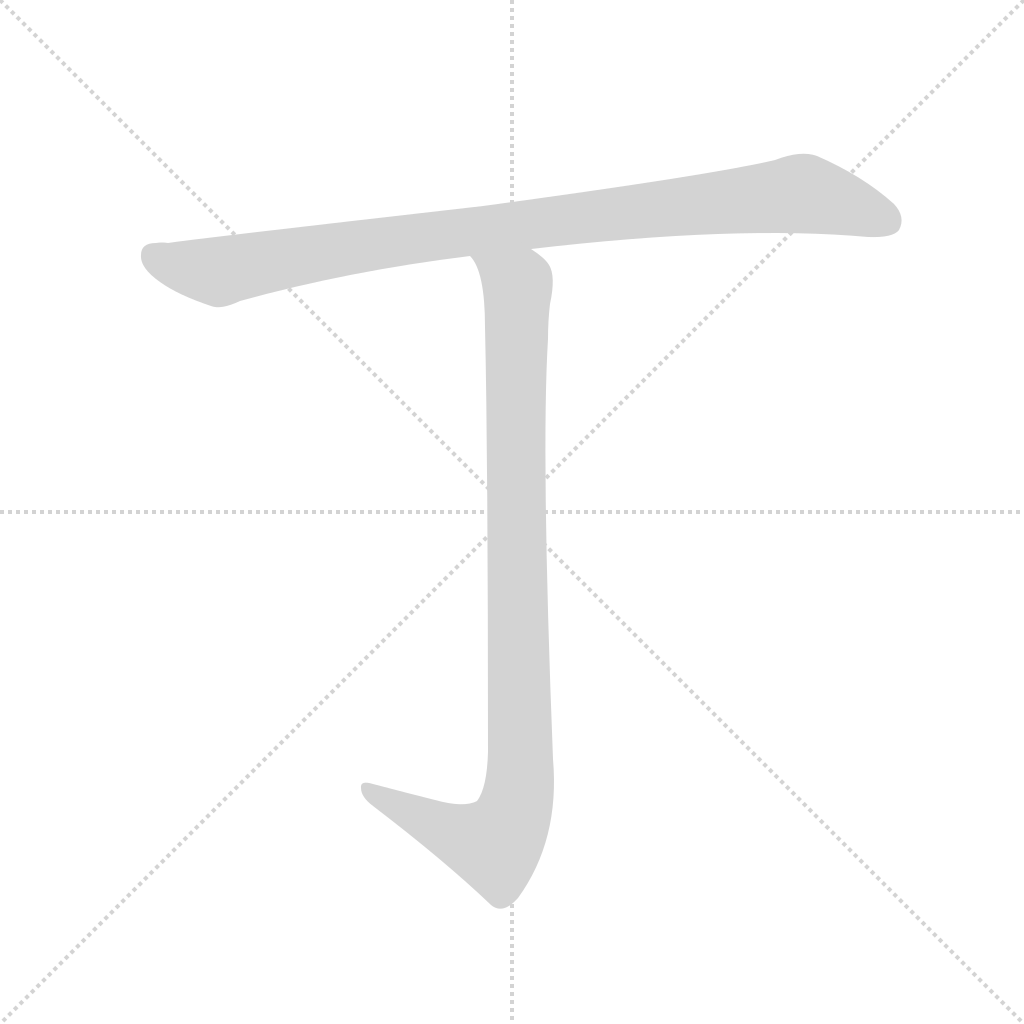
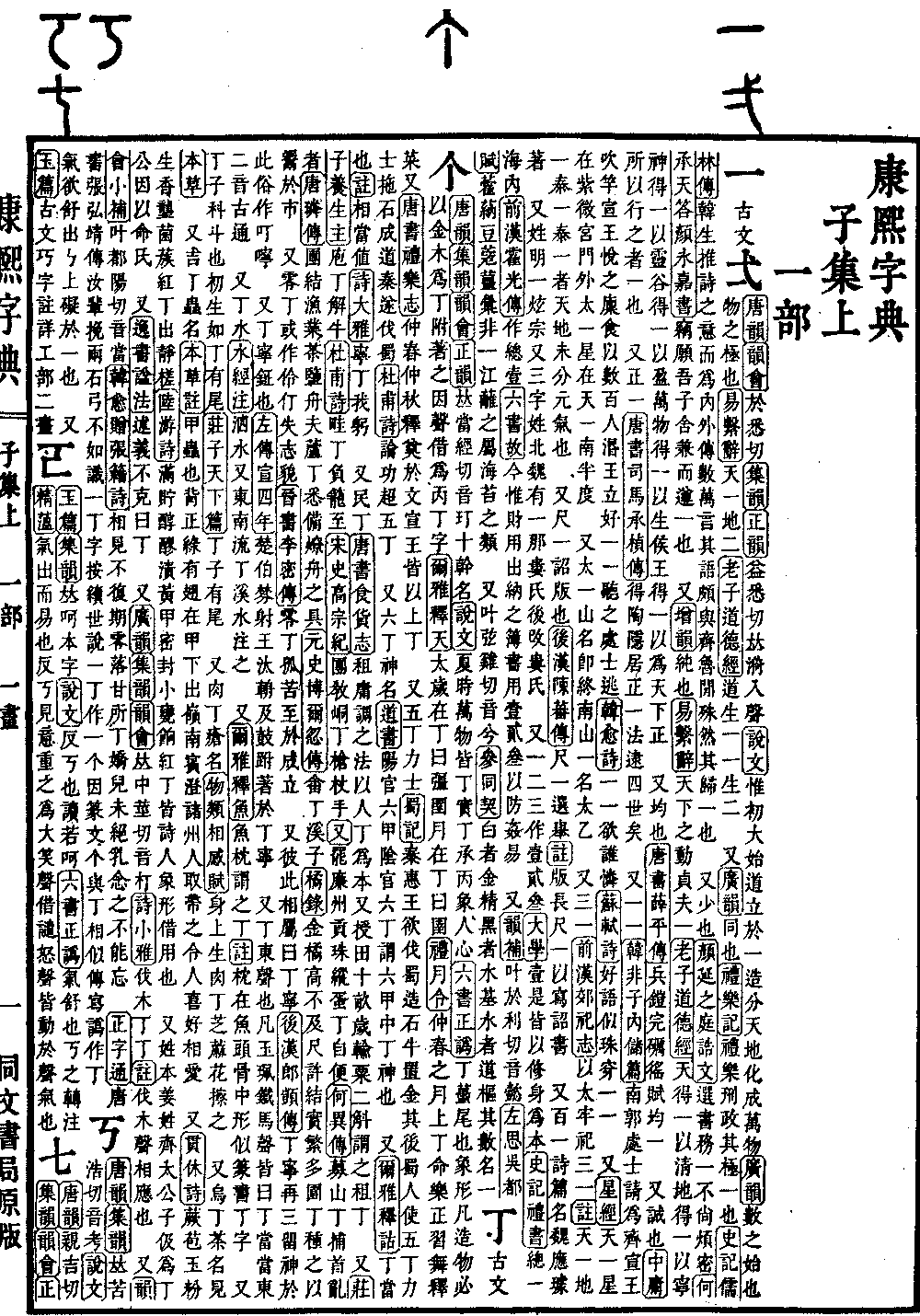
Zi Collection, Page Position: Upper. Radical: One (yī). Ding. Kangxi Strokes: 2. Page: Page 75, Number 03.
According to ancient records: The Tang Rhymes (Tangyun), Collected Rhymes (Jiyun), Rhyme Assembly (Yunhui), and Correct Rhymes (Zhengyun) all provide the fanqie pronunciation dāng combined with jīng, pronounced the same as dīng.
Ding is one of the Heavenly Stems. The Explaining Graphs and Analyzing Characters (Shuowen Jiezi) explains: In summer, all living things are solid and flourishing. Ding follows the stem Bing and symbolizes the human heart. The Correcting Errors in the Six Classes of Characters (Liushu Zhenge) states: The shape of the character resembles a scorpion's tail; it is a pictograph. Whenever implements are made, metal or wood must be used as nail-like fasteners to fix them in place, thus the sound was borrowed to represent the Heavenly Stem Ding.
The Erya, Explaining Heaven (Shitian) records: A year when the Great Year deity is in the position of Ding is called Qiangyu, and a month in the position of Ding is called Yu. The Book of Rites (Liji), Monthly Ordinances (Yueling) states: On the first Ding day of the second month of mid-spring, the music master is ordered to practice dancing and perform the vegetable offering ritual. Furthermore, the Book of Tang (Tangshu), Record of Ritual and Music (Liyue Zhi) records: The sacrifices to the King of Manifest Culture, Confucius, in mid-spring and mid-autumn are both performed on the first Ding day of the month.
Five Ding refers to strongmen. The Records of Shu (Shuji) records: King Hui of Qin wished to attack the state of Shu, so he created stone oxen and placed gold behind them. The King of Shu sent five strongmen to drag the stones to create a road, and the Qin army subsequently used this path to invade Shu. A poem by Du Fu contains the line: Merit exceeding the five strongmen.
Six Ding is the name of a group of deities. Daoist Books (Daoshu) state: Yang officials have the Six Jia, and Yin officials have the Six Ding. It refers to the Ding deities within the Six Jia calendrical cycle.
The Erya, Explaining Words (Shigu) states: Ding means to correspond to. The commentary notes: It means to be equivalent to or to fall exactly at a certain time. The Book of Odes (Shijing), Greater Odes (Daya) contains the line: Would that it fell upon my person.
The term male laborer (minding) refers to an adult male. The Book of Tang, Record of Food and Goods (Shihuo Zhi) records: The system of land tax, labor service, and cloth tax is based on the individual male. Furthermore, ten mu of land are granted, and two hu of grain are paid annually, which is called rent male (zuding).
The Zhuangzi, Inner Chapters (Yangshheng Zhu) mentions Cook Ding carving the ox. A poem by Du Fu contains the line: The garden laborer (yuanding) arrives carrying a basket. The History of Song (Songshi), Annals of Emperor Gaozong records: Training the mountain tribe laborers (dongding) in spear and staff techniques. It also records: Abolishing the tribute of pearls from Lianzhou and allowing the boat people (danding) to follow their own convenience. The Biography of He Yi (He Yi Zhuan) records: Recruiting mountain laborers (shanding) to capture rebel leaders. The Biography of Tang Lin (Tang Lin Zhuan) records: Organizing fishermen, tea and salt workers, boatmen, and reed cutters (luding) to prepare equipment for burning ships. The History of Yuan (Yuanshi), Biography of Borokhula mentions upland laborers and stream youths. The Orange Records (Julu) records: Kumquat trees less than a foot high bear much fruit; gardeners plant them for sale in the market.
The term lingding, sometimes written with different characters, describes being solitary and disappointed. The Book of Jin (Jinshu), Biography of Li Mi states: Solitary and lonely (lingding) until reaching adulthood and independence.
Giving repeated instructions is called dingning. The History of the Later Han (Hou Hanshu), Biography of Lang Ji states: Repeatedly instructing (dingning) to pay attention here. It is commonly written with the mouth radical.
Dingning also refers to a type of gong or musical instrument. The Zuo Commentary (Zuozhuan), Fourth Year of Duke Xuan records: Bofen of Chu shot at the King of Zhou; the arrow passed the carriage shaft, hit the drum frame, and lodged in the dingning instrument.
The term dingdong describes a sound. The sound of jade pendants or wind chimes can be called dingdang. The characters for dang and dong were phonetically interchangeable in ancient times.
Ding Stream is the name of a body of water. The Commentary on the Water Classic (Shuijing Zhu) records: The Si River flows southeast, and the Ding Stream flows into it.
The Erya, Explaining Fish (Shiyu) states: The bone in a fish's head is called ding. The commentary notes: The fish pillow bone is inside the head bone, shaped like the seal script character for ding.
The term dingzi refers to a tadpole. When first born, they are shaped like the character ding and have a tail. The Zhuangzi, Miscellaneous Chapters (Tianxia) states: Tadpoles (dingzi) have tails.
The term flesh nodule (rouding) is the name of a skin condition. The Ode on the Resonance of Things (Wulei Xianggan Fu) records: For flesh nodules on the body, rub with sesame flowers.
Black Ding (wuding) is the name of a tea, as seen in the Materia Medica (Bencao).
Lucky Ding (jiding) is the name of an insect. The commentary on the Materia Medica states: This is a type of beetle with a green back and wings hidden under a shell, produced in the regions of Binzhou and Chengzhou in Lingnan. People wear them, believing they cause people to love one another.
A poem by Guanxiu contains the line: Fern buds like jade powder grow on the fragrant mounds, mushroom clusters like red ding emerge from the quiet logs. A poem by Lu You contains the line: Filling the vessel with mellow wine to soak the yellow shells, sealing the small jar to send the red ding. These are instances where poets use the shape of the character as a metaphor.
Ding is also a surname. It was originally the Jiang surname. Ji, the son of Grand Duke Tai of Qi, was known as Duke Ding, and his descendants subsequently took Ding as their surname.
The Lost Book of Posthumous Titles (Yishu Shifa) states: Following righteousness but failing to achieve success is called Ding.
Furthermore, the Broad Rhymes (Guangyun), Collected Rhymes, and Rhyme Assembly provide the fanqie pronunciation zhòng combined with jīng, pronounced the same as tǐng. The Book of Odes, Lesser Odes (Xiaoya) contains the line: The sound of chopping wood (ding-ding). The commentary notes: This refers to the echoing sound of wood being felled.
Also, the Supplement to the Rhyme Assembly (Yunhui Xiaobu) gives the rhyming pronunciation dū combined with yáng, pronounced like dāng. A poem by Han Yu states: Meeting again is no longer expected; I am resigned to falling into loneliness (ding). My young child is not yet weaned, and the thought of him cannot be forgotten.
The Correcting Character Forms (Zhengzi Tong) records: The Book of Tang, Biography of Zhang Hongjing states: You men can pull a two-dan bow, but you do not know a single character (ding). According to the Continued Tales of the World (Xu Shishuo), the phrase one ding was originally one ge; because the seal script forms for ge and ding are similar, it was erroneously transcribed as ding.