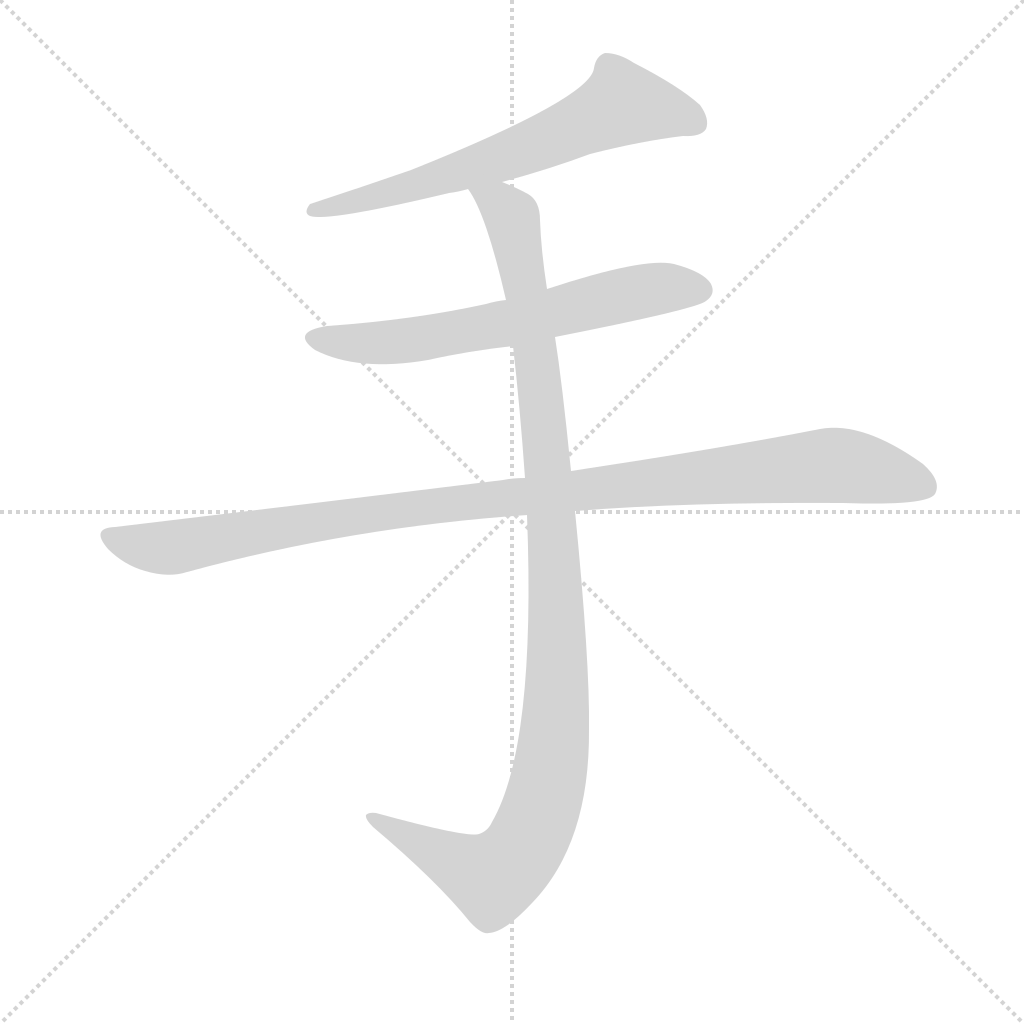
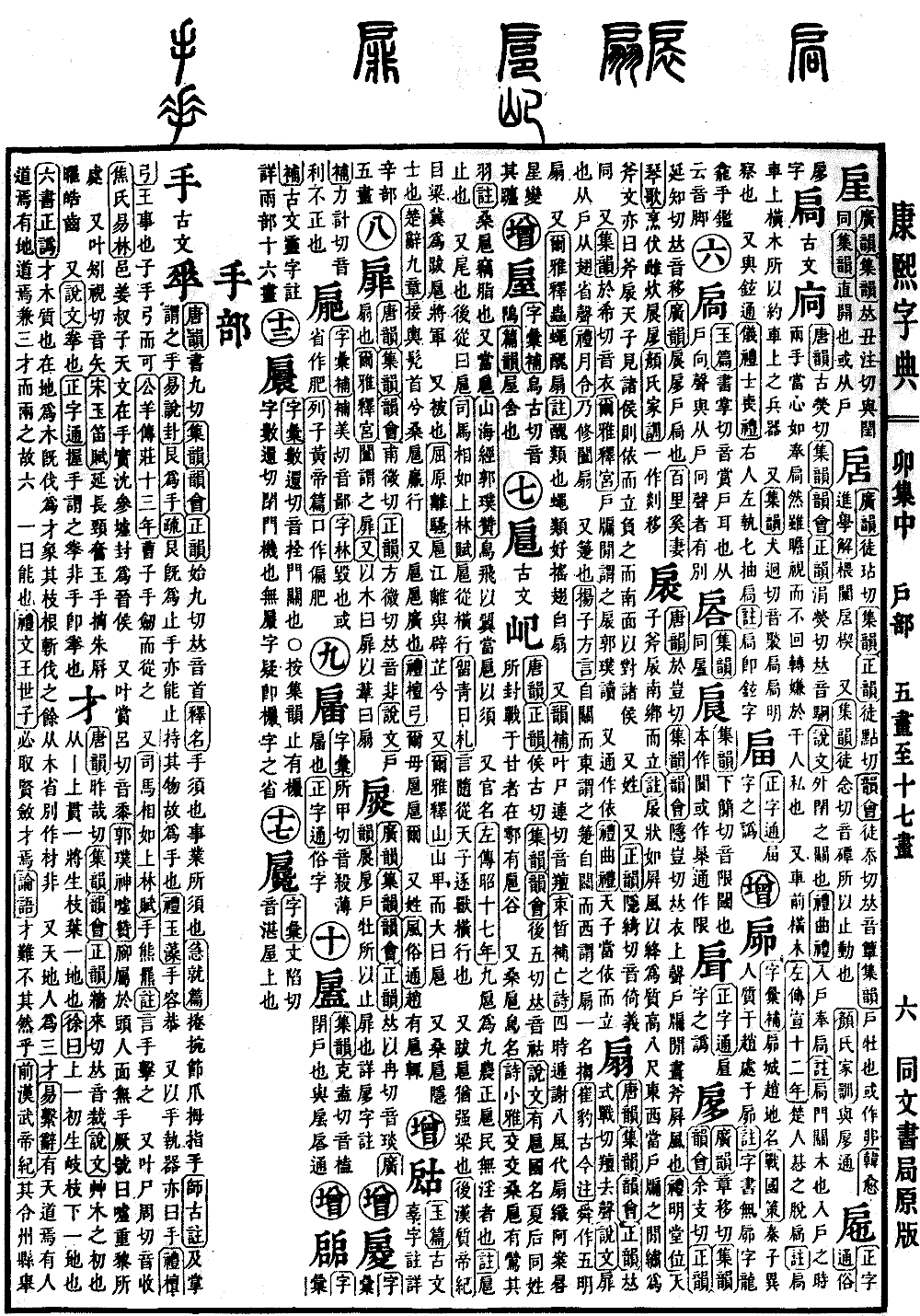
Mao Collection, Middle Volume. Radical: Hand (shǒu). Kangxi strokes: 4. Page 416, Entry 28.
Ancient script. According to Tang Rhymes (Tangyun), pronounced shou (rising tone). According to Collected Rhymes (Jiyun), Rhyme Meetings (Yunhui), and Orthodox Rhymes (Zhengyun), pronounced shou (rising tone).
Explanation of Names (Shiming): The hand is what is needed, that which is required for one's affairs.
Quick Literacy Text (Jijiu pian): Curled wrists, joints, claws, thumbs, and hands.
Shigu commentary: The part including the palm is called the hand.
Book of Changes (Yijing), Explanation of the Trigrams: The trigram Gen represents the hand.
Sub-commentary: Since Gen signifies stopping, and the hand is also able to stop or hold things, it is represented by the hand.
Book of Rites (Liji), Jade Pattern: Hand posture should be respectful.
Also, to grasp an implement with the hand is called shou.
Book of Rites (Liji), Tangong: It is the business of the King. You may grasp the bow with your hand.
Gongyang Commentary, 13th Year of Duke Zhuang: Cao Zi grasped his sword and followed him.
Also, in Sima Xiangru’s Rhapsody on the Upper Forest (Shanglin fu): Grappling with bears and brown bears.
Commentary: This refers to striking them with the hands.
Also, pronounced shou (level tone).
Master Jiao’s Forest of Changes (Jiao shi Yilin): Yijiang’s younger son, celestial patterns in hand. The star of Shichen and the ruins of Can, enfeoffed as the Marquis of Jin.
Also, pronounced shu (rising tone).
Guo Pu’s Eulogy on Divine Exhalations (Shenxu zan): Feet attached to the head, the human face has no hands. Its name is called Xu, where Zhongli resides.
Also, pronounced shi (rising tone).
Song Yu’s Rhapsody on the Flute (Di fu): Stretching the long neck, brandishing jade hands, parting red lips, displaying white teeth.
Also, according to Analytical Dictionary of Characters (Shuowen): A fist.
Orthodox Dictionary (Zhengzitong): To grasp hands is called a fist. If it is not a hand, it is a fist.