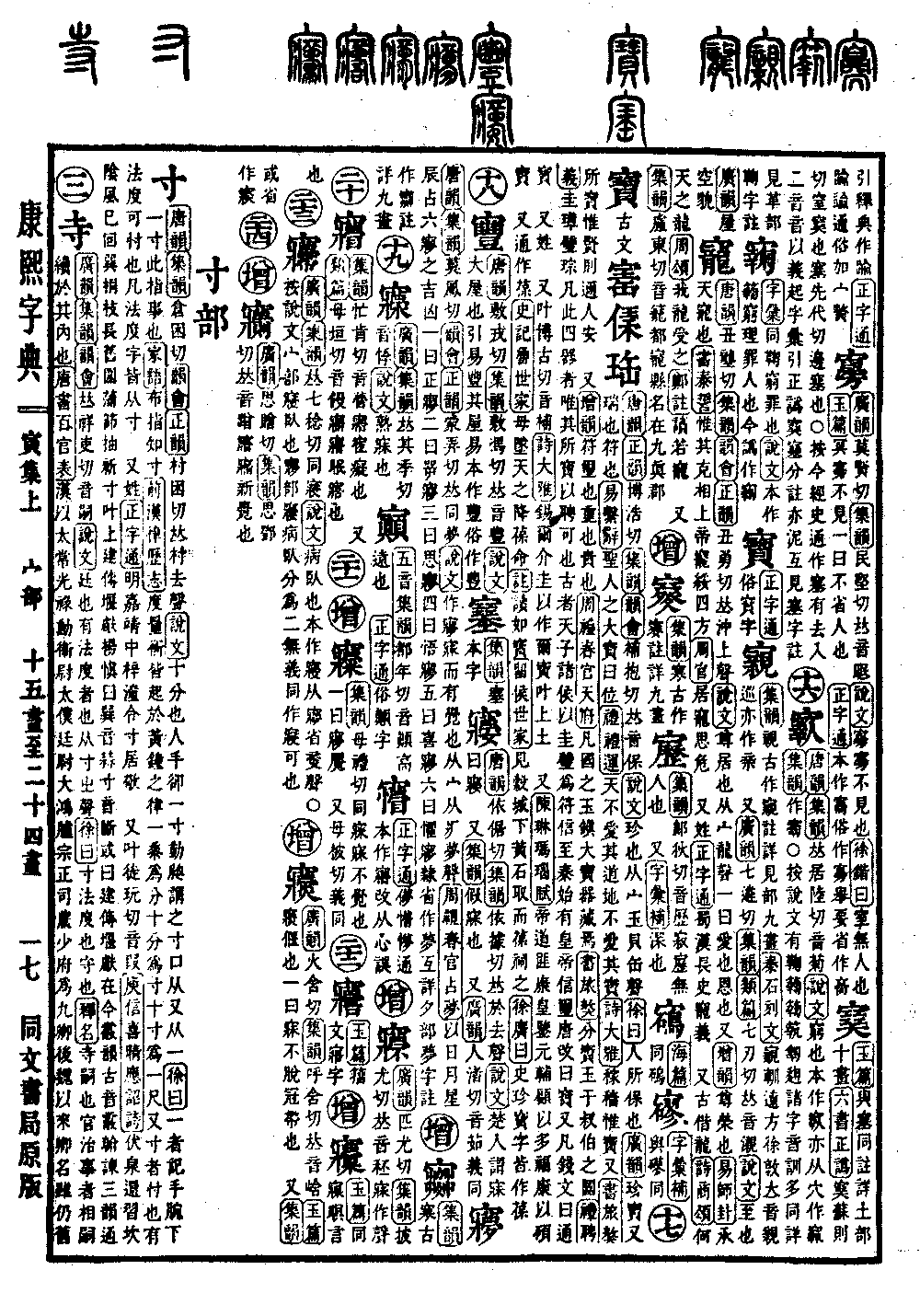
Yin Collection, Upper Volume
Radical: Inch (cùn)
Kangxi stroke count: 6
Page 293, Entry 33
Guangyun, Jiyun, and Yunhui dictionaries: Pronounced sì.
Shuowen Jiezi dictionary: A court of justice. A place where laws and regulations are maintained. Derived from the character for inch, serving as a phonetic element. Xu Kai says: An inch represents a standard of law and is kept or guarded.
Shiming dictionary: The character denotes succession. It is a place where officials responsible for administrative affairs hold their positions in succession.
Old Book of Tang (Tangshu): During the Han dynasty, the nine ministers consisted of the Minister of Ceremonies, the Minister of the Imperial Household, the Minister of the Guards, the Minister Coachman, the Minister of Justice, the Minister Herald, the Minister of the Imperial Clan, the Minister of Finance, and the Minister Steward. From the Northern Wei dynasty onward, although the titles of the ministers remained the same, the offices they managed were referred to as courts (si), hence they were known as the nine courts.
Notes to the Book of Han (Hanshu): Every place where government offices conduct business is referred to as a court (si).
During the reign of Emperor Ming of Han, Shemoteng arrived from the Western Regions carrying scriptures on a white horse. He initially resided at the Honglu court (Honglu si), and thus the name was adopted to establish the White Horse Temple (Baima si). Thereafter, places where Buddhists reside have been called temples (si).
Regarding court eunuchs: Book of Odes (Shijing), Qin Wind section: Orders from the court official. The commentary states: A minor official within the palace. The term order means to command.
Rites of Zhou (Zhouli), Office of Heaven: Responsible for the warnings and orders of the internal palace personnel and female officials of the sovereign. Zheng Xuan's commentary states that the meaning of the character is to serve (shi). The commentary and its sub-commentaries roughly use the character for to serve to explain the meaning of the character for court, which is incorrect. When the sound shifts, it is pronounced shì. The Zheng'e text treats the character for court and the character for to serve as having the same meaning, which is incorrect.
Jiyun dictionary: Sometimes written as a variant form.
Textual research: Rites of Zhou (Zhouli), Office of Heaven: Court official, responsible for the internal palace personnel of the sovereign. The commentary states: The meaning of the character is to serve, implying the significance of being close to and serving the sovereign. I note that the meaning cited here is incomplete; following the original text, it should be revised to: Responsible for the warnings and orders of the internal palace personnel and female officials of the sovereign. Zheng Xuan's commentary states that the meaning of the character is to serve.