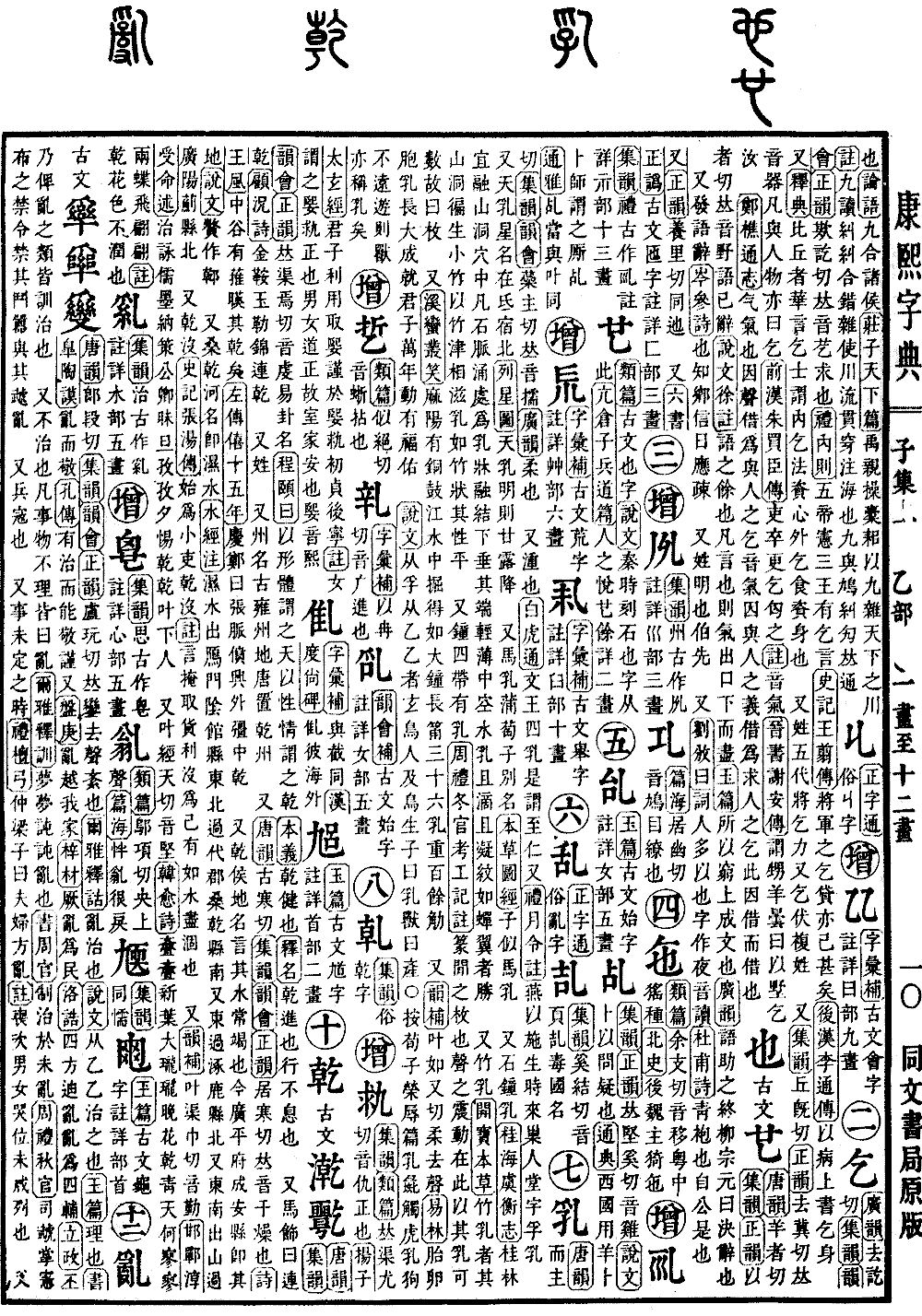
Yin Collection, Lower Volume
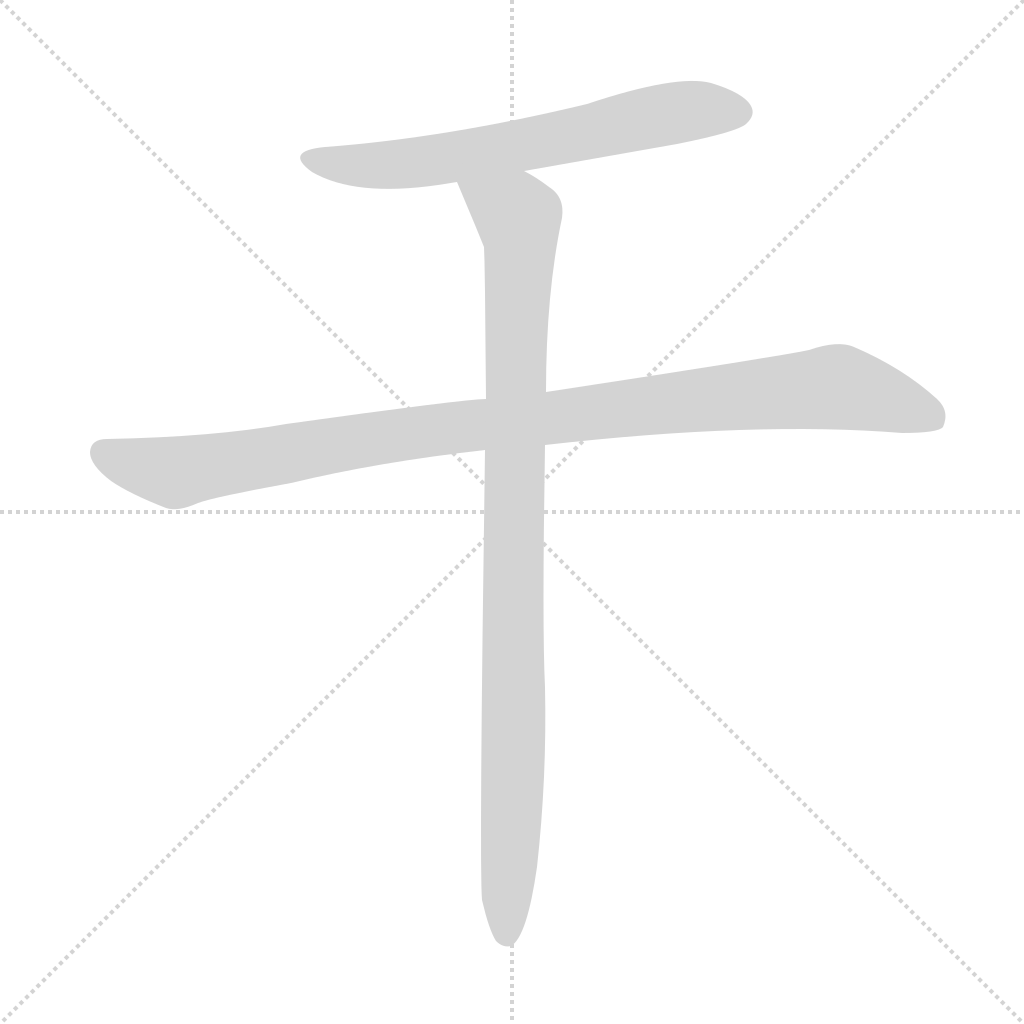
Radical: Shield (gān)
Page 84, Entry 03
Pronounced gān.
As defined in the Shuowen Jiezi (Shuowen): to offend.
As in the Zuo Commentary on the Spring and Autumn Annals (Zuo Zhuan): How dare one offend against grand rituals and bring punishment upon oneself.
As in the History of the Jin Dynasty (Jin Shu): Unexpectedly offending one another, one can be reconciled by reason.
Also: to seek.
As in the Book of Documents (Shujing): Do not violate the Way in order to seek the praise of the people.
As in the Analects of Confucius (Lunyu): Zizhang studied to seek an official salary.
Also: a shield.
As in the Fangyan: Shield (dun), from the pass to the east, is sometimes called shield-branch, or sometimes shield (gan); west of the pass, it is called a shield.
As in the Book of Documents (Shujing): Dancing with shields and feathers on the two steps.
As in the Book of Odes (Shijing): Shields and spears, axes and halberds.
Also: Sigan, a title of an official.
As in the Rites of Zhou (Zhouli): The Sigan is in charge of dance instruments.
Also: to defend.
As in the Book of Odes (Shijing): Feudal lords are the shields and walls.
Also: a mountain stream.
As in the Book of Odes (Shijing): Flowing is this stream.
Also: a riverbank.
As in the Classic of Changes (Yijing): The wild swan gradually advances to the riverbank.
As in the Book of Odes (Shijing): Place it on the bank of the river.
Also: the outskirts of a state.
As in the Book of Odes (Shijing): Departing to sleep on the outskirts.
Also: an uncertain quantity, meaning how many.
As in the Book of Rites (Liji): When asked the age of the Son of Heaven, the reply was: I heard when he first wore robes he was several feet tall.
As in the Book of Han (Hanshu): Or using light coins, each adding a certain amount.
Also: from jia to gui are the Heavenly Stems (tiangan).
As in the Huangji Jingshi: The ten stems represent Heaven; the twelve branches represent Earth.
Also: langan, the appearance of being horizontal or slanted.
As in the Gulaofu: The moon sets, the stars cross, and the Big Dipper is slanted.
Also: a railing (often written as langan).
As in the poems of Li Bai: Leaning on the railing north of the Chenxiang Pavilion.
Also: the eye socket.
Also: the appearance of tears flowing.
Also: a plant, a type of ramie.
As in the History of the Later Han (Hou Hanshu): Fine ramie cloth, woven with patterns like damask or silk.
Also: Ganjiang, the name of a sword.
As in the Wu Yue Chunqiu: Ganjiang was a man of Wu.
Also: Ganzhe, the name of a musical piece.
As in the Zixu Fu: The Ganzhe of Huainan.
Also: shegan, the name of a tree.
As in the Xunzi: In the west there is a tree called shegan.
Also: a grass name.
As in the Bencao Tujing: The shegan has white flowers and long stems, resembling an archer holding a bow.
Also: the name of a beast.
As in the Zixu Fu: Leaping far, the shegan. (Note: The shegan resembles a fox and can climb trees.)
Also: yegan, also the name of a beast.
As in the Lotus Sutra (Fahuajing): The yegan, with a thin body and no eyes, is plucked and thrown by children, suffering various pains.
Also: Fagan, Langan, Yugan, names of counties.
As in the History of the Later Han (Hou Hanshu): Dong Commandery had Fagan County; Hanyang Commandery had Langan County.
Also: Changgan, a place name.
As in the Wu Du Fu: Changgan extends continuously.
Also: a surname.
As in the Zuo Commentary on the Spring and Autumn Annals (Zuo Zhuan): In Song, there was Gan Chou.
Also: Duangan and Ganji, compound surnames.
As in the Records of the Grand Historian (Shiji): Laozi's son was named Zong; he served as a general for Wei and was enfeoffed in Duangan.
Pronounced gàn.
To defend. (As read by Shen Zhong).
Pronounced hán.
A state name.
As in the Huainanzi: Jing had a warrior named Cifei who obtained a precious sword in the state of Gan.
Also: commonly used as a variant for jian (to deceive/illicit).
As in the Book of Han (Hanshu): Frequently illicit of the death penalty.
Also: commonly used as a variant for gan (to interfere).
As in the History of the Tang Dynasty (Tang Shu): Do not interfere in current affairs.
Also: commonly used as a variant for gan (a pole).
As in the History of the Later Han (Hou Hanshu): Riding a carriage with green covers; people of the time called it a pole-rubbing carriage.
Also: interchangeable with gan (a rock).
Also: interchangeable with yan (a target).
Also: in ancient times, interchangeable with gan (dry).
As in the Chuyue Tie: Pale and suffocated, dry retching. Yang Shen stated: Tan is the old word for thin liquid; gan is the old word for dry/wet. Writing it as tan (phlegm) and gan (dry) today is incorrect.
Also: rhymes with jian (pronounced jiān).
As in the Huangting Jing: Returning purple and embracing yellow, entering the cinnabar field; rinsing and swallowing the spiritual fluid, the disaster does not dry up.