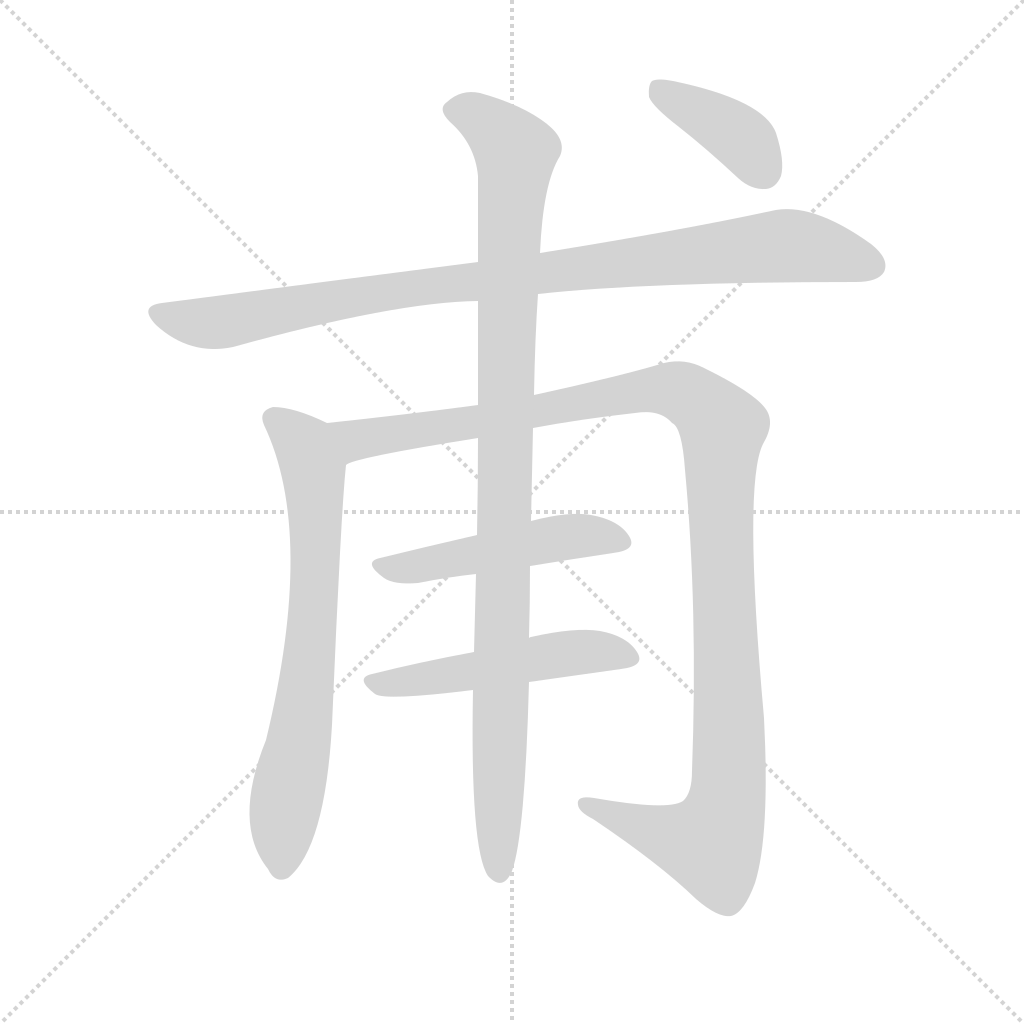
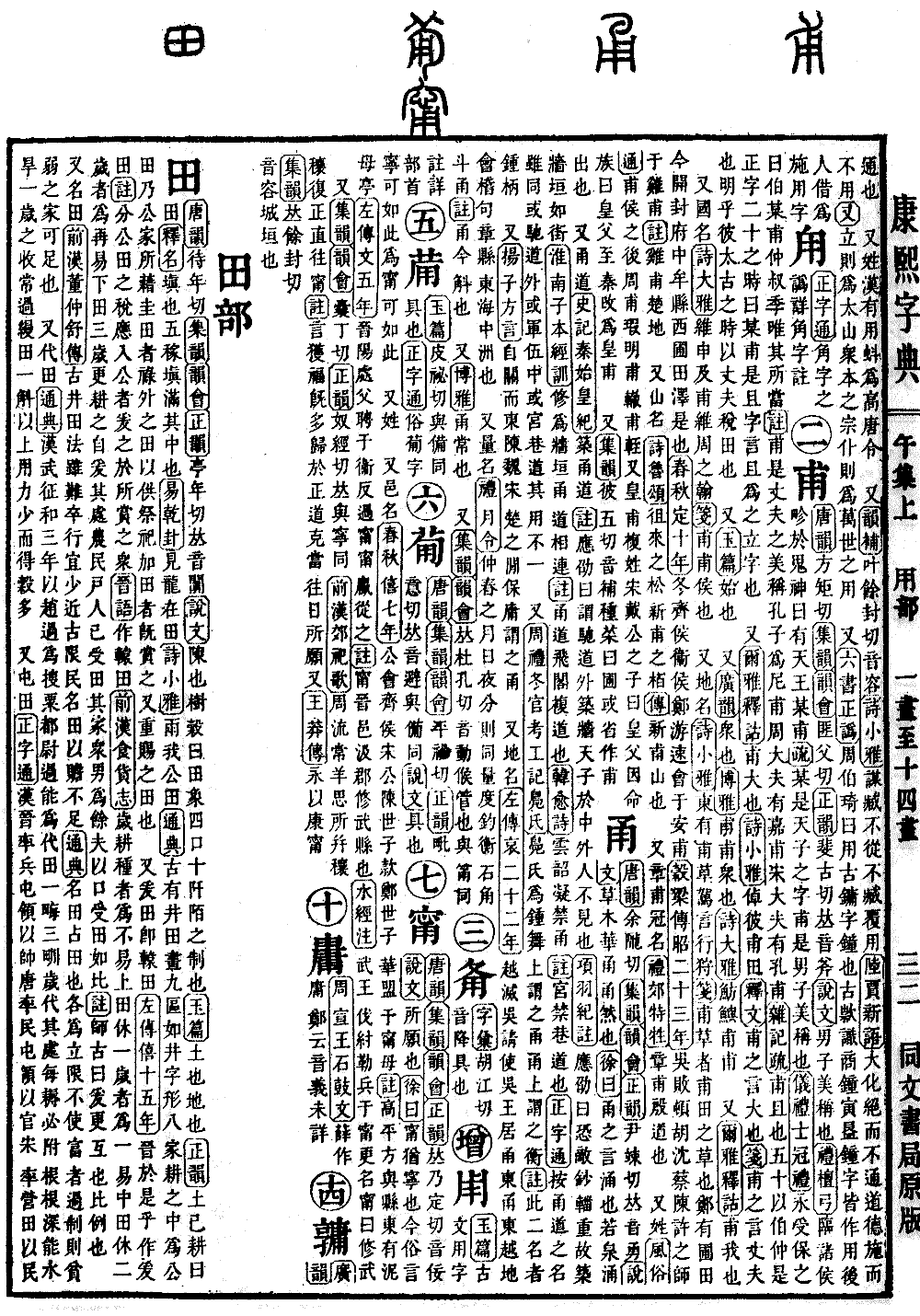
Wu Collection, Upper Volume
Radical: Use (yòng)
Kangxi Strokes: 7
Page 756, Entry 02
Pronounced fu (falling tone).
Shuowen Jiezi (Explanation of Words and Phrases): An honorific title for men.
Book of Rites (Liji), Tan Gong: When approaching the feudal lords at the borders to address the spirits, one says, "The Son of Heaven, So-and-so Fu." Commentary: "So-and-so" is the name of the Son of Heaven, and "Fu" is an honorific title for men.
Book of Etiquette and Ceremonial (Yili), Guanli (Coming of Age Ceremony): "May you long preserve this," saying "Bo So-and-so Fu," "Zhong," "Shu," "Ji," depending on their order. Commentary: "Fu" is an honorific title for husbands. Confucius was called Ni Fu; a Zhou dynasty official was called Jia Fu; a Song dynasty official was called Kong Fu.
Zaji Shu (Commentary on Miscellaneous Records): "Fu" means "also." At fifty, one uses Bo, Zhong, etc., which is the formal name. At twenty, one is called "So-and-so Fu," which uses the "also" character, meaning it is also used to establish a name.
Also, Erya (Approaching Elegance), Interpretation of Words: "Fu" means great.
Book of Odes (Shijing), Xiaoya: "Great are those vast fields." Commentary: "Fu fields" refers to fields throughout the realm. Commentary: "Fu" means husband. It refers to how in ancient times, husbands were taxed on their fields.
Also, Yupian (Jade Chapters): Means "to begin."
Also, Guangyun (Broad Rhymes): Means "many."
Also, Guanya (Broad Refinements): "Fu-fu" means many.
Book of Odes (Shijing), Daya: "The bream and the rudd are many."
Also, Erya (Approaching Elegance), Interpretation of Words: "Fu" means "I."
Also, the name of a state. Book of Odes (Shijing), Daya: "The states of Shen and Fu are the pillars of Zhou." Commentary: "Fu" are the marquises.
Also, a place name. Book of Odes (Shijing), Xiaoya: "In the east are the Fu grasses, I yoke my carriage for the hunt." Commentary: "Fu grass" refers to the grass of the Fu fields. Zheng had a Pu field; today it is the Pu field marsh west of Zhongmu County in Kaifeng Prefecture.
Spring and Autumn Annals (Chunqiu), Tenth Year of Duke Ding: In winter, the Marquis of Qi, the Marquis of Wei, and the Zheng official You Su met at Anfu.
Guliang Zhuan (Guliang's Commentary), Twenty-third Year of Duke Zhao: Wu defeated the armies of Dun, Hu, Shen, Cai, and Xu at Jifu. Commentary: Jifu is a place in the state of Chu.
Also, a mountain name. Book of Odes (Shijing), Lusong: "The pines of Culai, the cypresses of Xinfu." Commentary: "Xinfu" is a mountain.
Also, Zhangfu, a type of cap. Book of Rites (Liji), Jiaotesheng: The Zhangfu cap follows the way of the Yin dynasty.
Also, a surname. Fengsu Tong (Customs and Traditions): Descendants of the Marquis of Fu. Zhou official Fu Xia, Ming official Fu Zhe, Fu Zhi.
Also, Huangfu, a compound surname. A son of Duke Dai of Song was called Huangfu, and his clan was thus named Huangfu. During the Qin dynasty, it was changed to Huangfu.
Also, pronounced bu (falling tone). Planting vegetables is called pu, sometimes abbreviated as fu.