Wei Collection, Lower Volume
Radical: Sheep (yáng)
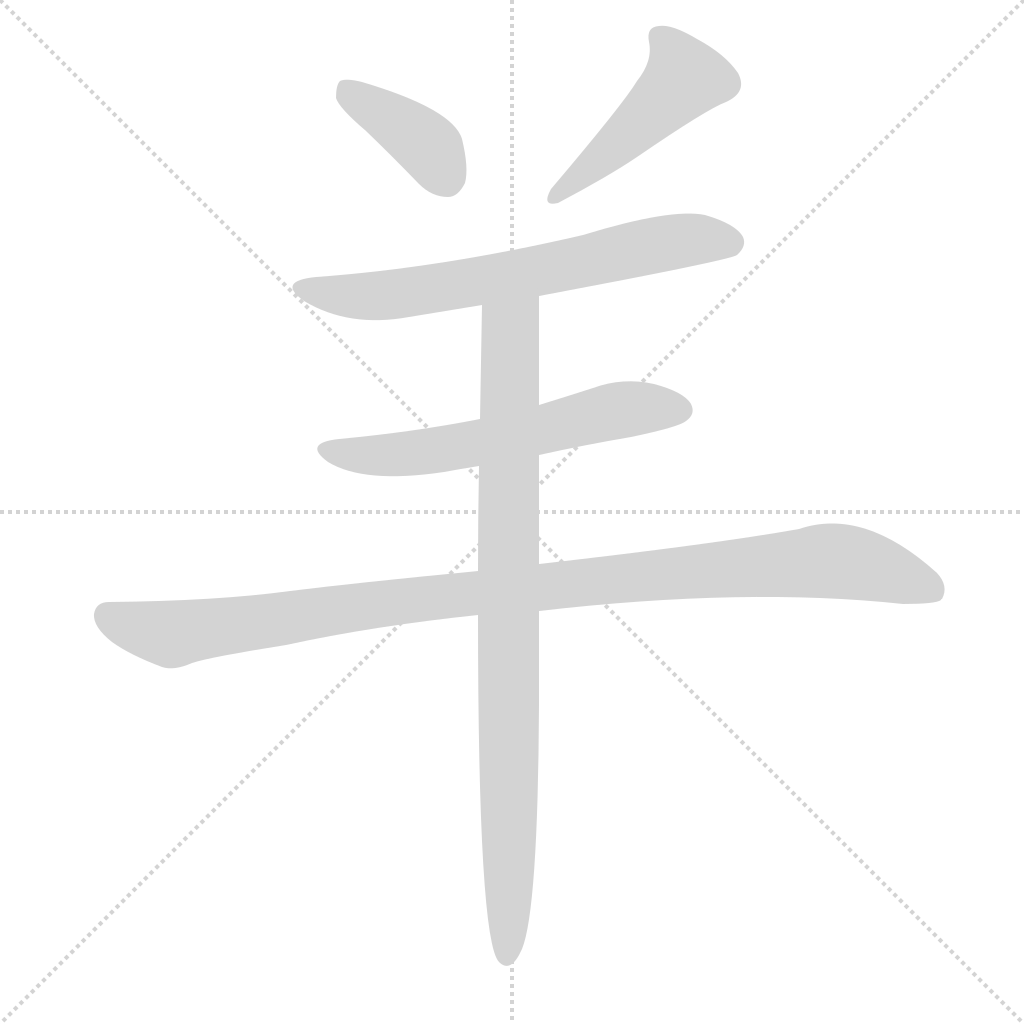
Sheep
Kangxi strokes: 6
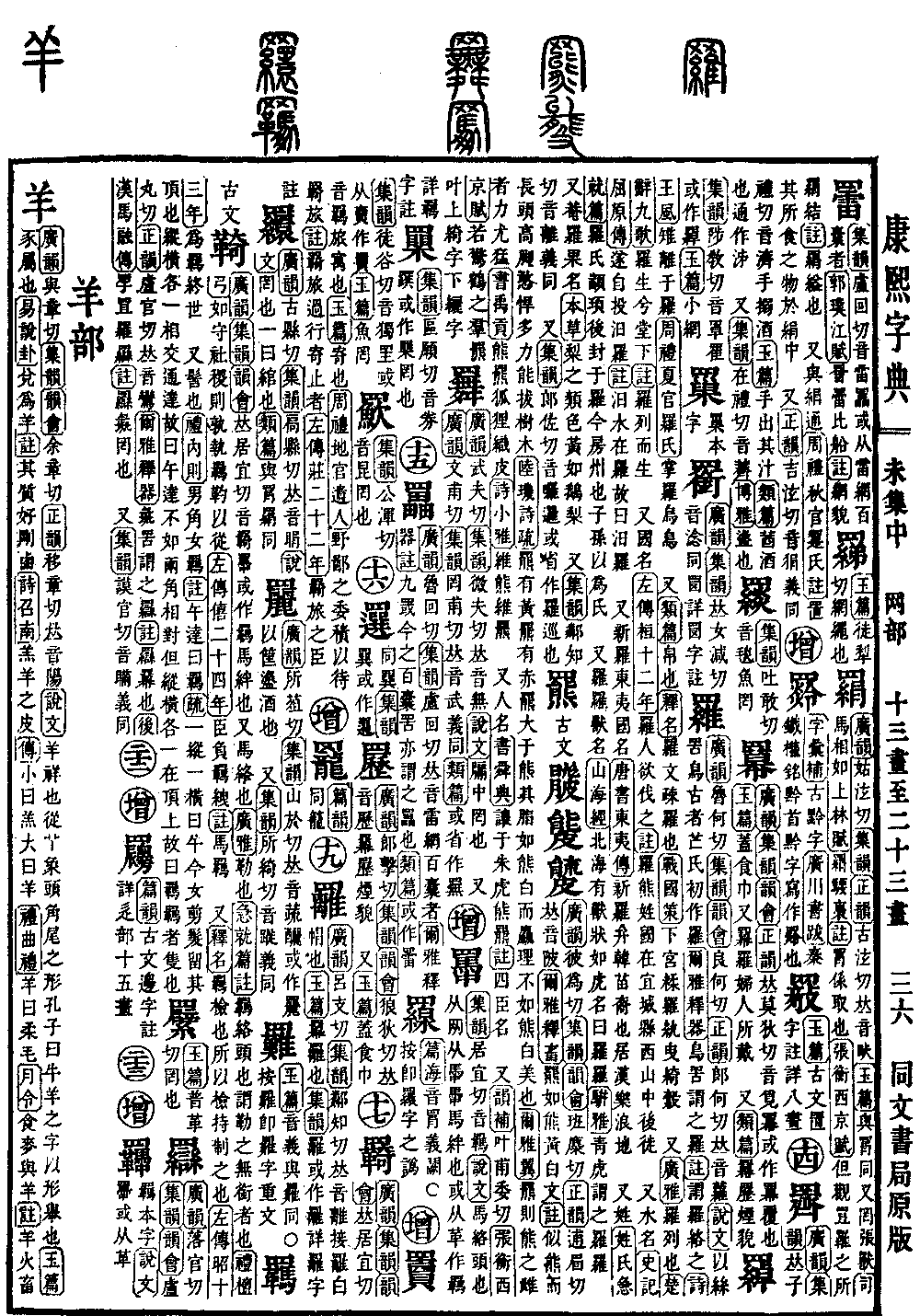
Page 950, Entry 38
Pronounced yang.
According to the Explaining Graphs and Analyzing Characters (Shuowen Jiezi), sheep is associated with auspiciousness. It is derived from the representation of the head, horns, and tail. Confucius said: The characters for ox and sheep are descriptive of their physical forms.
According to the Jade Chapters (Yupian), it belongs to the swine family.
In the Book of Changes (Yijing), regarding the Discussion of Trigrams (Shuogua), it states that the Dui trigram represents the sheep. The commentary notes that its nature is fond of harsh, saline environments.
In the Book of Odes (Shijing), in the section regarding the Shao South, it mentions the skin of a lamb. The commentary states that the young are called lambs, and the mature are called sheep.
In the Book of Rites (Liji), in the section regarding the Summary of Rules of Proper Conduct, it refers to the sheep as a soft-haired animal. In the section regarding the Monthly Ordinances, it mentions consuming wheat and sheep. The commentary notes that the sheep is an animal of the fire element. As the season is still cold, consuming it harmonizes the constitution.
Also, it refers to the mountain sheep. In the Erya, a lexicon on animals, it states that the mountain sheep is a large sheep. The commentary notes that it resembles a sheep but is larger, with round, sharp horns, and it likes to reside among mountain cliffs.
Also, it is the name of a bird. In the School Sayings of Confucius (Kongzi Jiayu), it is recorded that in the state of Qi, a one-legged bird flew and landed in the royal court. The ruler of Qi sent an envoy to ask Confucius about it, and Confucius said: This bird is called the Shangyang, and it is a harbinger of rain.
Also, it is a surname. In the Zuo Tradition (Zuo Zhuan), second year of Duke Min, it mentions the grandee Yangshe. The commentary notes that Yangshe is a clan name. In the commentary on the Gongyang Tradition (Gongyang Zhuan), it mentions Zixia passing down the tradition to Gongyang Gao. In the Records of the Grand Historian (Shiji), in the biography of Prince Xiao of Liang, it mentions Yang Sheng of Qi.
Also, it refers to an official title. In the Rites of Zhou (Zhou Li), section on the Summer Office, the commentary on the shepherd official notes that the sheep belongs to the fire element of the south, and since the Minister of War is the fire official, it is placed here.
Also, White Sheep is the name of a Xiongnu state. In the Records of the Grand Historian, in the biography of the Xiongnu, it mentions the annexation of the Loufan, the White Sheep, and the lands south of the Yellow River.
Also, in the Book of Han (Qianhan Shu), section on Rites and Music, it mentions flying together in a leisurely manner. The commentary notes that it means to roam freely. In the Lament (Lisao) by Qu Yuan, it mentions roaming about freely. The commentary notes that both expressions signify wandering or roaming.