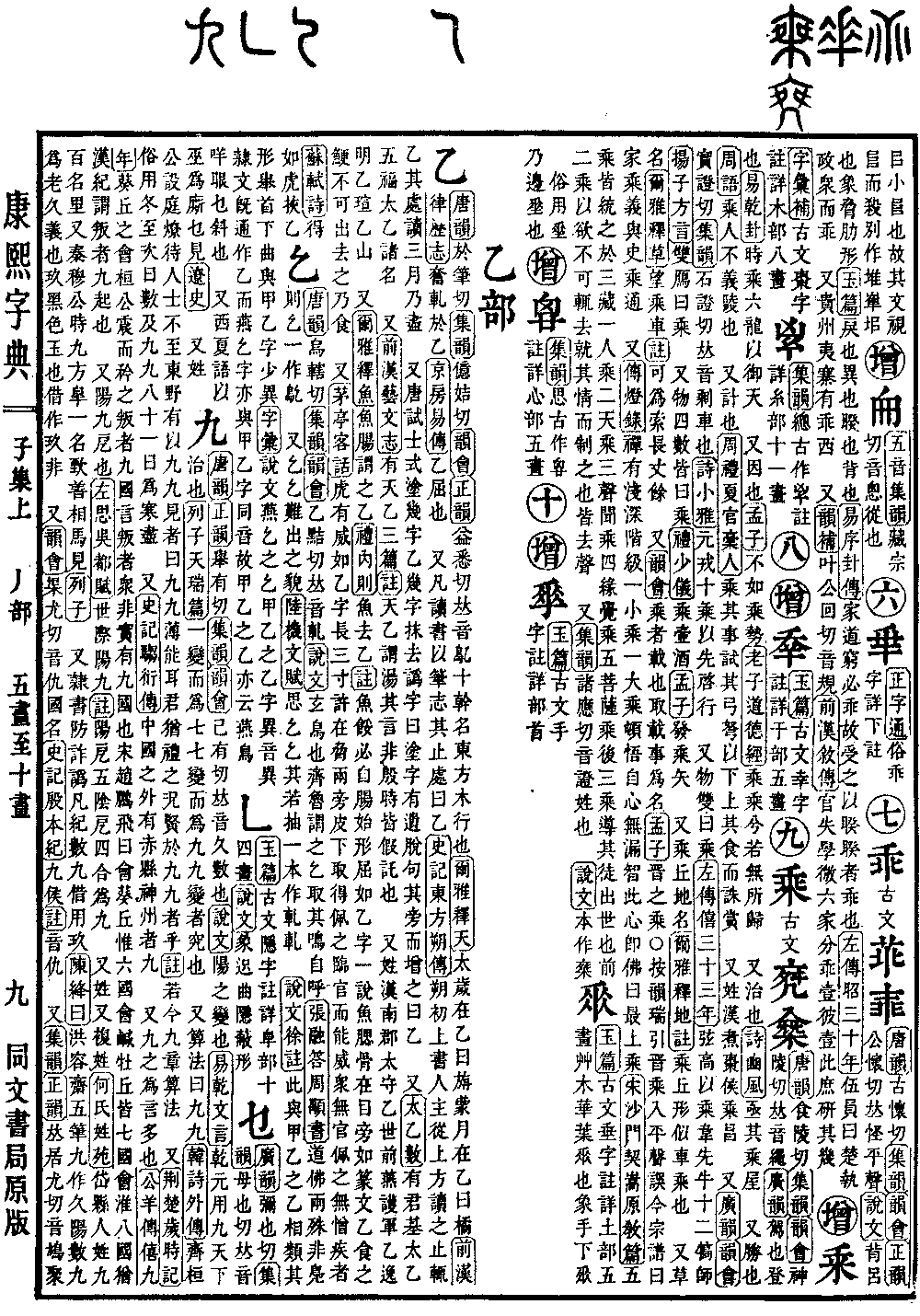
Zi Collection, Page Position: Upper
Radical: Second (yǐ)
Yi
Kangxi Dictionary Stroke Count: 1
Page: 83, Entry: 15
In the Tang Rhymes (Tangyun), the phonetic notation is given as the initial of yu and the final of bi. In the Collected Rhymes (Jiyun), it is given as the initial of yi and the final of ji. In the Rhyme Assembly (Yunhui) and the Correct Rhymes (Zhengyun), it is given as the initial of yi and the final of xi. The pronunciation is similar to the word for swallow (yǐ). It is one of the Heavenly Stems, corresponding to the Wood element of the East.
Approaching the Refined (Erya): Explaining Heaven records that when the Great Year is in the position of Yi, the year is called Zhanmeng; when the month is in the position of Yi, it is called Ju.
The Book of the Former Han (Qian Hanshu): Treatise on Rhythm and the Calendar contains the phrase, Sprouting and struggling at the stage of Yi.
Jing Fang’s Commentary on the Book of Changes (Jing Fang Yi Zhuan) explains that Yi carries the meaning of bending or folding.
Furthermore, marking a pause while reading is called yi. The Records of the Grand Historian (Shiji): Biography of Dongfang Shuo records that when Dongfang Shuo first submitted a memorial to the throne, the Emperor used a pen to mark each pause as he read; it took three months to finish reading the entire document.
In the examination formats of the Tang Dynasty, erasing a mistake was called tu, and inserting missing words or phrases was called yi.
In the Calculations of the Great One (Taiyi Shu), there are names such as the Sovereign Foundation Great One and the Five Blessings Great One.
The Book of the Former Han: Treatise on Arts and Literature records three chapters titled Tianyi. The commentary states that Tianyi refers to King Tang of the Shang Dynasty, but the content was not actually written during the Yin-Shang period and is a pseudepigraphal work.
Yi is also a surname. During the Han Dynasty, there was Yi Shi, the Governor of Nanjun; during the Former Yan period, there was Yi Yi, a military protector; and during the Ming Dynasty, there were individuals such as Yi Xuan and Yi Shan.
Approaching the Refined: Explaining Fish states that fish intestines are called yi. The Book of Rites (Liji): Internal Regulations mentions removing the yi from the fish. The commentary explains that the spoilage of fish often begins in the intestines, and the shape of the intestines is curved like the character yi. Another theory suggests that yi refers to the gill bone located beside the eye, which is shaped like the seal script form of the character yi; because it easily gets stuck in the throat, it must be removed before the fish is eaten.
Guest Talk from the Thatched Pavilion (Maoting Kehua) records that beneath the flanks of a tiger, there are two bones about three inches long shaped like the character yi, known as majesty bones. Located under the skin, wearing them as an ornament can grant an official the authority to command respect, while those without office who wear them will not be hated or envied. A poem by Su Shi contains the line, Obtaining it is like a tiger clutching its yi bone.