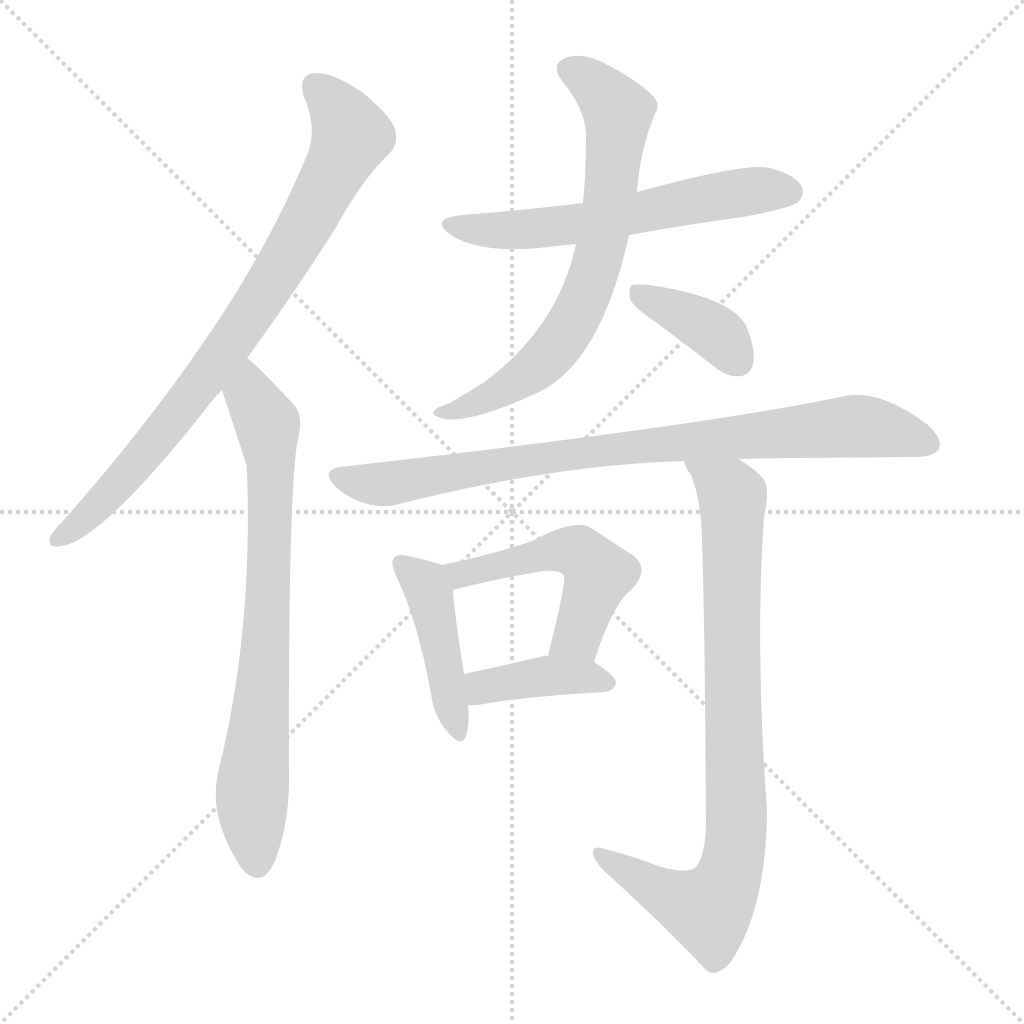
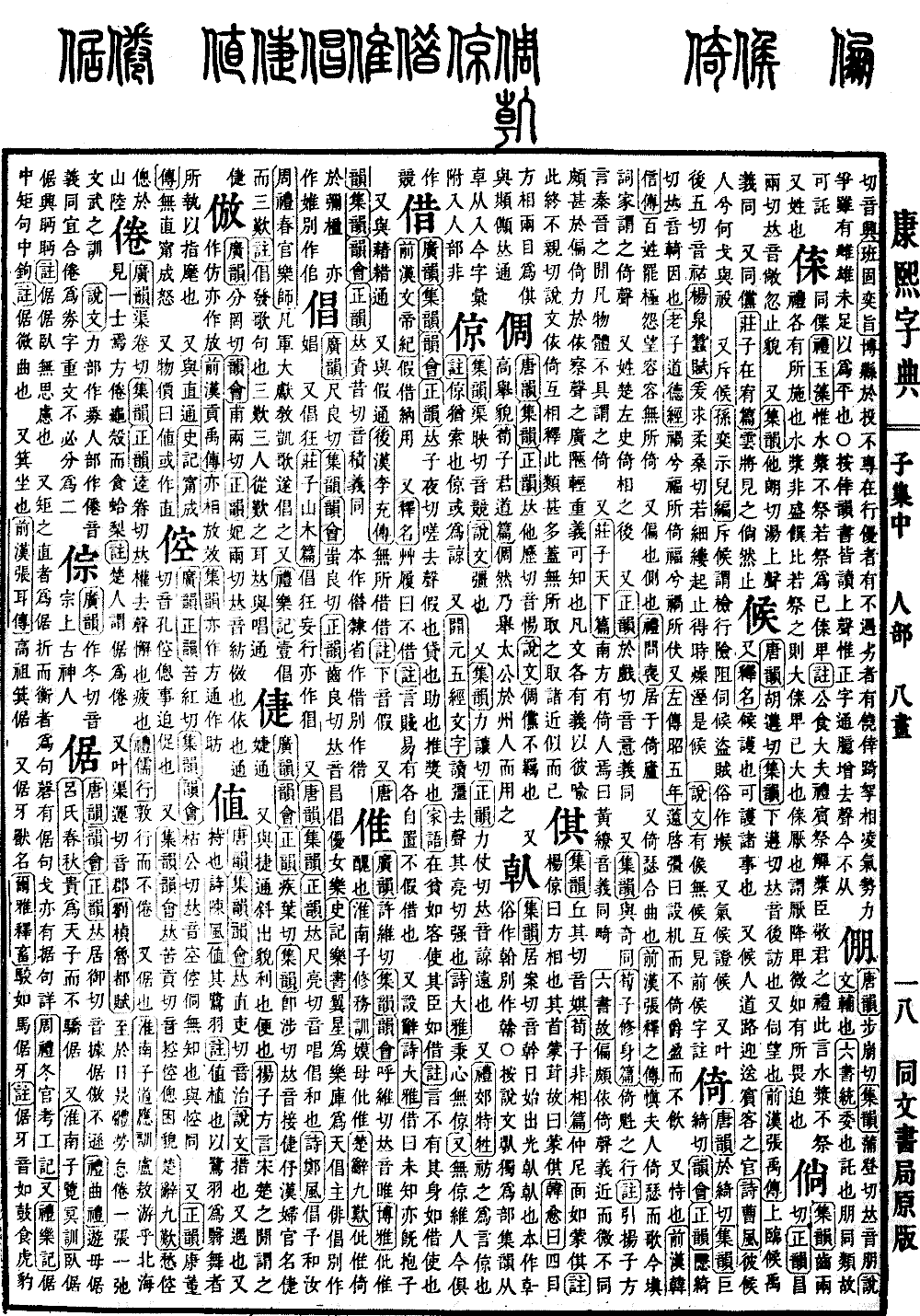
Zi Collection, Middle Volume
Radical: Person (rén)
Yǐ
Kangxi stroke count: 10
Page 108, Number 05
Tang Rhymes (Tangyun): yú qǐ qiè. Collected Rhymes (Jiyun): jù qǐ qiè. Rhyme Assembly (Yunhui) and Correct Rhymes (Zhengyun): yǐn qǐ qiè. Pronunciation is the same as the character yǐ. The meaning is to lean on or to rely upon.
Misfortune is that upon which fortune leans; fortune is that in which misfortune hides — Classic of the Way and Virtue (Daodejing).
Also, from the Zuo Commentary (Zuozhuan), Duke Zhao, Fifth Year, Wei Qiqiang said: To set out small tables without leaning on them, and to fill wine cups without drinking from them.
Also refers to relying on or depending upon.
The common people are exhausted to the extreme, harboring resentment in their hearts, and are anxious and uneasy with nothing to rely on — History of the Former Han (Qian Han Shu), Biography of Han Xin.
Also refers to being slanted or tilted.
Living in a mourning hut (yǐlú), a simple shack used during mourning — Book of Rites (Liji), Questions on Mourning (Wensang).
Also yǐ sè, which refers to singing in accompaniment to the melodies of the se zither.
Lady Shen sang in accompaniment to the zither — History of the Former Han (Qian Han Shu), Biography of Zhang Shizhi. Today, writers of lyrics refer to this as yǐ shēng (writing lyrics to fit an existing melody).
Also a surname. Derived from the descendants of Yixiang, the Scribe of the Left of the state of Chu.
Also, in the Correct Rhymes: yú xì qiè. Pronunciation is the same as the character yì. The meaning is the same.
Also, in the Collected Rhymes: same as the character qí (odd or extraordinary).
Conduct that is odd and extraordinary — Xunzi (Xunzi), Self-Cultivation (Xiushen). The commentary cites Regional Words (Fangyan) by Yang Zi: In the region between the states of Qin and Jin, any object that is incomplete is called yǐ.
Also, from the Zhuangzi (Zhuangzi), The World (Tianxia): In the south there was an extraordinary man named Huang Liao. The pronunciation and meaning are the same as the character jī (unconventional).
Explanation of the Six Scripts (Liushu Gu): Bias and leaning, the sounds and meanings are similar but slightly different. Bias (pō) is more severe than being slanted (piān), and leaning with force (yǐ) is stronger than simply relying on something (yī). By examining the breadth and weight of the sounds, the meanings can be understood. Every character has its own specific meaning; using one to illustrate another is ultimately not precise enough. The Analytical Dictionary of Characters (Shuowen Jiezi) uses the character yī (to rely) to explain yǐ (to lean) and uses yǐ to explain yī. There are many such cases, likely because there were no better explanations available, so similar meanings were selected.