Xu Collection, Upper Volume
Radical: Gate (mén)
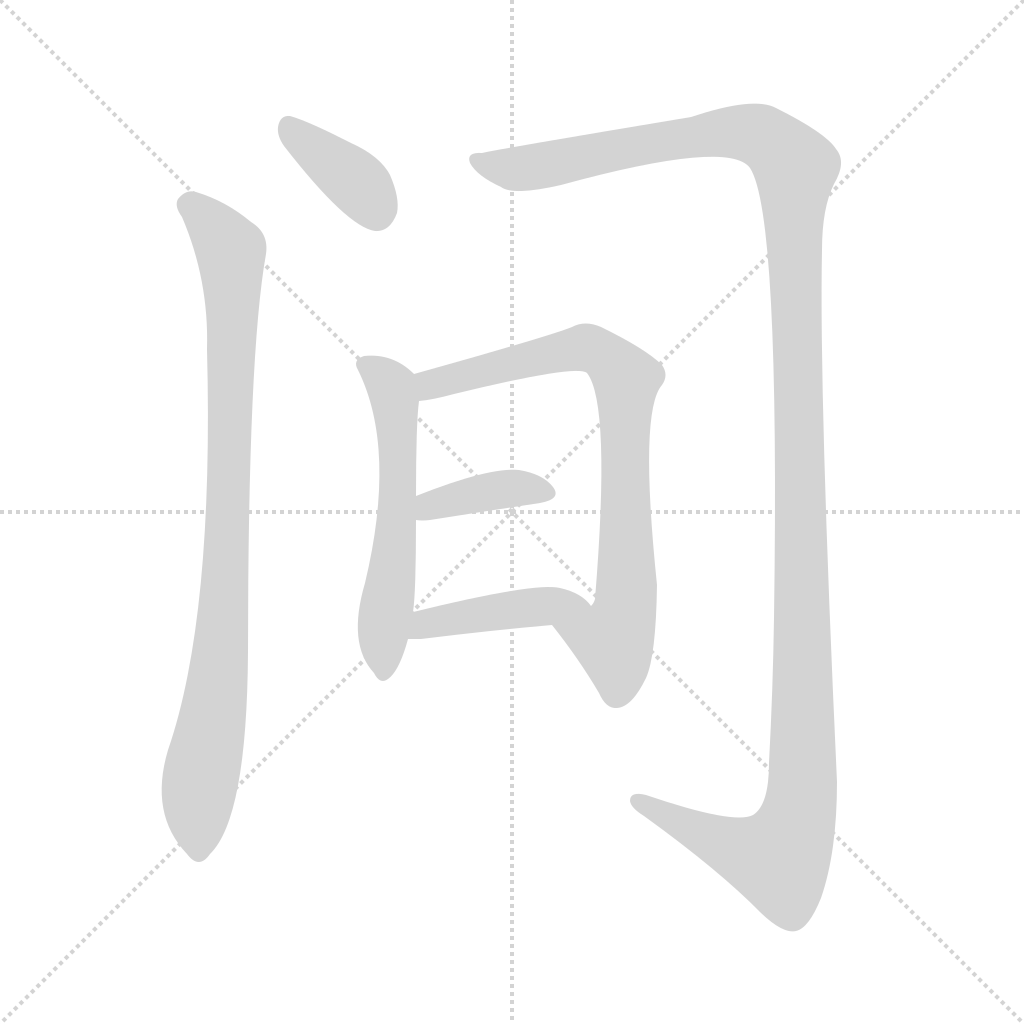
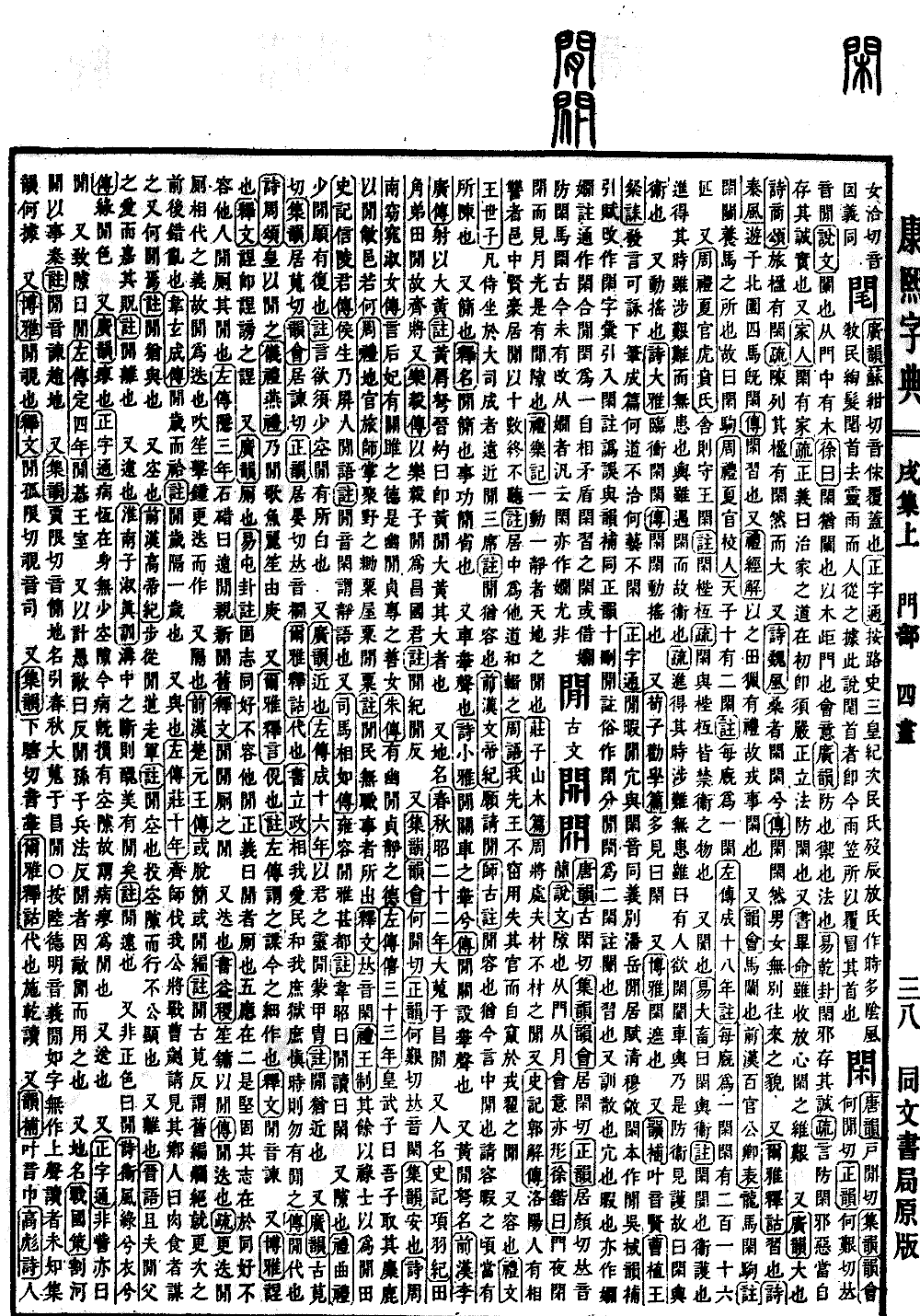
閒; Kangxi dictionary stroke count: 12; Page 1332
Ancient form. Pronounced jian.
Shuowen Jiezi (Shuowen): A gap. Composed of the radicals for gate and moon. An associative compound, also representing form.
Xu Kai stated: Gates are closed at night. When closed, one sees the moonlight; this is a gap.
Book of Rites (Liji), Record of Music (Yueji): That which is one movement and one stillness is the gap between heaven and earth.
Zhuangzi, Mountain Tree Chapter (Shanmu Pian): Zhou will dwell between the useful and the useless.
Records of the Grand Historian (Shiji), Biography of Guo Jie: In Luoyang, there were those who held vendettas against one another. The virtuous and powerful of the city stayed in the middle (the gap) by the tens, and in the end, they did not listen.
Annotation: Staying in the middle to reconcile them.
Discourses of the States (Zhouyu): Our former king, Buju, lost his office and dwelt between the Rong and Di tribes.
Also means capacity.
Book of Rites (Liji), Records of the Hereditary Princes (Wenwang Shizi): Whoever waits to be seated at the Great Minister of Instruction, those far and near take three mats of space.
Annotation: The term for gap also means capacity.
Book of Han (Qianhan), Annals of Emperor Wen: I wish to request a moment of leisure.
Shigu Annotation: The term for gap means capacity. It is like saying middle time today. It means requesting a moment of spare time to have something to say.
Also means to rest.
Shiming: The term for gap means to rest. It means the work is reduced.
Also refers to the sound of a carriage.
Book of Odes (Shijing), Lesser Odes (Xiaoya): The sound of the carriage is rhythmic (jianguan).
Commentary: Jianguan is the sound of the carriage settings.
Also Yellow Jian, a type of crossbow.
Book of Han (Qianhan), Biography of Li Guang: Shot with the Great Yellow.
Annotation: Yellow shoulder crossbow. Jin Zhuo said: It is the Yellow Jian; the Great Yellow is its larger version.
Also a place name.
Spring and Autumn Annals (Chunqiu), Duke Zhao, 22nd Year: A great military review at Changjian.
Also a personal name.
Records of the Grand Historian (Shiji), Chronicle of Xiang Yu: Tian Jian, younger brother of Tian Jiao, was a former general of Qi.
Also, Records of the Grand Historian (Shiji), Biography of Yue Yi: Made Yue Yi's son, Jian, the Lord of Changguo.
Annotation: Pronounced jian.
Also pronounced xian.
Guangyun: To be peaceful.
Book of Odes (Shijing), Zhou Nan: It says the queen consort had the virtue of the osprey, a good woman who was quiet, virtuous, and focused.
Zhu's Commentary: Possessing the virtue of being quiet, virtuous, and steady.
Zuo Tradition (Zuozhuan), Duke Xi, 33rd Year: Huang Wuzi said: If you, my son, take their deer to provide for our humble state, how would that be?
Rites of Zhou (Zhouli), Earth Office, Travelers' Master: In charge of gathering the gathered grain, shed grain, and spare grain of the wilderness.
Annotation: Spare grain refers to that produced by people without official duties.
Explanation of Characters (Shiwen): Pronounced xian.
Book of Rites (Liji), Royal Regulations (Wangzhi): The remainder is used to pay the scholars and to serve as spare fields.
Records of the Grand Historian (Shiji), Biography of Lord Xinling: Hou Sheng then screened off others to speak in private.
Annotation: Pronounced xian. It means quiet speech.
Also, Records of the Grand Historian (Shiji), Biography of Sima Xiangru: Modest, quiet, and elegant, very refined.
Annotation: Wei Zhao said: Read as xian.
Also means to wait.
Book of Rites (Liji), Quli: A little later, I wish to report something.
Annotation: It means wishing to wait for a moment of free time to have something to say.
Also Guangyun: To be near.
Zuo Tradition (Zuozhuan), Duke Cheng, 16th Year: By the spirit of the ruler, I have come near to wearing armor.
Annotation: Means near.
Also Guangyun: Pronounced jian.
Erya, Explaining Words (Shigu): To substitute.
Book of Documents (Shujing), Establishing Government (Lizheng): Observe the people I have received, harmonize the many lawsuits and many officials, and do not allow any to interfere.
Commentary: Means to substitute.
Book of Odes (Shijing), Zhou Eulogies (Zhou Song): The Emperor used this to replace it.
Ceremonial and Ritual (Yili), Yanli: Then they performed the song Yuli alternately, and the sheng played Yougeng.
Also Erya, Explaining Speech (Shiyan): To spy.
Annotation: Zuo Tradition calls this espionage. They are the spies of today.
Explanation of Characters (Shiwen): Pronounced jian.
Also Boya: To slander.
Explanation of Characters (Shiwen): It is to slander.
Also Guangyun: To alternate.
I Ching (Yi), Tun Hexagram Annotation: To hold fast to one's will and be of the same heart, not allowing others to interfere.
Commentary: The term for gap means to alternate. The fifth line responds to the second; this is to firm up one's will to be of the same heart, not allowing others to interfere or intrude in that space.
Zuo Tradition (Zuozhuan), Duke Yin, 3rd Year: Shi Qu said: To alienate the distant and favor the close, to favor the new and alienate the old.
Explanation of Characters (Shiwen): Pronounced as the gap of alternation.
Also to alternate (die).
Book of Documents (Shujing), Yiji: The sheng and zhong bells performed alternately.
Commentary: Means to alternate.
Sub-commentary: To alternate and shift, the meaning of replacing one another, so it means to alternate. Blowing the sheng and striking the bells, they perform in turns.
Also to separate.
Book of Han (Qianhan), Biography of King Yuan of Chu: Some came loose, or the bindings were separated.
Annotation: Pronounced jian. Refers to old bindings being frayed and broken, so they were replaced in turn, becoming disordered front and back.
Biography of Wei Cheng: The sacrificial assembly was held every other year.
Annotation: Every other year means skipping a year.
Also to participate.
Zuo Tradition (Zuozhuan), Duke Zhuang, 10th Year: The Qi army attacked us, the Duke was about to fight, Cao Gui asked to see him, and his fellow villagers said: Those who eat meat are planning this, why do you participate?
Annotation: Means to participate.
Also empty.
Book of Han (Qianhan), Annals of Emperor Gaozu: The infantry followed an empty path to reach the army.
Annotation: Means empty. Entering the empty and moving, not publicly or openly.
Also to distance.
Discourses of Jin (Jinyu): Moreover, to alienate a father's love and praise his gifts.
Annotation: Means to distance.
Also far.
Huainanzi, Treatise on Truth (Chuzhen Xun): In the fracture of a ditch, there is a gap between ugly and beautiful.
Annotation: Means far.
Also non-standard color is called jian.
Book of Odes (Shijing), Wei Feng: Green is a non-standard color.
Also Guangyun: To recover from illness.
Zhengzitong: Illness is usually in the body, without a moment of emptiness; now that the illness has subsided, there is emptiness, hence recovery from illness is called jian.
Also to send off.
Also Zhengzitong: To slander is also called jian.
Also to cause is called jian.
Zuo Tradition (Zuozhuan), Duke Ding, 4th Year: To interfere with the royal house.
Also, using a strategy to deceive the enemy is called counter-espionage (fan jian). Sun Tzu's Art of War: Counter-espionage means using the enemy's own spies.
Also a place name.
Strategies of the Warring States (Zhanguo Ce): Ceding Hexian to serve Qin.
Annotation: Pronounced jian. A territory of Zhao.
Also Jixian, pronounced . A place name. Citing the Spring and Autumn Annals: A great military review at Changjian.
Note: According to Lu Deming's Sound and Meaning, the character is read as it appears, with no reading in the rising tone. It is unknown on what the Jixian bases its claim.
Also Boya: To peer.
Explanation of Characters (Shiwen): Pronounced si.
Also Jixian, pronounced .
Erya, Explaining Words (Shigu): To substitute. Read as shi-qian.
Also Rhyme Supplement (Yunbu): Rhymes with jin.
Gao Biao's Poem: People have strategies, six tricks and five intervals. Putting these three matters together, consult the plans.
Textual correction: Book of Documents (Shujing), Establishing Government: Observe the people I have loved... the original text "love the people" should be corrected to "received the people."
Textual correction: Huainanzi, Treatise on Truth: The original text "Shuzhen Xun" should be corrected to "Chuzhen Xun."
Textual correction: Zuo Tradition (Zuozhuan), Duke Ding, 4th Year: The original text "interfere in the royal house" should be corrected to "interfere with the royal house."
Page 1332, Entry 01