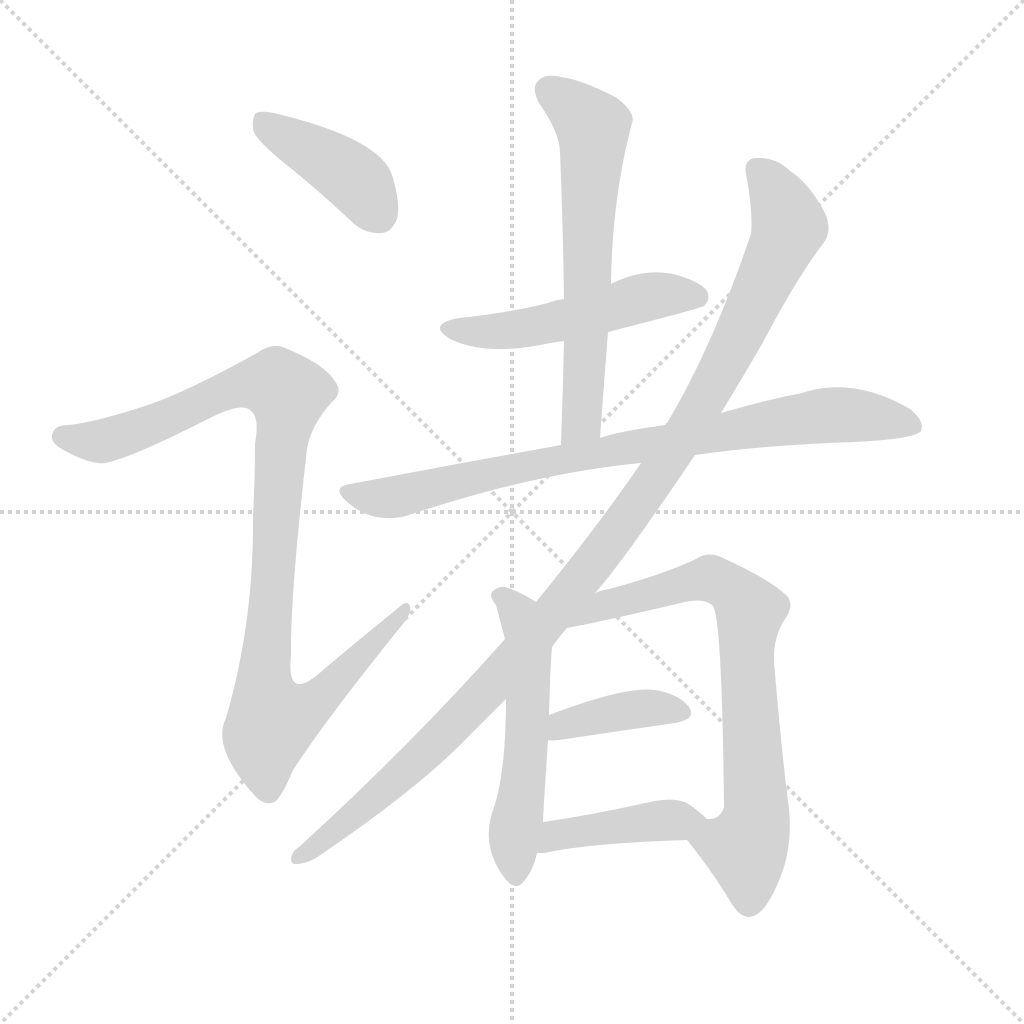
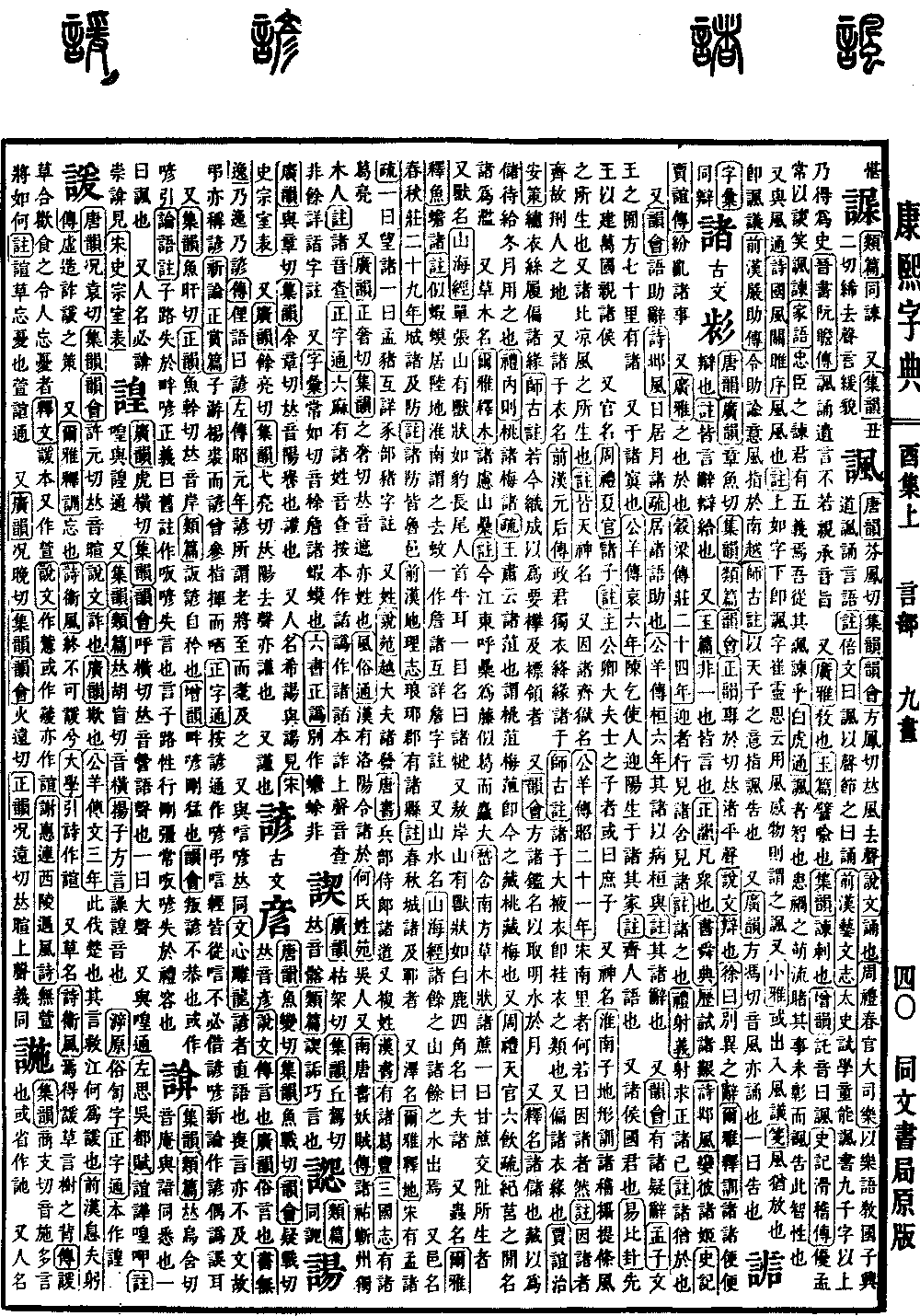
You Collection, Upper Volume. Radical: Speech (yán). Page 1172, Entry 01.
Pronounced zhu (level tone).
Defined as to argue or debate.
Xu Shen remarks: A term used to indicate distinction.
Book of Rites (Er-ya), Interpretations of Teachings: Zhuzhu, bianbian means to argue. Commentary: Both indicate readiness and fluency in speech.
Also defined as not one, meaning all, and as a particle for speech.
Zheng Yun: Indicates a multitude.
Book of Documents (Shu), Canon of Shun: To test them through all kinds of hardship.
Book of Odes (Shijing), Bei Feng: Lovely are those ladies of the house of Ji.
Records of the Grand Historian (Shiji), Biography of Jia Yi: Chaotic are these various affairs.
Also defined as at or in.
Gongyang Commentary, Zhuang Year 24: Those who welcome him see him at this place, those who lodge him see him at this place. Commentary: Zhu means in.
Book of Rites, Meaning of Archery: In archery, seek to rectify it in oneself. Commentary: Zhu is equivalent to at.
Also a particle for discourse.
Book of Odes, Bei Feng: Oh sun, oh moon. Commentary: Ju and zhu are particles for discourse.
Gongyang Commentary, Huan Year 6: Perhaps it is because of the illness of Duke Huan. Commentary: Qi zhu is a particle.
Also used to express doubt.
Mencius: King Wen had a park seventy miles square, is this so?
Also, to place or deposit.
Gongyang Commentary, Ai Year 6: Request that someone go to meet Yangsheng and place him at his home. Commentary: This is the dialect of the state of Qi.
Also, the feudal lords, rulers of states.
I Ching, Bi Hexagram: The former kings established ten thousand states and treated the feudal lords with affection.
Also a title for officials.
Rites of Zhou (Zhouli), Summer Offices: Various sons. Commentary: Those in charge of the sons of dukes, ministers, grandees, and scholars. Some say they are the sons of the commoners.
Also the names of gods.
Huainanzi, Treatise on Terrain: The god Zhuji Sheti is born from the rising of the eastern wind. Also Zhubi, born from the rising of the cool wind. Commentary: Both are names of celestial gods.
Also Yin-zhu, the name of a prison in the state of Qi.
Gongyang Commentary, Zhao Year 21: What is the Southern Li of Song like? Answer: It is like Yin-zhu. Commentary: Yin-zhu is an old location in the state of Qi.
Also Zhu-yu, the name of a garment.
Book of the Former Han (Hanshu), Biography of Empress Yuan: Zhengjun wore only a crimson-edged zhu-yu. Commentary by Yan Shigu: A zhu-yu is a large ceremonial robe, similar to a sleeveless jacket.
Also Pian-zhu, the hem of a garment.
Biography of Jia Yi: Wearing embroidered robes and silk shoes with pian-zhu hems. Commentary by Yan Shigu: Similar to what we now call woven borders, used for belts or collars.
Also a name for a mirror-like vessel used to collect dew from the moonlight.
Also interpreted as storage. Hidden away to be stored and used during the winter.
Book of Rites, Inner Teachings: Preserved peaches, preserved plums. Commentary: Wang Su says: Zhu means pickled. This refers to pickled peaches and plums, similar to what we now call preserved peaches and plums.
Also Rites of Zhou, Heaven Offices: Between the states of Ji and Ju, the term zhu is used to mean an overflow.
Also the names of plants.
Book of Rites, Interpretations of Woods: Zhulu is a type of mountain vine. Commentary: In the region east of the Yangtze River, this is called teng; it is similar to kudzu but coarser and larger.
Ji Han, Flora of the Southern Regions: Zhu-zhe is also known as sugarcane, which grows in Jiaozhi.
Also the names of beasts.
Classic of Mountains and Seas (Shanhaijing): On Danzhang Mountain there is a beast that looks like a leopard, with a long tail, a human head, cow ears, and one eye, named Zhujian. Also on Aogan Mountain there is a beast that looks like a white deer with four horns, named Fuzhu.
Also the name of an insect.
Book of Rites, Interpretations of Fish: A type of toad. Commentary: Resembles a frog, lives on land, in Huainan it is called qufu. Sometimes written as zhanzhu.
Also names of mountains and rivers.
Classic of Mountains and Seas: Zhuyu Mountain, where the Zhuyu River rises.
Also the name of a city.
Spring and Autumn Annals (Chunqiu), Zhuang Year 29: Fortified Zhu and Fang. Commentary: Zhu and Fang were both cities of the state of Lu.
Book of the Former Han, Treatise on Geography: Langya Commandery has Zhu County. Commentary: The Spring and Autumn Annals mentions the fortification of Zhu and Yun.
Also the name of a marsh.
Book of Rites, Interpretations of Lands: In the state of Song there is Mengzhu. Commentary: Another name is Wangzhu. Also written as Mengzhu.
Also a surname.
Shuoyuan: The Great Officer Zhu Fa of the state of Yue.
History of the Tang (Tangshu): Zhu Dao, Vice Minister of the Ministry of War.
Also a compound surname.
Book of the Former Han: Zhu Ge Feng.
Records of the Three Kingdoms: Zhu Ge Liang.
Also pronounced zhe (level tone).
Also a surname.
Fengsu Tong: During the Han dynasty, there was a Magistrate of Luoyang named Zhu Yu.
He Shi Xing Yuan: A person from the state of Wu.
History of the Southern Tang: Zhu You, from Dumu in Qizhou. Commentary: Zhu is pronounced cha.
Zhengzitong: In the Liu Ma rhyme group, there is the surname Zhu, pronounced cha. Note: The original character was written incorrectly as Zhu. The character that should have been used, originally meaning to deceive and pronounced cha, is not the same.