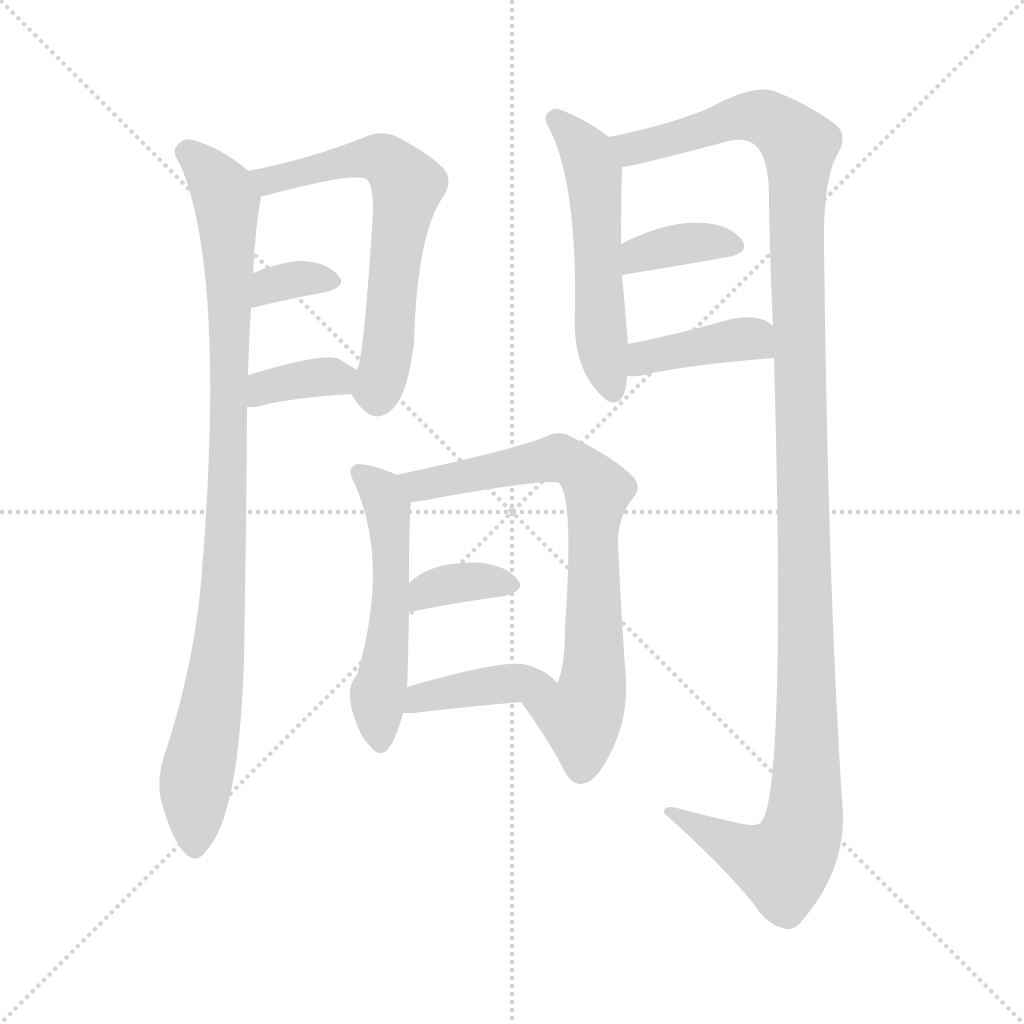
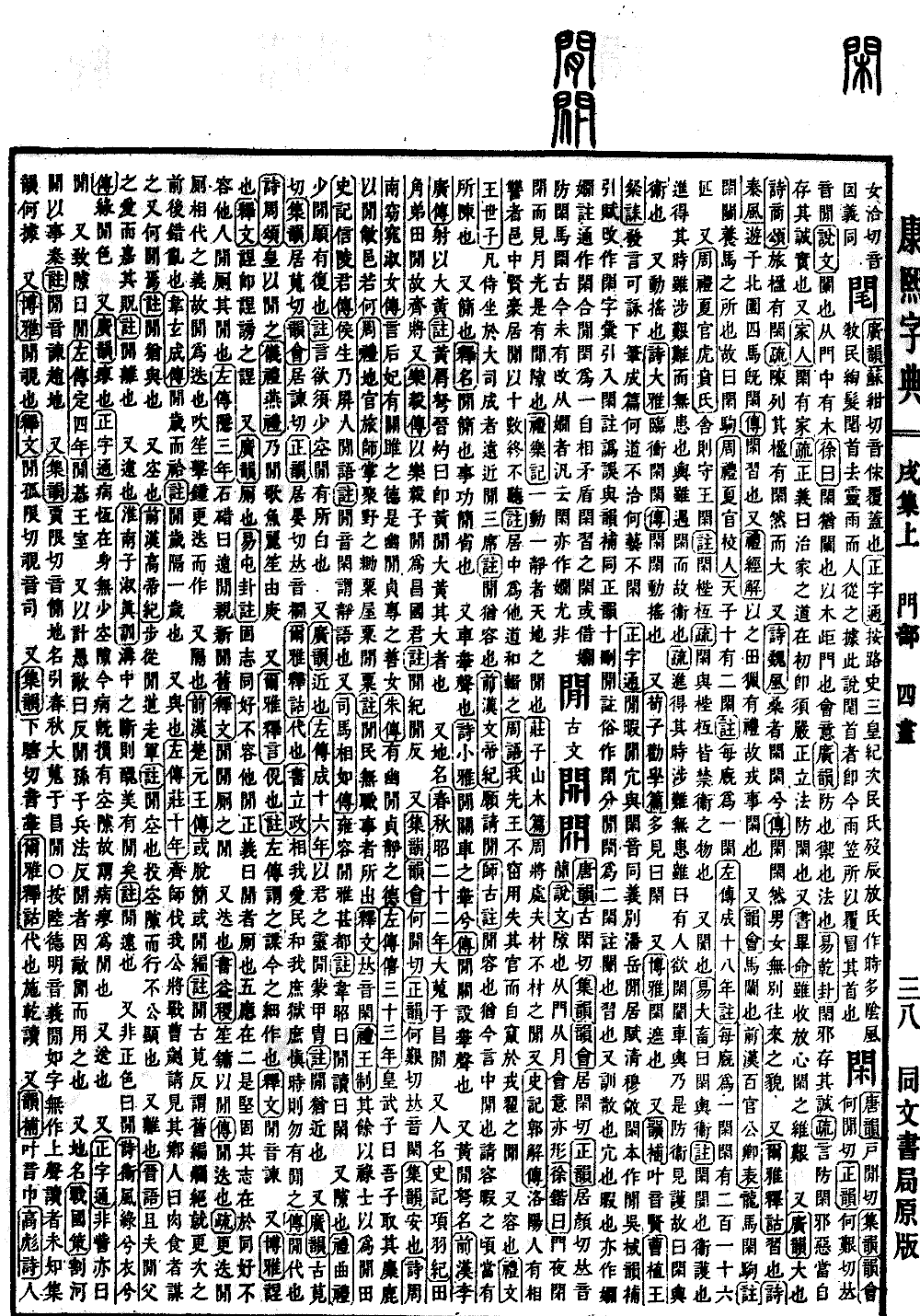
Xu Collection, Upper Volume
Radical: Door (mén)
12
Page 1332, Entry 01
Ancient form. Pronounced jian.
Shuowen Jiezi (Explaining Graphs and Analyzing Characters): A gap. Composed of door and moon. An ideograph, also a pictograph. Xu Kai says: The door is closed at night. Being closed while seeing moonlight, this is a gap.
Book of Rites (Liji), Record of Music: That which is one movement and one stillness is the gap of heaven and earth.
Zhuangzi, Mountain Tree: Zhou will dwell in the gap between the useful and the useless.
Records of the Grand Historian (Shiji), Biography of Guo Jie: People in Luoyang had those who were enemies; the virtuous and prominent in the city dwelt in the gap by the tens, and ultimately they did not listen. Commentary: Dwelling in the middle to act as a go-between and reconcile them.
Discourses of the States (Guoyu): Our former king Bujiu lost his office and came from between the Rong and Di tribes.
Also, to contain.
Book of Rites (Liji), Records of the Son of Heaven of Wen Wang: Whenever waiting to be seated with the Grand Master, distance and closeness are spaced by three mats. Commentary: Gap, meaning to contain.
History of the Former Han (Hanshu), Annals of Emperor Wen: I wish to request a gap. Commentary by Shigu: Gap, meaning to contain. Just like saying the middle gap today. Requesting a moment of leisure to have something to say.
Also, to rest.
Shiming (Explanation of Names): Gap, to rest. Achievement is reduced.
Also, the sound of a carriage.
Book of Odes (Shijing), Lesser Odes: The sound of the carriage is rhythmic (jianguan). Commentary: Jianguan is the sound of the equipment.
Also, Huangjian, a type of crossbow.
History of the Former Han (Hanshu), Biography of Li Guang: Shot with a large yellow crossbow. Commentary: Huangjian is a large crossbow. Jin Zhuo says: It is the Huangjian, the Great Yellow, being the large one.
Also, a place name.
Spring and Autumn Annals (Chunqiu), 22nd Year of Duke Zhao: A grand hunt at Changjian.
Also, a person's name.
Records of the Grand Historian (Shiji), Biography of Xiang Yu: Tian Jiao's younger brother Tian Jian was a former Qi general.
Also, Biography of Yue Yi: Made Yue Yi's son Jian the Lord of Changguo. Commentary: Jian is pronounced like jian (falling-rising tone).
Also, pronounced xian.
Jiyun (Collection of Rhymes): Peaceful.
Book of Odes (Shijing), Zhou Nan: The ode says the empress has the virtue of the osprey, which is a good woman who is reclusive, peaceful, and chaste. Zhu’s Commentary: Having the virtue of being reclusive, peaceful, and chaste.
Zuo Zhuan, 33rd Year of Duke Xi: Huang Wuzi said: If you, my son, take the deer to provide for our humble state, how is that?
Rites of Zhou (Zhouli), Earth Officer, Traveler Officer: Responsible for gathering the grain from the wild, the house grain, and the gap grain. Commentary: Gap people are those who have no official duties. Explanation of Texts: Pronounced xian.
Book of Rites (Liji), Royal Regulations: The remainder is used to pay the scholars, used as gap fields.
Records of the Grand Historian (Shiji), Biography of Lord Xinling: Hou Sheng then cleared the people for private talk. Commentary: Jian is pronounced xian. It means quiet talk.
Also, Sima Xiangru Biography: Graceful, peaceful, and elegant; very refined. Commentary: Wei Zhao says: Jian should be read as xian.
Also, to wait.
Book of Rites (Liji), Qu Li: A little gap and I wish to return. Commentary: Meaning I wish to wait for a little empty time to have something to report.
Also, near.
Zuo Zhuan, 16th Year of Duke Cheng: By the spirit of the ruler, I am near to wearing armor. Commentary: Gap, meaning near.
Also, pronounced jian (falling-rising tone).
Erya: To replace.
Book of Documents (Shujing), Establishing Government: Look after the people I have received, harmonize the various punishments and the various cautious matters, and then there will be no gap between them. Commentary: Gap, meaning to replace.
Book of Odes (Shijing), Zhou Hymns: The king uses it to replace them.
Etiquette and Ceremonial (Yili), Yan Li: Then they alternate singing the Fish Collection, with sheng accompaniment for the Yougeng.
Also, to spy.
Erya: To spy. Commentary: Zuo Zhuan calls it espionage. It is what we call secret agents today. Explanation of Texts: Jian is pronounced jian (falling-rising tone).
Also, to slander.
Explanation of Texts: It means to slander.
Also, to interpose.
I Ching (Yijing), Tun Hexagram Commentary: Solidify the will and the shared liking, do not allow other gaps. The justice says: Gap means to interpose. The fifth responds to the second; this is to solidify the will, residing in a shared liking, not allowing others to gap or interpose in the middle.
Zuo Zhuan, 3rd Year of Duke Yin: Shi Que said: Distance the gap with relatives, and interpose the new with the old. Explanation of Texts: Jian is the jian of interposing.
Also, to alternate.
Book of Documents (Shujing), Yi and Ji: The sheng and yong bells alternate. Commentary: Gap, meaning to alternate. Commentary: To alternate and interpose, with the meaning of replacing one another, so gap means to alternate. Blowing the sheng and striking the bells, they perform by alternating.
Also, to separate.
History of the Former Han (Hanshu), Biography of King Yuan of Chu: Sometimes missing, sometimes separated in the compilation. Commentary: Jian is pronounced jian (falling-rising tone). It means the old compilation was decayed and broken, and it was replaced, making the front and back confused.
Biography of Wei Cheng: Every other year is the ancestral sacrifice. Commentary: Gap year means to skip one year.
Also, and.
Zuo Zhuan, 10th Year of Duke Zhuang: The Qi army attacked us, the Duke was about to fight, Cao Gui requested an audience, his fellow villager said: Those who eat meat plot it, why do you also interpose? Commentary: Gap, meaning and.
Also, empty.
History of the Former Han (Hanshu), Annals of Emperor Gaozu: Followed the empty road to the army. Commentary: Gap, meaning empty. Throwing oneself into the empty path to travel, not openly.
Also, to separate.
Discourses of the Jin (Jinyu): And furthermore, to separate the father's love and praise his gifts. Commentary: Gap, meaning to separate.
Also, far.
Huainanzi: If the break in the ditch is made, then ugly and beautiful have a gap. Commentary: Gap, meaning far.
Also, non-standard colors are called jian.
Book of Odes (Shijing), Wei Feng, Green Clothes Commentary: Green is a jian color.
Also, to recover.
Zhengzitong: Illness is always in the body, without a little emptiness; now that the illness has subsided, there is emptiness, so recovering from illness is called jian.
Also, to send.
Also, non-criticism is also called jian.
Also, to cause, called jian.
Zuo Zhuan, 4th Year of Duke Ding: Causing discord in the royal house.
Also, using strategies to deceive the enemy is called reverse spying (fanjian). Sun Tzu's Art of War, reverse spying means utilizing the enemy's own spies.
Also, a place name.
Strategies of the Warring States (Zhanguo Ce): Ceding Hejian to serve Qin. Commentary: Jian is pronounced jian (falling-rising tone). A place in Zhao.
Also, pronounced jian (falling tone). A place name. Citing the Spring and Autumn Annals, a grand hunt at Changjian. Note: According to Lu Deming's sounds and meanings, jian is read as written, and there is no reading in the upper tone. It is unknown what the Jiyun based this on.
Also, to peep.
Explanation of Texts: Jian is pronounced like the character for lone or boundary. Peep is pronounced si.
Also, pronounced xia (falling-rising tone).
Erya: To replace. Read as shi (level tone) and qian (level tone).
Also, in rhyming dictionaries, it rhymes with jin.
Gao Biao's Poem: People have strategies, six miraculous and five jian. With these three things, consult when plotting.