You Collection, Lower Volume
Radical: Village (lǐ)
Kangxi Strokes: 12
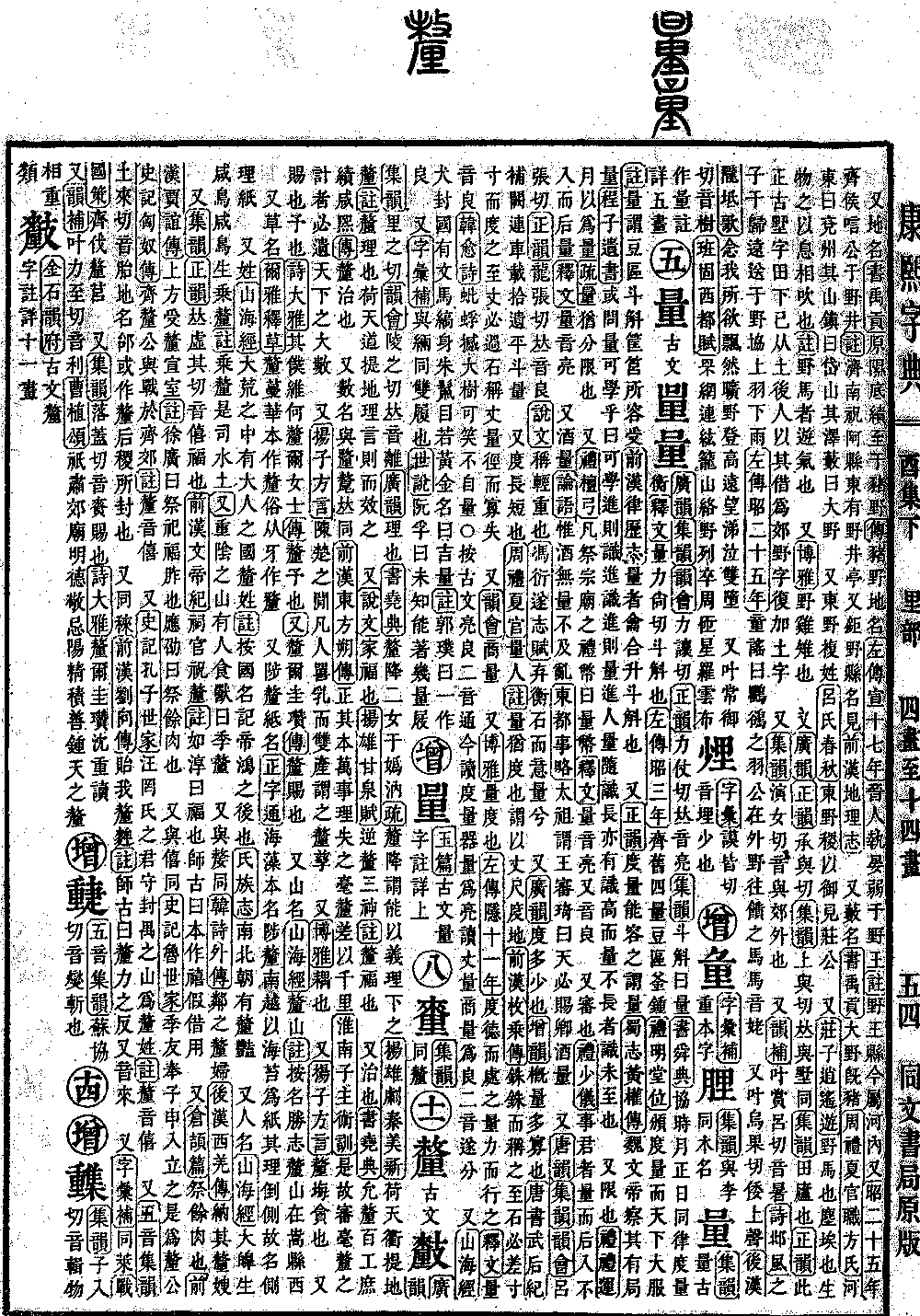
Page 1292, Entry 05
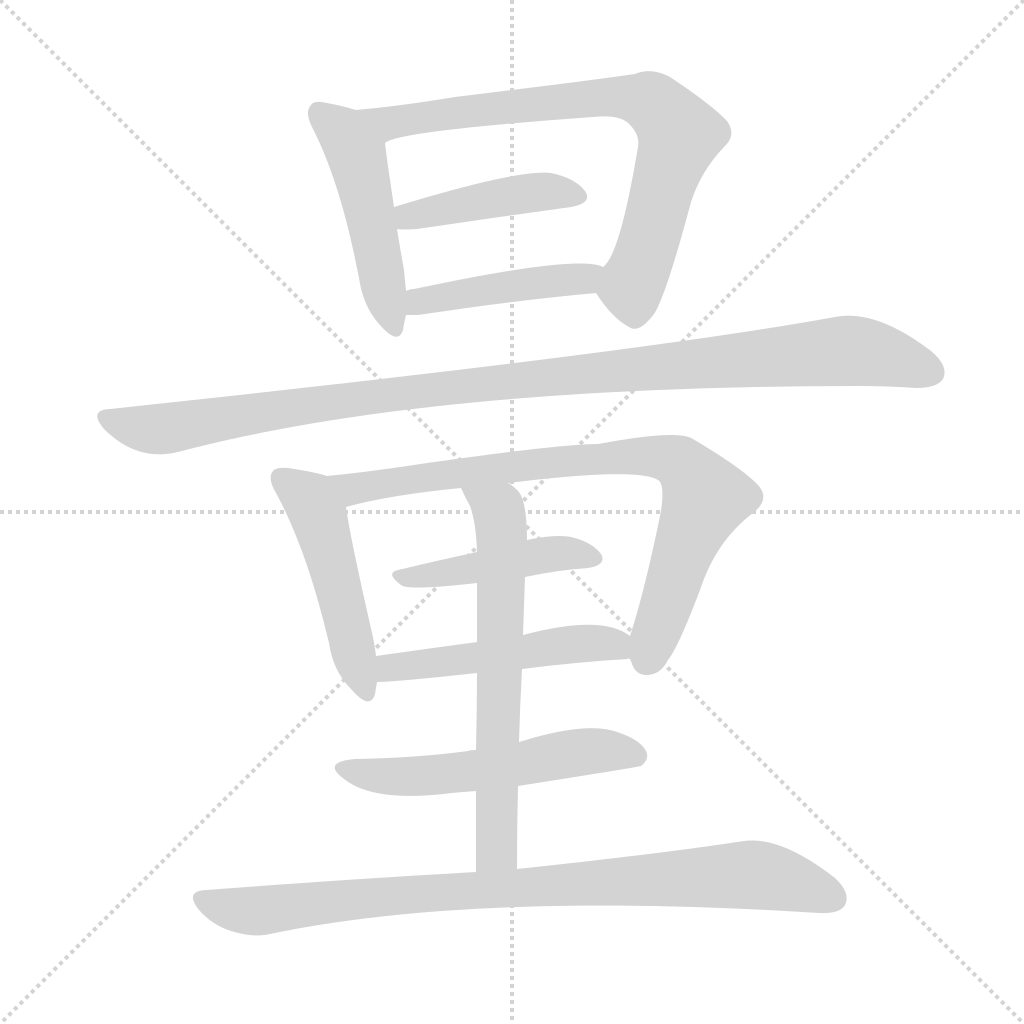
Ancient form. According to the Guangyun (Guangyun), Jiyun (Jiyun), and Yunhui (Yunhui), the pronunciation is liang (falling tone). According to the Zhengyun (Zhengyun), the pronunciation is liang (falling tone).
Jiyun (Jiyun): A bucket or scoop is called a liang.
Book of Documents (Shujing): Harmonize the seasons, months, and days, and standardize the pitch pipes, lengths, capacities, and weights.
Explication of Texts (Shiwen): Liang, pronounced liang (falling tone), refers to measuring vessels such as buckets and scoops.
Zuo Tradition (Zuozhuan): The state of Qi originally possessed four types of measuring vessels: the dou, the qu, the fu, and the zhong.
Book of Rites (Liji): Proclaim the standards of length and capacity, and the world will be truly compliant.
Commentary: Liang refers to the capacity of containers such as the dou, the qu, the dou, the hu, the kuang, and the ju.
History of the Former Han (Qianhan Shu): Liang refers to capacity units such as the yue, the he, the sheng, the dou, and the hu.
Also, according to the Zhengyun (Zhengyun): Measure of capacity, referring to the breadth of one's mind, is called liang.
Records of the Three Kingdoms (Shu Zhi): Emperor Wen of Wei observed that he possessed a large capacity of character.
Surviving Writings of Master Cheng (Chengzi Yishu): Someone asked: Can the capacity of one's character be learned? The answer was: Yes. As learning progresses, knowledge increases; as knowledge increases, the capacity of character expands. One's capacity of character grows with knowledge, though there are those whose knowledge is high but whose capacity of character is not yet broad; that is because their knowledge has not reached that level.
Also refers to a limit.
Book of Rites (Liji): Using the months as the limit.
Sub-commentary: Liang is similar to a boundary or limit.
Also, Book of Rites (Liji): For all ritual offerings to ancestral temples, silk fabrics are called liang bi (measured currency).
Explication of Texts (Shiwen): Liang is pronounced liang (falling tone). Also pronounced liang (rising tone).
Also refers to assessing or estimating.
Book of Rites (Liji): Those who serve a ruler must first estimate their capabilities before entering office, and not enter office only to estimate them later.
Explication of Texts (Shiwen): Liang is pronounced liang (falling tone).
Also refers to capacity for alcohol.
Analects (Lunyu): Only regarding alcohol is there no fixed limit, provided one does not become intoxicated or disorderly.
Events of the Eastern Capital (Dongdu Shilue): Emperor Taizu said to Wang Shenqi: Heaven will certainly grant you the capacity for alcohol.
Also, according to the Tangyun (Tangyun), Jiyun (Jiyun), and Yunhui (Yunhui), the pronunciation is liang (rising tone). According to the Zhengyun (Zhengyun), the pronunciation is liang (rising tone).
Explaining Simple and Compounding Characters (Shuowen): To weigh and determine the heaviness.
Feng Yan, Fu on Fulfilling Ambitions (Sui Zhi Fu): Abandon the scale and rely on the heart to estimate.
Also, Guangyun (Guangyun): To measure how much there is.
Zengyun (Zengyun): To roughly estimate quantities.
Old Book of Tang (Tangshu): The Buque (official title) were so numerous that they were transported in long lines of carriages, and the Shiyi (official title) were so numerous that they were measured by the bucket.
Also refers to measuring length.
Rites of Zhou (Zhouli): The Measuring Official (Liangren).
Commentary: Liang is similar to surveying, referring to the use of rods and rules to measure land.
History of the Former Han (Qianhan Shu): To weigh objects grain by grain, one will certainly have an error when reaching one shi. To measure objects inch by inch, one will certainly have an error when reaching one zhang. By using the shi to weigh and the zhang to measure, one deals directly with the units and reduces errors.
Also, according to Yunhui (Yunhui): To discuss or deliberate.
Boya: Liang means to measure or judge.
Zuo Tradition (Zuozhuan): Weigh moral conduct to arrange positions, and estimate abilities to carry out actions.
Explication of Texts (Shiwen): Liang is pronounced liang (rising tone).
Poetry of Han Yu: The ants think they can shake the great tree, laughable in their failure to estimate their own strength. Note: In ancient texts, the two pronunciations, liang (falling tone) and liang (rising tone), were used interchangeably. Currently, when read as capacity or breadth of character, it is pronounced liang (falling tone); when read as measuring distance or deliberating, it is pronounced liang (rising tone), thus separating the two.
Also, Classic of Mountains and Seas (Shanhaijing): In the Dog-Holding Kingdom there is a patterned horse, white in body, red in mane, with eyes like gold, named Jiliang.
Commentary: Guo Pu says: One text writes it as Jiliang.
Also, Zhuhui Bu (Zhuhui Bu): The same as the variant form (liang). Refers to a pair of shoes.
A New Account of Tales of the World (Shishuo): Ruan Fu said: I do not know how many pairs of wooden clogs I can wear.
Textual correction: Book of Rites (Liji), record of Tan Gong. Following the original text, the mention of Tan Gong has been changed to Qu Li.