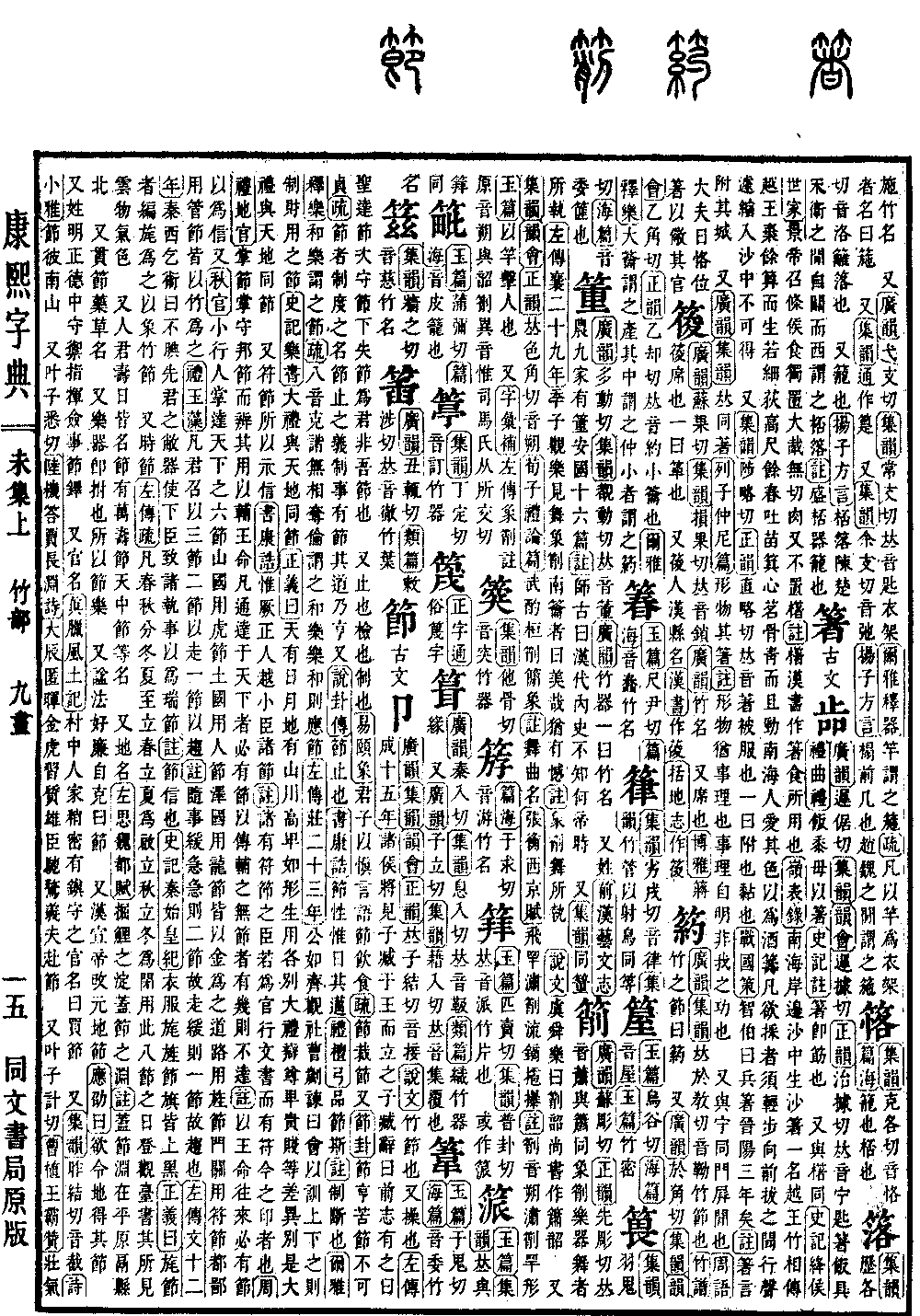
Wei Collection, Upper Volume
Radical: Bamboo (zhú)
Kangxi Strokes: 15
Page 891, Entry 03
Ancient character form.
According to the Broad Rhymes (Guangyun), pronounced ning. According to the Collected Rhymes (Jiyun) and the Rhyme Collection (Yunhui), pronounced ning. According to the Correct Rhymes (Zhengyun), pronounced ning.
Chizhu, eating utensils.
Book of Rites (Liji), Songs of Propriety (Quli): When eating millet, do not use chopsticks.
Records of the Grand Historian (Shiji) commentary: Zhu is the same as zi (chopsticks).
Also synonymous with the character zhu.
Records of the Grand Historian (Shiji), Biography of Marquis Jiang: Emperor Jing summoned Marquis Tiao to eat, and placed only a large piece of meat without slicing it, and also did not provide chopsticks. Commentary: Zhu, in the Book of Han (Hanshu) is written as zhu, which is what is used for eating.
Record of Things Seen and Heard in the South (Lingbiao Luyi): On the sandy shores of the South Sea grows sand-chopstick bamboo, also known as Yue King bamboo. Legend says it grew from the discarded counting rods of the King of Yue. It resembles fine reeds, grows over a foot tall, and sprouts in spring with a wicker-like core and tea-like stem, blue-green and sturdy. People of the South Sea admire its color and use it as wine tallies. Anyone wishing to gather it must approach with light steps to pull it; if it hears the sound of movement, it immediately retracts into the sand and cannot be obtained.
Also, according to the Collected Rhymes (Jiyun) and the Correct Rhymes (Zhengyun), pronounced zhu. To wear or to clothe. Another meaning is to adhere to or to stick.
Strategies of the Warring States (Zhanguo Ce): Zhi Bo said: The army has been attached to Jinyang for three years. Commentary: Zhu means to remain attached to the city.
Also, the same as the character for manifest or appear according to the Broad Rhymes (Guangyun) and Collected Rhymes (Jiyun).
Master Lie (Liezi), Confucius Chapter: The form and the object are manifest. Commentary: Form and object refer to the principles of affairs. If the principles of affairs are self-evident, it is not through my merit.
Also synonymous with the character for a screen or gate, referring to the space between a gate and a screen.
Discourses of the States (Guoyu): The high officials are diligent in their positions at the gate to admonish their subordinates.