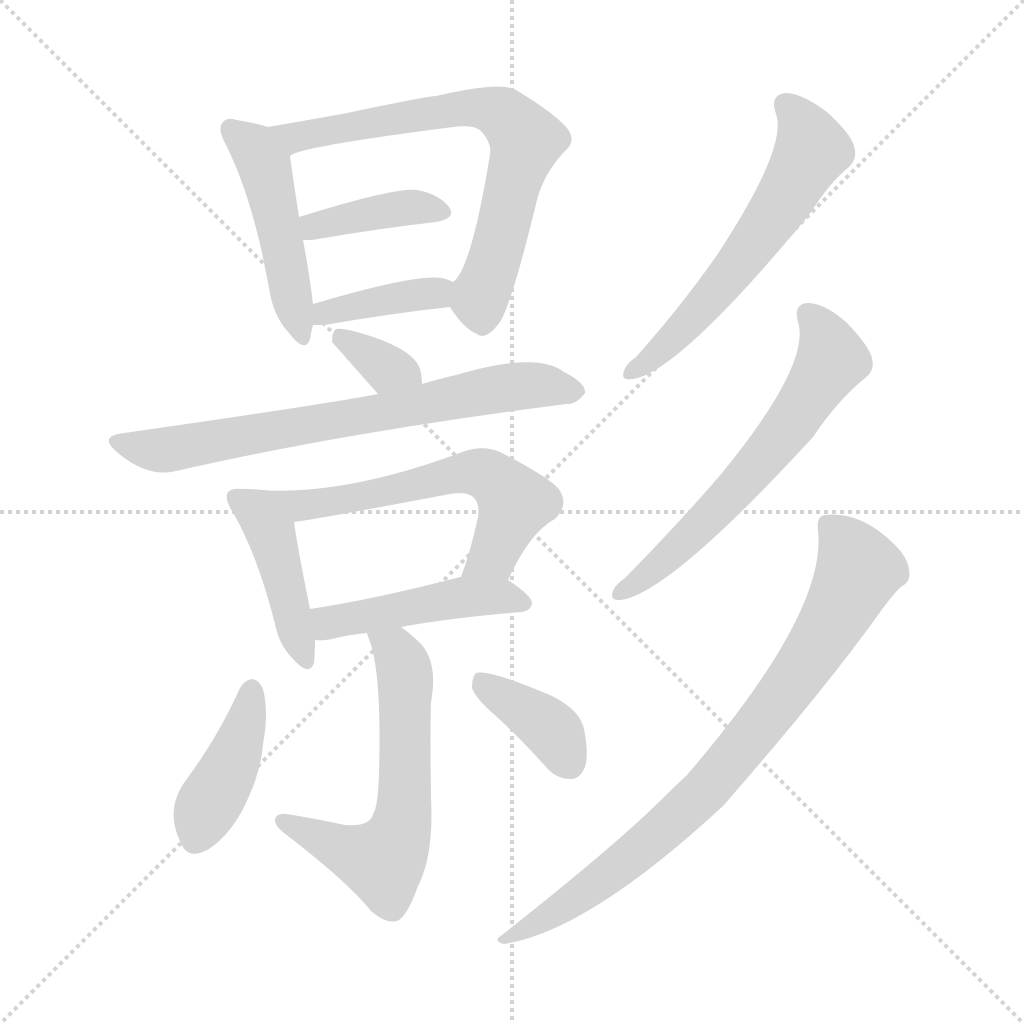
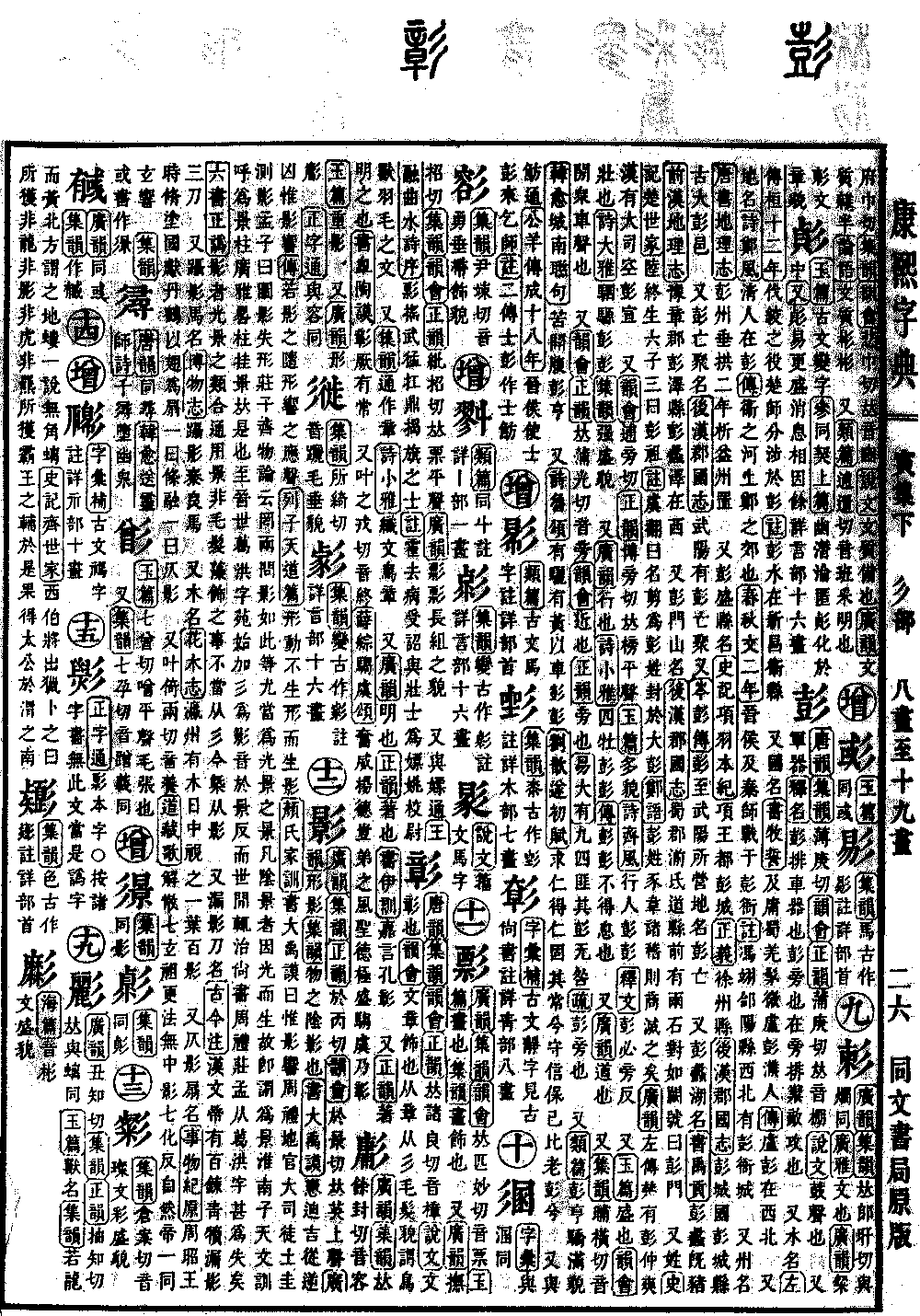
Yin Collection, Lower Volume
Radical: Bristle (shǎn)
Kangxi Strokes: 15
Page 364, Entry 19
Guangyun and Jiyun and Zhengyun pronounce it ying (rising tone). Yunhui pronounces it ying (rising tone), read as the rising tone of ying.
Guangyun defines it as the shadow of a form.
Jiyun defines it as the shadow cast by an object.
Book of Documents (Shujing), Great Plan of Yu (Dayumo): It says, To follow the way brings good fortune, to oppose it brings misfortune, just as the shadow and the echo (follow inevitably). Commentary explains: It is like the shadow following the form, and the echo responding to the sound.
Liezi, Heavenly Questions (Tiandao Pian): It says, The movement of a form does not produce another form, but produces a shadow.
Family Instructions of Master Yan (Yanshi Jiaxun): It says, The character for shadow in the Great Plan of Yu of the Book of Documents, the earth dial used to measure the shadow in the Rites of Zhou (Zhouli), the lost shadow and lost form in Mencius (Mengzi), and the shadow asked by the penumbra in Zhuangzi (Zhuangzi); in these instances, the character for shadow should specifically be the character for sunlight (jing). All shadows are created by light, so they are properly called sunlight. In the Huainanzi, it is referred to as a shadow pillar. Guangya also says, A sundial pillar, hanging shadow, which carries the same meaning. It was only during the Jin dynasty that Ge Hong in the Garden of Characters (Ziyuan) added the bristle radical to write it as shadow, pronounced ying (rising tone). People of the world began to randomly use Ge Hong's character to replace the related characters in the Book of Documents, the Rites of Zhou, Zhuangzi, and Mencius, which is a great error.
Six Writings Rectified (Liushu Zheng'e): It says, Shadow belongs to the category of sunlight. It is commonly thought to be the same as the character for sunlight, but this is not so. Things related to hair and decoration should not take the bristle radical, but now they are all written with it.
There is also a sword named Leaking Shadow (Louying). Ancient and Modern Notes (Gujinzhu) records: Emperor Wen of Han had three swords, including the Hundred-Refined Green Calf and the Leaking Shadow.
There is also a horse named Shadow Tracker (Nieying). Record of Investigations (Bowuzhi) records: Shadow Tracker is an excellent horse from the Qin region.
There is also a tree name. Record of Flowers and Trees (Huamuzhi) records: In Yingzhou there is a tree that, when viewed under the midday sun, a single leaf can cast hundreds of shadows.
There is also a fan named Slanting Shadow (Zeying). Origin of Things (Shiwu Jiyuan) records: During the time of King Zhao of Zhou, the Xiutu state presented a cinnabar crane, and its wings were used to make fans. One was called Tiaorong and one was called Slanting Shadow.
Also, rhymed as yang (rising tone). Daoist Canon Songs (Daozang Ge) sings: Dissolving the seven ancestors, changing the law to have no shadow within. The seven transformations return to nature, the Emperor is the same as the echo.
Jiyun records: Sometimes also written in a variant form.