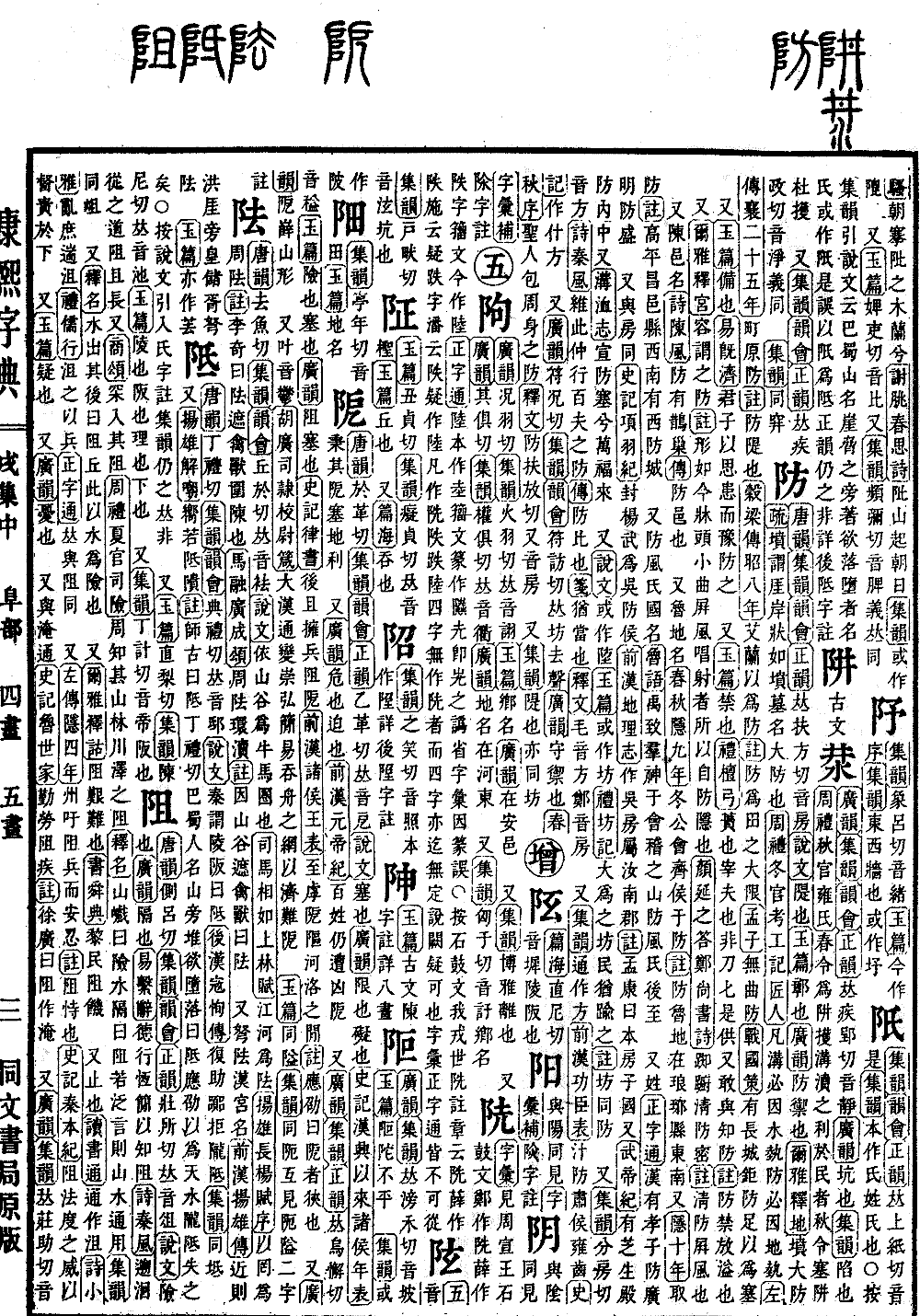
Xu Collection, Middle Volume
Radical: Mound (fù)
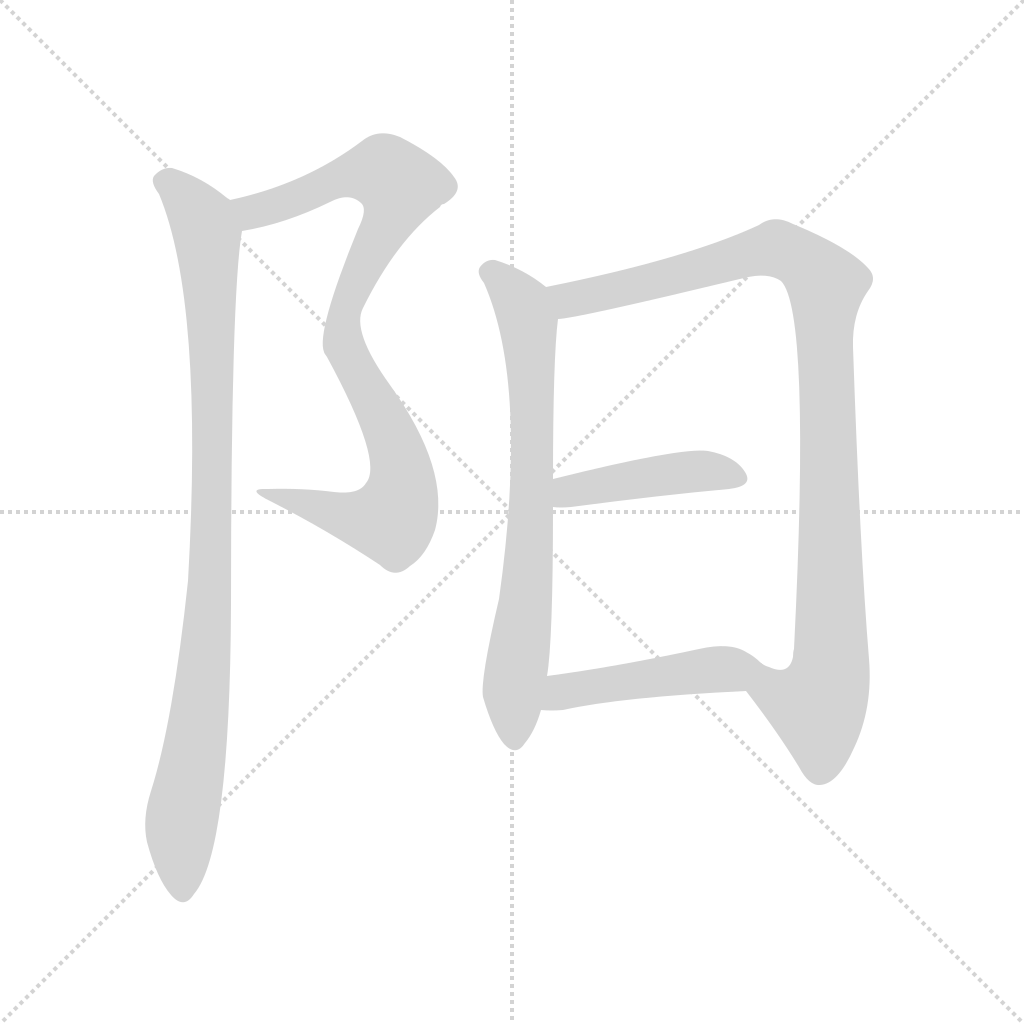
Character: yáng
Kangxi Strokes: 17
Page Number: Page 1347, No. 07
Same as the character yáng. See the annotations in the Supplement to the Lexicon (Zihui Bu).
An ancient written form of the character yáng.
The Tang Rhymes (Tangyun) provides the pronunciation as a combination of yŭ and zhāng. The Collected Rhymes (Jiyun) and the Rhyme Compendium (Yunhui) provide the pronunciation as a combination of yú and zhāng. The Correct Rhymes (Zhengyun) provides the pronunciation as a combination of yí and zhāng. It is pronounced the same as the character for sheep, yáng.
The Jade Chapters (Yupian) explains: To accomplish heavenly works and make all things manifest is called yáng.
Explaining Graphs and Analyzing Characters (Shuowen Jiezi) explains: High and bright.
Also refers to the sun.
The Lesser Odes (Xiaoya) section of the Classic of Poetry (Shijing) says: With heavy dew, indeed, without the sun it will not dry. The Mao Commentary (Maozhuan) explains: Yáng is the sun.
The Zuo Commentary (Zuozhuan) for the fourth year of Duke Wen says: The Son of Heaven should face the sun.
The Record of Ritual (Liji) in the section on the Meaning of Sacrifices says: The people of the Yin dynasty sacrificed at the height of the day. The Note (Zhu) explains: Yáng refers to the time of midday.
The Mencius (Mengzi) says: Use the autumn sun to dry it.
Also, the Songs of the South (Chuci) in the section Far-off Journey says: Ascend the ninefold heavens and enter the palace of the Emperor. The Note explains: Accumulated yáng energy forms heaven. Since heaven has nine layers, it is called Chóngyáng.
Also, the Jade Chapters explains it as: Even numbers.
Also refers to a month.
Approaching the Refined (Erya) in the section Explaining Heaven says: The tenth month is called yáng.
The Lesser Odes of the Classic of Poetry says: The year has reached the tenth month.
Also, Approaching the Refined in the section Explaining Heaven says: Spring is called Qīngyáng. The Note explains: The weather is clear, harmonious, and warm.
Also, Approaching the Refined in the section Explaining Heaven says: The Year Star is called Zhāoyáng when it is in a guĭ year.
Also, the fifth day of the fifth month is called Duānyáng, and the ninth day of the ninth month is called Chóngyáng, as seen in the General Significance of Seasonal Ordinances (Yuèling Guǎngyì).
Also, Approaching the Refined in the section Explaining Mountains says: The west side of a mountain is called xīyáng, and the east side is called zhāoyáng.
The Greater Odes (Daya) of the Classic of Poetry says: Surveying the western side of that mountain. It also says: The parasol trees grow on the eastern side of that mountain.
Also refers to the northern bank of a river.
The Greater Odes of the Classic of Poetry says: On the northern bank of the Qià River.
The Guliang Commentary (Guliangzhuan) for the twenty-eighth year of Duke Xi says: The northern bank of a river is called yáng.
Also, the Explanation of Names (Shiming) says: A high mound is called yángqiū because its high position is close to the yáng energy.
Also, the Odes of Bin (Binfeng) in the Classic of Poetry says: My red is very bright. The Mao Commentary explains: Yáng means bright.
Also, the Jade Chapters explains it as: Clear and bright.
Also, the Sacrificial Odes of Zhou (Zhousong) in the Classic of Poetry says: Dragon banners are brightly colored. The Mao Commentary explains: Yángyáng describes a patterned or colorful appearance.
Also, the Odes of Wang (Wangfeng) in the Classic of Poetry says: The gentleman is leisurely and contented. The Mao Commentary explains: Yángyáng describes a state of being carefree and having nothing on one's mind.
Also, the Rites of Zhou (Zhouli) in the section for the Minister of Education says: Use the yáng ritual to teach humility, and the people will not fight. The Note explains: Yáng ritual refers to the ceremonies of village archery and village drinking.
Also refers to the name of a state.
The Spring and Autumn Annals (Chunqiu) for the second year of Duke Min says: The people of Qi moved the state of Yáng. The Note explains: Yáng is a state name.
The Strategies of the Warring States (Zhanguoce) says: To plug a leaking boat while disregarding the waves of Yánghóu. The Note cites the Records of Diverse Matters (Bowuzhi) saying: The Marquis of Yáng of the state of Jin drowned and became the god of the sea.
Also, the Spring and Autumn Annals for the twelfth year of Duke Zhao says: Gao Yan of the state of Qi led an army to escort the ruler of Northern Yan to the region of Yáng. The Note explains: Yáng is the same as Tang, which was a secondary city of the state of Yan. The state of Zhongshan had a Tang county.
Also refers to a county name.
The Records of the Grand Historian (Shiji) in the Annals of Emperor Gaozu says: Passing westward through Gāoyáng county. The Note explains: Gāoyáng belongs to Liú commandery.
Also refers to the name of a pass.
The Book of Han (Hanshu) in the Traditions of the Western Regions says: It is seven thousand eight hundred and two li from the Yáng Pass.
Also, the Zuo Commentary for the twenty-fourth year of Duke Zhao says: Duke Zhao of Lu fled to Qi and stayed in Yángzhōu.
Also, Yángchéng is the name of a mountain. During the Han dynasty, it was established as a county belonging to Yĭngchuān commandery.
Also refers to the title of an ancient emperor.
The Records of the Grand Historian in the Annals of the Five Emperors records: Emperor Zhuānxū was titled Gāoyáng Shì.
Also, the Explanation of Names says: Regarding the standing person radical, it looks like a person standing. Some call it the yáng gate. That which is in front is called yáng, and the two sides are like a gate.
Also, the Jade Chapters explains it as: To harm.
Also, the Zhuangzi in the section on Understanding Life says: Below the northwest is where the ghost Yìyáng dwells. The Note explains: Yìyáng is the name of a ghost.
Also, the Master Who Embraces Simplicity (Baopuzi) in the section on Climbing and Wading says: When trees in the mountains can speak with human voices, it is not that the trees themselves speak, but it is caused by their spirits, whose name is Yúnyáng.
Also, chāngyáng is another name for the sweet flag plant.
Han Yu says in the Explanation of Progress in Learning (Jinxuejie): Chāngyáng can prolong one's life.
Also used as a surname.
The Records of the Grand Historian in the Rhapsody of Sir Vacuous (Zixufu) by Sima Xiangru says: Yángzĭ served as a chariot attendant. The Note explains: Yángzĭ refers to the ancient immortal Yánglíng.
The Expanded Rhymes (Guangyun) records: King Jing of the Zhou dynasty enfeoffed his younger son at Yángfán, and his descendants took the name of the fief as their surname.
Also, in the Han dynasty, there were twenty-two compound surnames: Ouyang, Gaoyang, Qingyang, Sunyang, Ziyang, Zhouyang, Jingyang, Biyang, Gengyang, Xiyang, Guiyang, Yeyang, Lingyang, Xianyang, Yueyang, Puyang, Taiyang, Laoyang, Anyang, Chengyang, Zhuyang, and Suoyang.
Also used interchangeably with the character yáng, meaning to spread or display.
The Record of Ritual in the section on Jade Diadems says: Make the internal energy full and solid, and display beauty. The Note explains: Diān is read as tián. Yáng is read as yáng. It means making the breath within the body full and solid, just as yáng energy nourishes all things.
The Explanation of Names explains: Yáng is the same as the word for spread, meaning energy spreading outward.
Also used interchangeably with the character yăng, meaning to feign or pretend.
The Record of Ritual in the section on the Sandalwood Bow says: To appear to agree with him on the surface.
The Book of Han in the Annals of Emperor Gaozu says: Feigning to honor King Huai as the Righteous Emperor while actually not following his orders.
Also pronounced as cháng.
Approaching the Refined in the section Explaining Words says: Yáng means I. The Note explains: The Lu Odes (Lushi) says: Yáng, what can be done. Currently, people in the area of Ba and Pu call themselves āyáng. The Commentary (Shu) explains: The Treatise on Arts and Literature in the Book of Han says: Shen Gong of the state of Lu produced the glosses for the Classic of Poetry, thus it is the Lu Odes. The text of the classic says: Yáng, what can be done. Shen Gong interpreted yáng as I, and thus it is cited. The Phonetic Explanations (Shiwen) provides the pronunciation: Yáng is read as cháng.
The Five Tone Collected Rhymes (Wuyin Jiyun) records that a vulgar form is written as a variant of yáng.
The Lexicon (Zihui) records that a vulgar form is written as a variant of yáng.
The Supplement to the Lexicon records it is also written as the variant forms pronounced yáng.