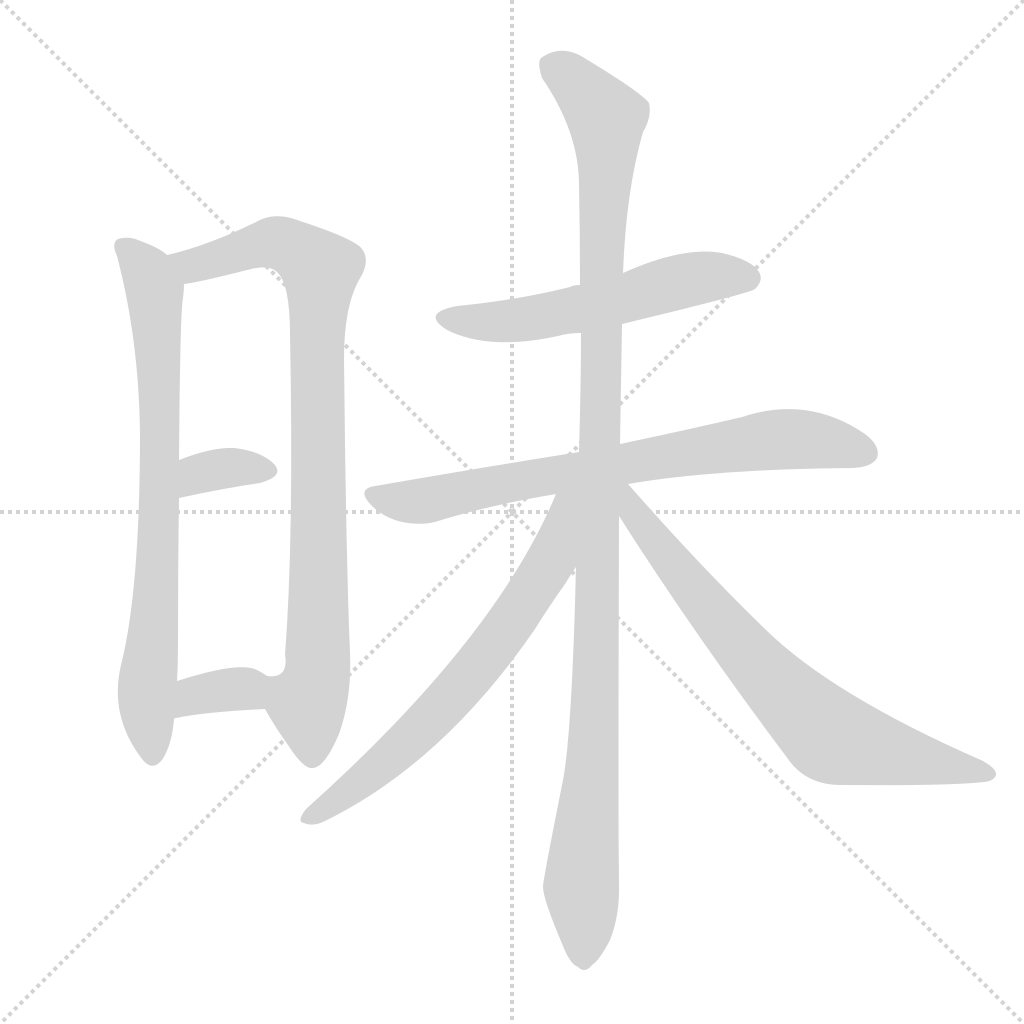
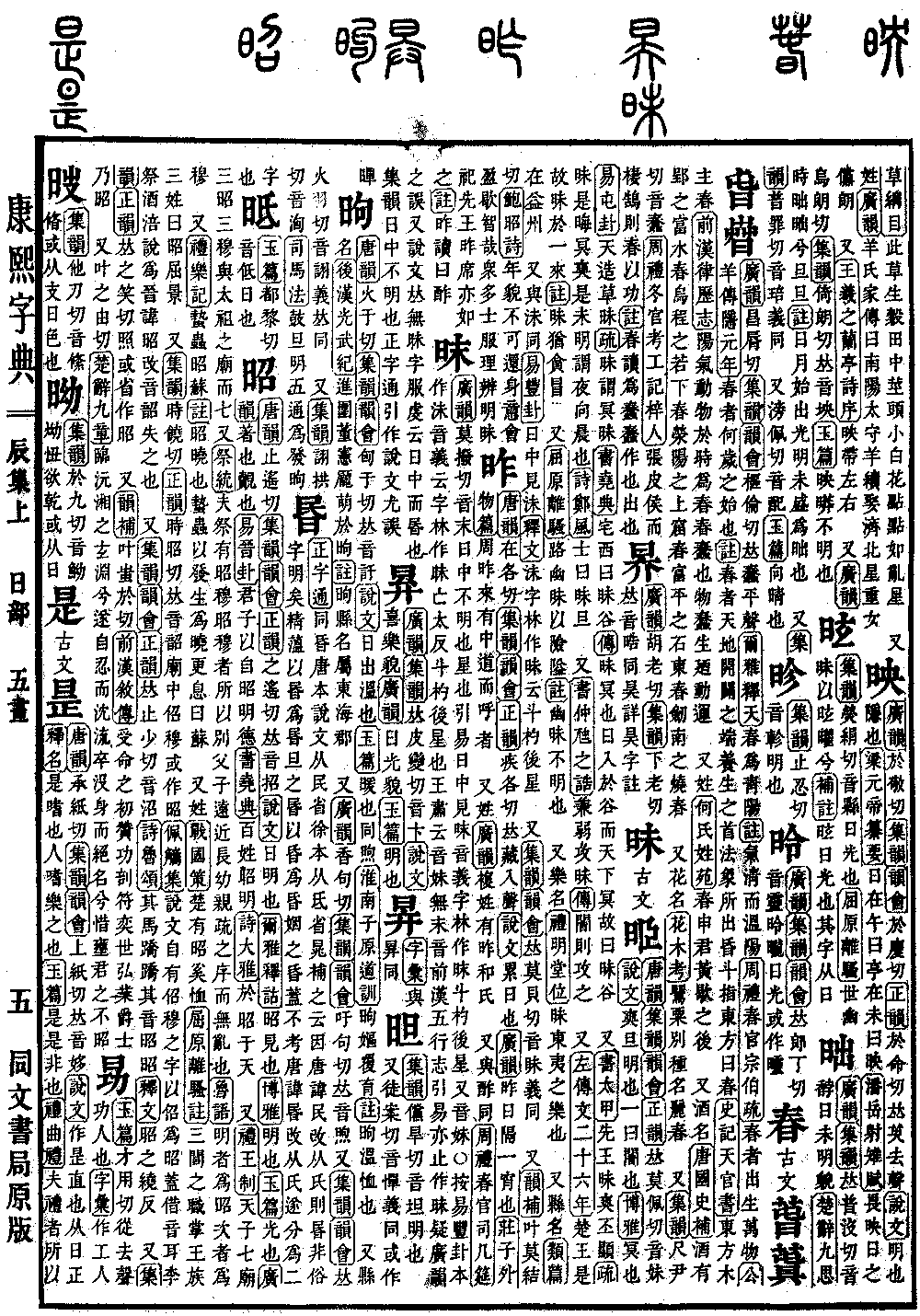
Chen Collection, Upper Volume. Radical: Sun (rì). Kangxi stroke count: 9. Page 493, Entry 12.
Ancient form. Pronounced mei. According to the Shuowen Jiezi, it means the time when the sky is just beginning to brighten. Another definition is dim or dark. The Guangya defines it as hidden or dark. In the Book of Changes (Yijing), in the Zhun hexagram, it says, "Heaven creates the beginning of the world." The commentary explains that this refers to a state of being dim and unclear. The Book of Documents (Shangshu) records, "The place where it dwells in the west is called the Valley of Mei." The commentary explains that this refers to being dim; when the sun sets into the valley, the world becomes dark, hence it is called the Valley of Mei. Additionally, the Book of Documents (Shangshu) contains the phrase, "The former king was not yet fully enlightened." The commentary explains that this refers to the dimness of not yet being fully light, indicating the time of night approaching morning. The Book of Odes (Shijing) contains the phrase, "The gentleman says the dawn is dim." Also, the Book of Documents (Shangshu) mentions, "Combining the weak and attacking the ignorant." The commentary explains this as attacking those who are dim and lack clarity. Furthermore, the Zuo Commentary (Zuozhuan) mentions, "The King of Chu was therefore greedy for a single arrival." The commentary explains that here, the term is synonymous with greedy. Also, in the Li Sao, it is written, "The path is dark and dangerous." The commentary explains that "dark" means not bright.
It also refers to the name of a piece of music. The Book of Rites (Liji) records that the Mei was a piece of music from the Eastern Yi.
It also refers to a county name. The Leipian records it as being in Yizhou.
It is also synonymous with the character for mo. The Book of Changes (Yijing), in the Feng hexagram, mentions, "At midday, one sees the mo." The commentary explains that mo is written as mei in the Zilin and refers to the star behind the handle of the Dipper.
Pronounced mei (falling tone). The meaning is the same.
Also, the Yunbu records an alternative pronunciation as jie. In the poems of Bao Zhao, it is written: "Age and appearance cannot be restored; the body and mind will inevitably wax and wane. How wise are the many scholars, who submit to reason and distinguish between light and dark."