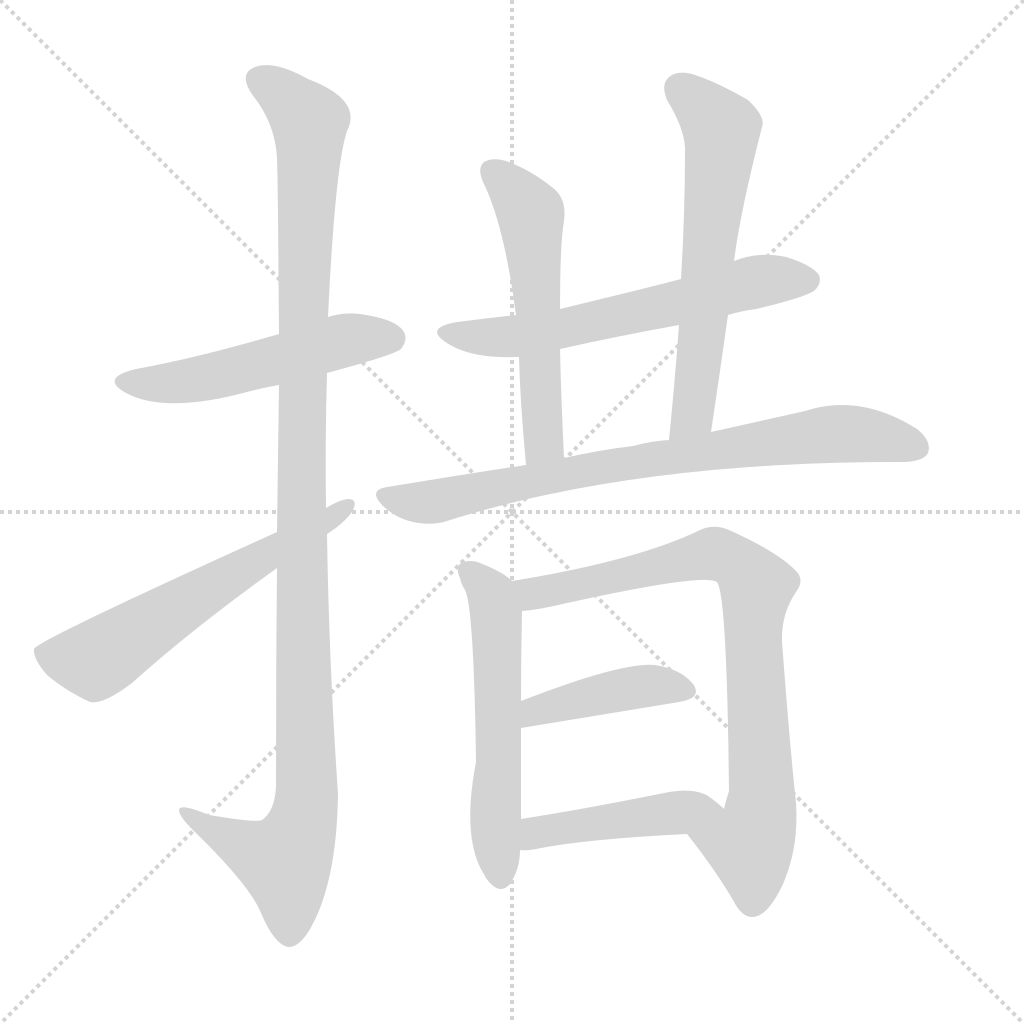
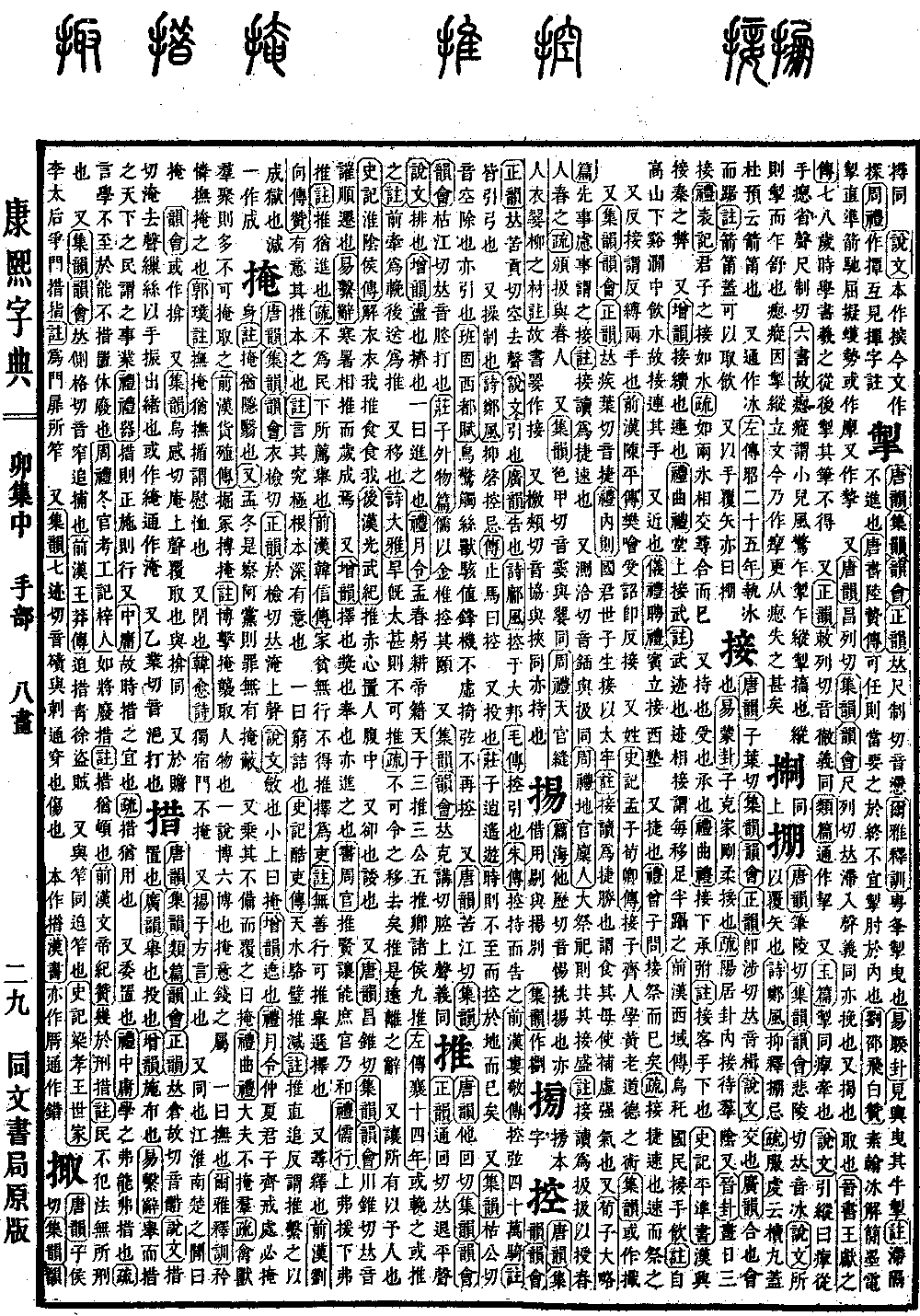
Mao Collection, Middle Volume
Radical: Hand (shǒu)
Kangxi stroke count: 12
Page 439, Entry 10
Pronounced cuo (falling tone).
According to the Explaining Graphs and Analyzing Characters (Shuowen Jiezi), cuo means to place.
According to the Expanded Rhymes (Guangyun), it means to lift or to throw.
According to the Added Rhymes (Zengyun), it means to apply or to spread out.
From the Book of Changes (Yijing), Appended Remarks (Xici): To lift it and place it for the people of the world, this is what is called a noble undertaking.
From the Book of Rites (Liji), Ritual Vessels (Liqi): When placed it is upright, when applied it is effective.
Also from the Doctrine of the Mean (Zhongyong): Therefore, he applies them according to the requirements of the time.
The commentary notes that cuo is like using something.
It also means to entrust or to put aside.
From the Doctrine of the Mean (Zhongyong): If one learns it but cannot do it, one does not put it aside.
The commentary notes that if learning does not reach the point of mastery, one does not abandon or discard the process.
From the Rites of Zhou (Zhouli), Winter Officials, Record of Tradesmen (Kaogongji), The Joiner: As if about to abandon or set aside.
The commentary notes that cuo is like to deposit.
From the History of the Former Han (Qianhan Shu), Annals of Emperor Wen, Appraisal: Nearly set in place.
The commentary notes that because the people did not break the law, there was nothing to be done.
Also pronounced ze (entering tone).
To pursue and capture.
From the History of the Former Han (Qianhan Shu), Biography of Wang Mang: Pressing and seizing the bandits of Qing and Xu.
Also the same as the character ze (to press or squeeze).
To press or constrict.
From the Records of the Grand Historian (Shiji), House of the Prince of Liang: The Empress Dowager Li fought for the door and had her fingers crushed.
The commentary notes that this refers to being squeezed by the door leaves.
Also pronounced qi (entering tone).
Used interchangeably with the character ci (to pierce).
To pierce or to wound.
Originally written as a different character.
In the History of the Former Han (Hanshu), it is also written as cuo.
Commonly used as the character cuo (error/to polish).