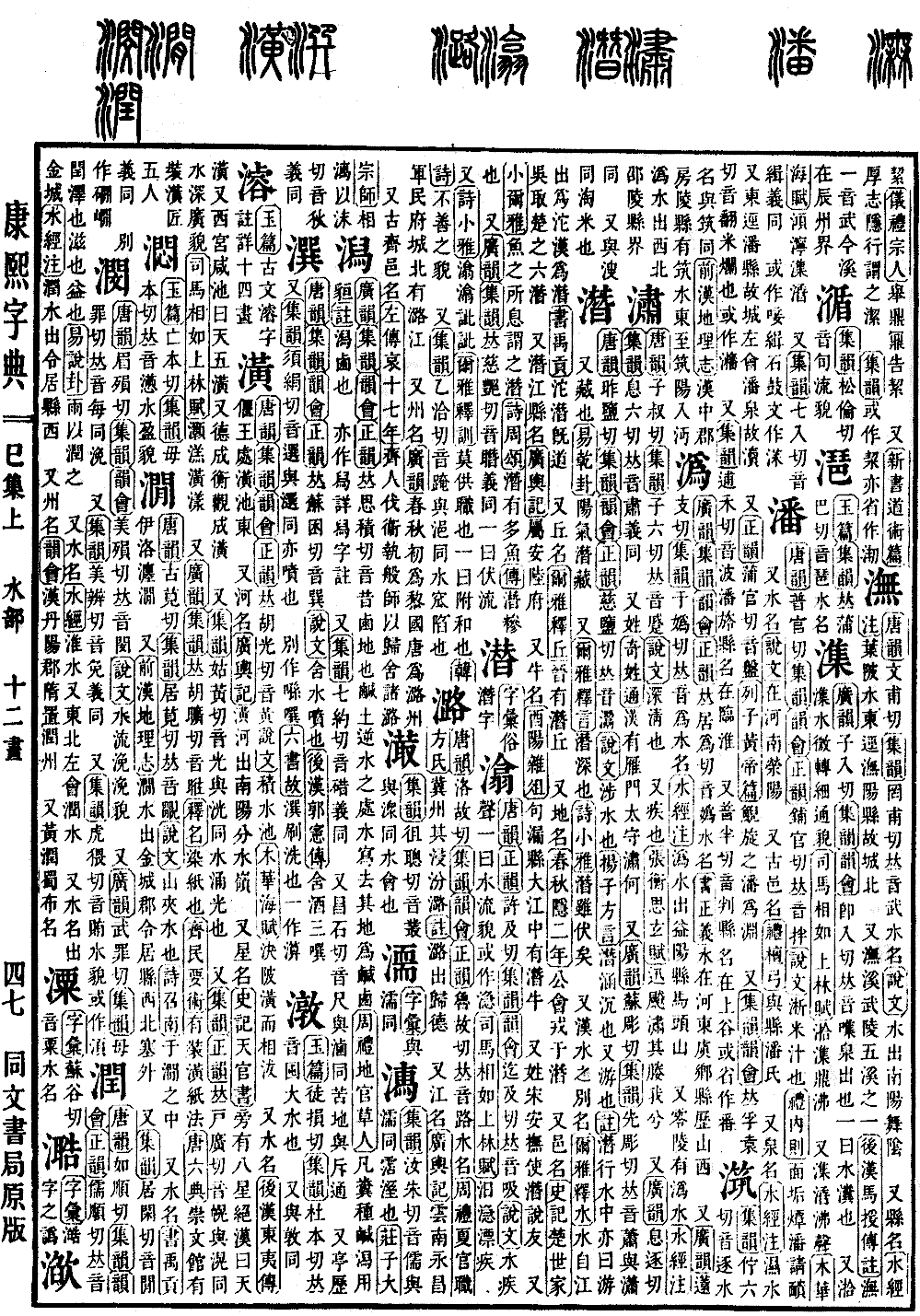
Si Collection, Upper Volume
Radical: Water (shuǐ)
潜
Kangxi strokes: 16
Page 649, Entry 10
Dictionary of Characters (Zihui): This is the vulgar form of the character written as qian.
Qian:
Tang Dynasty Rhymes (Tangyun): Pronounced jian.
Collected Rhymes (Jiyun), Rhyme Compilation (Yunhui), Correct Rhymes (Zhengyun): Pronounced jian. The pronunciation is the same as the aforementioned.
Shuowen Jiezi: Refers to wading or crossing a river.
Yang Xiong's Dialect (Fangyan): Qian-han means to sink or submerge.
Also refers to swimming or moving.
Commentary: To walk underwater is also called swimming.
Also refers to hiding.
Book of Changes (Yijing), Qian Hexagram: The yang energy is hidden.
Also, Erya: Explaining Words (Shiyan): Qian means deep.
Book of Odes (Shijing), Lesser Odes (Xiaoya): Although deeply hidden and lurking.
Also an alternate name for the Han River.
Erya: Explaining Waters (Shishui): A branch flowing from the Yangtze River is called Tuo; a branch flowing from the Han River is called Qian.
Book of Documents (Shangshu), Tribute of Yu (Yugong): The Tuo River and the Qian River have both been dredged.
Also the name of a hill.
Erya: Explaining Hills (Shiqiu): There is a Qian Hill in the land of Jin.
Also a place name.
Spring and Autumn Annals (Chunqiu), Second Year of Duke Yin: Duke Yin met with the Rong people at Qian.
Also the name of a walled city.
Records of the Grand Historian (Shiji), House of Chu: The state of Wu seized Liu and Qian from the state of Chu.
Also Qianjiang, a county name.
Guangyu Ji: Belongs to the Anlu Prefecture.
Also a name for a type of ox.
Miscellaneous Morsels from Youyang (Youyang Zazu): There are qian-oxen in the large river of Goulou County.
Also a surname. For example, Qian Shuoyou, a pacification commissioner of the Song Dynasty.
Also Small Erya (Xiao Erya): A place where fish dwell is called a qian.
Book of Odes (Shijing), Eulogies of Zhou (Zhousong): There are many fish in the deep-water qian.
Commentary: Qian refers to piles of wood and brush where fish gather.
Also Guangyun and Jiyun: Pronounced yan. The meaning is the same. One source states it refers to subterranean water currents.