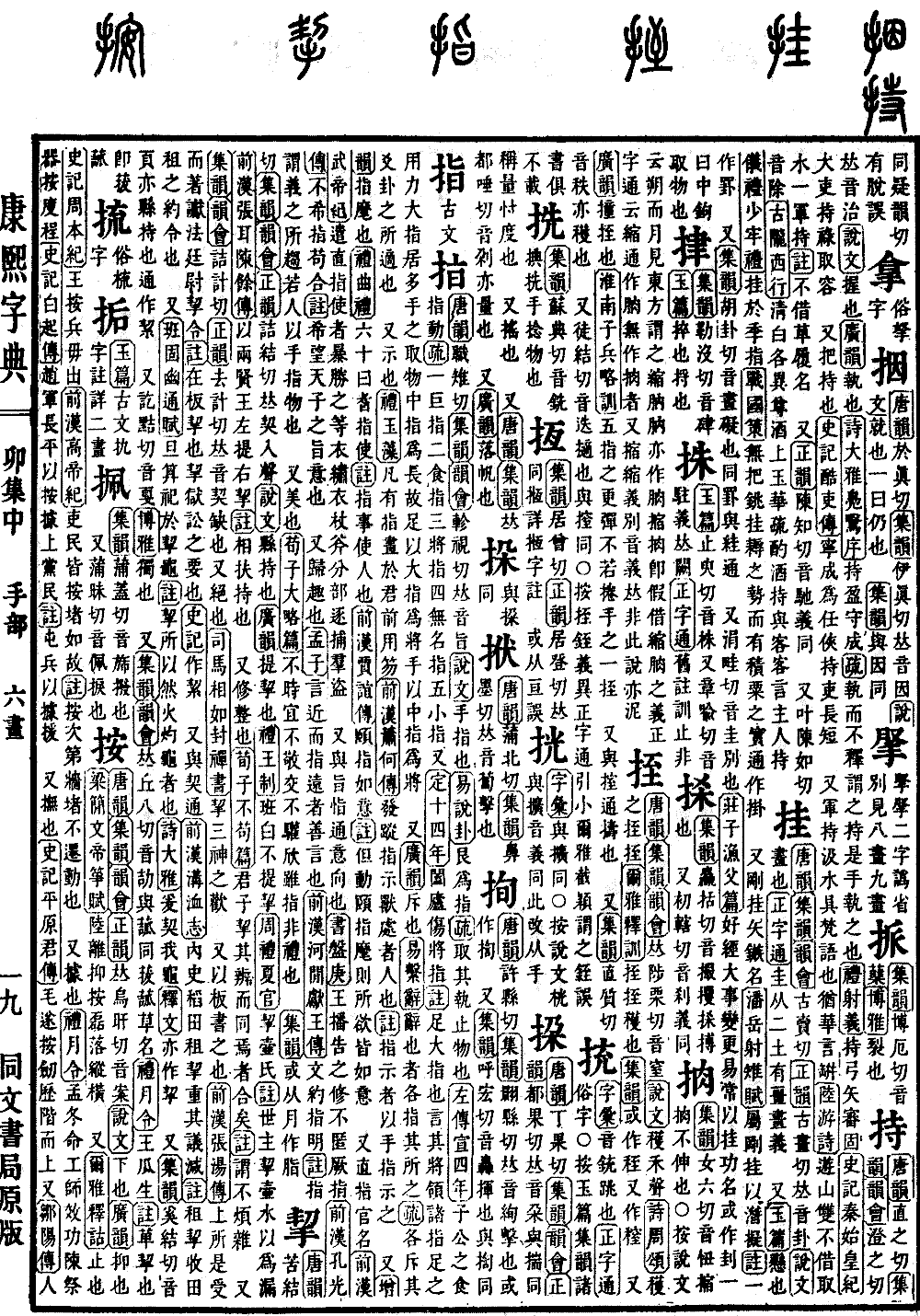
Mao Collection, Middle Volume
Radical: Hand (shǒu)
Kangxi Strokes: 10
Page 429, Entry 20
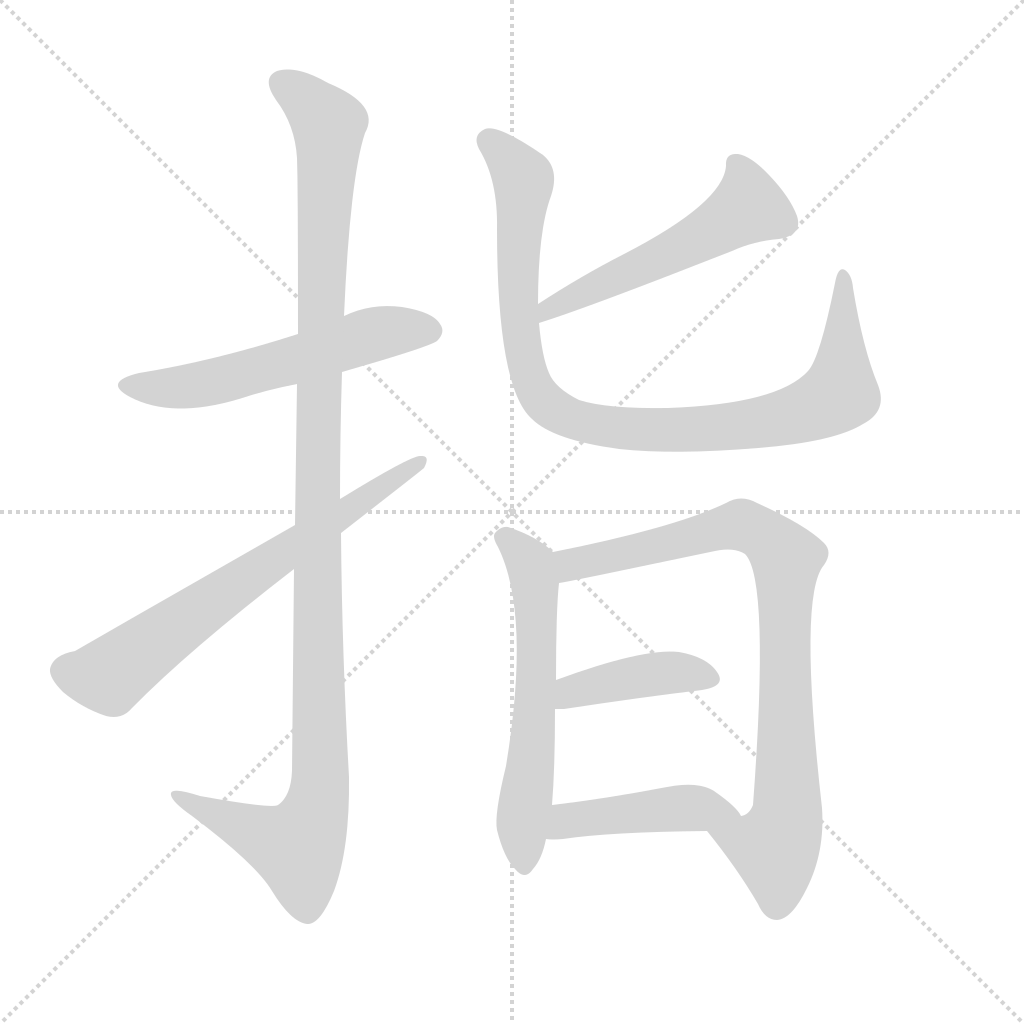
Pronounced zhǐ.
According to the Shuo Wen Jiezi (Shuo Wen), the fingers of the hand.
Book of Changes (Yijing), Explanation of the Trigrams: Mountain (Gen) represents the finger.
Commentary: This refers to the ability to hold and stop objects.
Zuo Tradition (Zuo Zhuan), Fourth Year of Duke Xuan: The index finger of Zigon moved.
Commentary: The first is the thumb, the second is the index finger, the third is the middle finger, the fourth is the ring finger, and the fifth is the little finger.
Also, Fourteenth Year of Duke Ding: Struck Helü with a dagger-axe, wounding the general finger.
Annotation: This refers to the big toe. It implies that the big toe governs all other toes. When the foot exerts force, the big toe is used the most. When the hand holds objects, the middle finger is the longest. Therefore, for the foot, the big toe is the leader, and for the hand, the middle finger is the leader.
Also, Extensive Dictionary of Rhymes (Guangyun): To point at.
Book of Changes (Yijing), Appended Remarks: Words are used so that each may point to that to which it refers.
Commentary: Each points out the direction to which the line or hexagram tends.
Also, to indicate.
Book of Rites (Liji), Jade Pattern: Whenever one needs to point or illustrate in the presence of the ruler, use a tablet (hu).
History of the Former Han (Qianhan Shu), Biography of Xiao He: Those who track the footprints and indicate the location of the beasts are the hunters.
Annotation: To indicate means to use the hand to show a direction.
Also, Increased Dictionary of Rhymes (Zengyun): To command or direct.
Book of Rites (Liji), Traditions of Propriety (Qu Li): At sixty, one is called a senior who may direct others.
Annotation: To delegate tasks for others to perform.
History of the Former Han (Qianhan Shu), Biography of Jia Yi: To command with a movement of the chin and have one's wishes fulfilled.
Annotation: By merely moving the chin to give orders, one obtains what one desires.
Also, Direct Investigator, an official title.
History of the Former Han (Qianhan Shu), Annals of Emperor Wu: Dispatched Direct Investigator envoys such as Bao Shengzhi, wearing embroidered robes, holding axes and staffs, to divide regions and pursue groups of bandits.
Also, interchangeable with the term zhi (intent or meaning). Intent or direction.
Book of Documents (Shujing), Pan Geng: The King proclaimed the regulations and did not conceal his intent.
History of the Former Han (Qianhan Shu), Biography of Kong Guang: Did not seek to align with the imperial will to obtain favor.
Annotation: To not cater to the emperor's intent.
Also, destination or tendency.
Mencius: Words that are near but have a distant meaning are good words.
History of the Former Han (Qianhan Shu), Biography of King Xian of Hejian: The text is concise and the meaning is clear.
Annotation: Zhi means the tendency of the meaning, just as a person uses a finger to point at an object.
Also, beautiful or fine.
Xunzi, Great Summary: If it is not timely, not respectful in interaction, and not joyful, even if it is fine, it is not in accordance with propriety.
Collected Rhymes (Jiyun): Sometimes written as a variant form (zhī).
Textual Research: Fourteenth Year of Duke Ding: Helü wounded the general finger. In accordance with the original text, the three characters strike with a dagger-axe have been added before Helü.