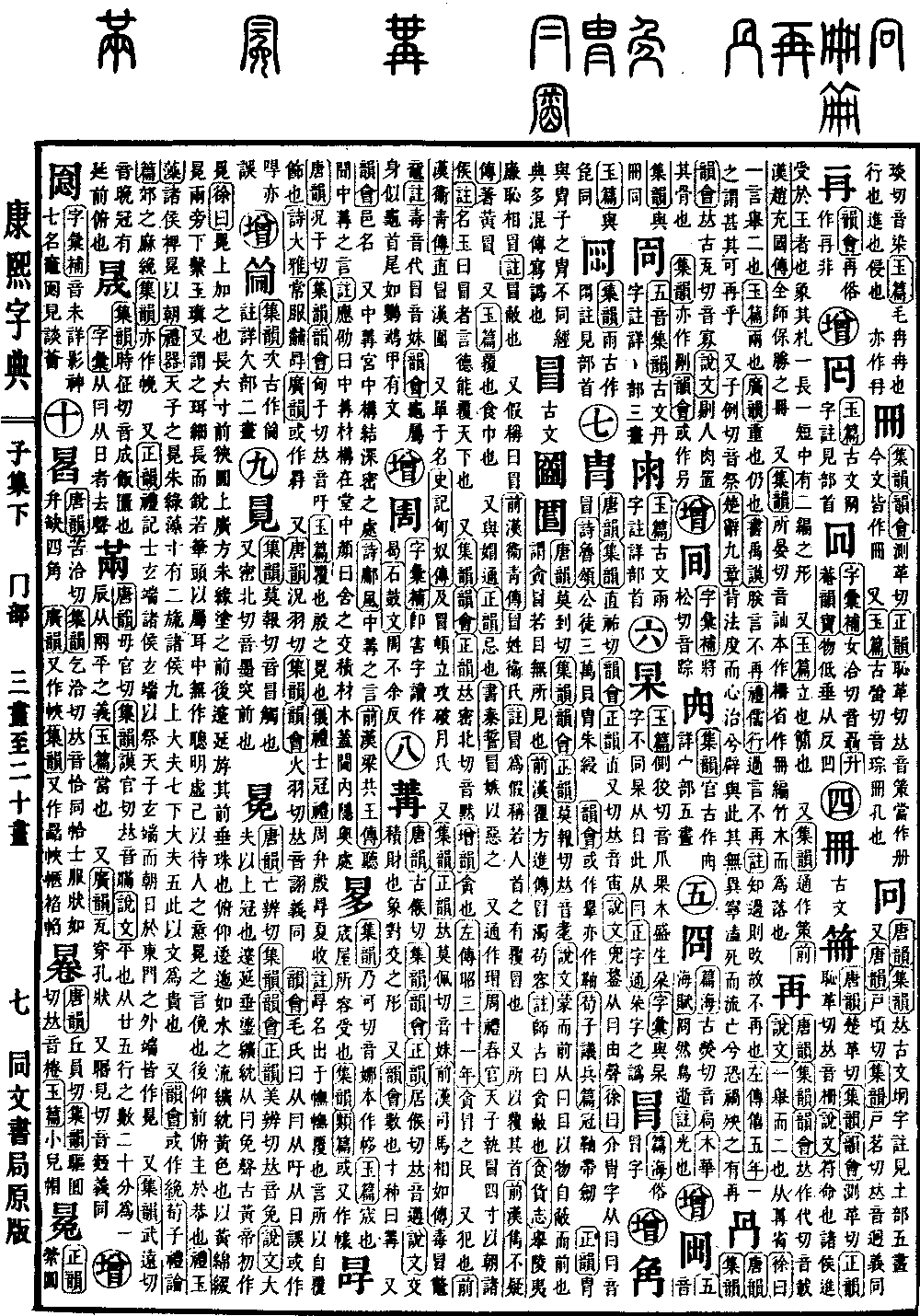
Zi Collection, Page Position: Lower
Radical: Enclosing Box (jiōng)
冕
Kangxi strokes: 11
Page 129, Entry 30
According to Tang Rhymes (Tangyun), pronounced wángbiàn. According to Jiyun, Yunhui, and Zhengyun, pronounced měibiàn, with the sound miǎn. According to Explaining Graphs and Analyzing Characters (Shuowen Jiezi): A cap worn by high officials and above. It has a projecting board (suì yán), dangling ornaments (chuí liú), and a chin-strap (kuàng hóng). It is formed from "mào" as the semantic component and "miǎn" as the phonetic component. In ancient times, the Yellow Emperor (Huángdì) first made the miǎn. Xu Kai says: The miǎn is something that is placed on top. It is six cùn long, narrow and round in front, wide and square on top, painted in crimson and green, with projecting boards (suì yán) both front and back. The pendants (yóu) are the pearls that hang in front, swaying and flowing like water when one bows or raises one's head. The chin-strap (kuàng hóng) is yellow; yellow silk floss is attached to both sides of the miǎn, and jade earplugs (yù zhèn), also called ěr, are suspended below. These are slender and sharp like a brush tip, fitting into the ears, symbolizing the idea of not being presumptuous but maintaining humility. The word miǎn means "to stoop" (fǔ); it inclines backward and stoops forward, emphasizing reverence. In the "Jade Girdles" chapter of the Book of Rites (Lǐjì): Feudal lords wore a miǎn with a supplementary crown when attending court. In the "Ritual Vessels" chapter of the Book of Rites: The Son of Heaven's miǎn had crimson and green algae patterns and twelve strings of beads (liú). A feudal lord's had nine, a high official's seven, and a low official's five. This was to honor their status through ornamentation. Also, according to Yunhui: It is sometimes written as miǎn (gùn). In the "Discourse on Rites" chapter of Xunzi (Xúnzǐ): The hemp miǎn for the suburban sacrifice. According to Jiyun: Also written as miǎn (jī). Also, according to Zhengyun: In the Book of Rites, for a scholar, it says xuánduān; for a feudal lord sacrificing, it says xuánduān; for the Son of Heaven holding morning court outside the Eastern Gate, it says xuánduān. In all these instances, xuánduān should be understood as miǎn. Also, according to Jiyun: Pronounced wǔyuǎn, with the sound wǎn. It refers to a cap with a projecting board (yán) that stoops forward.