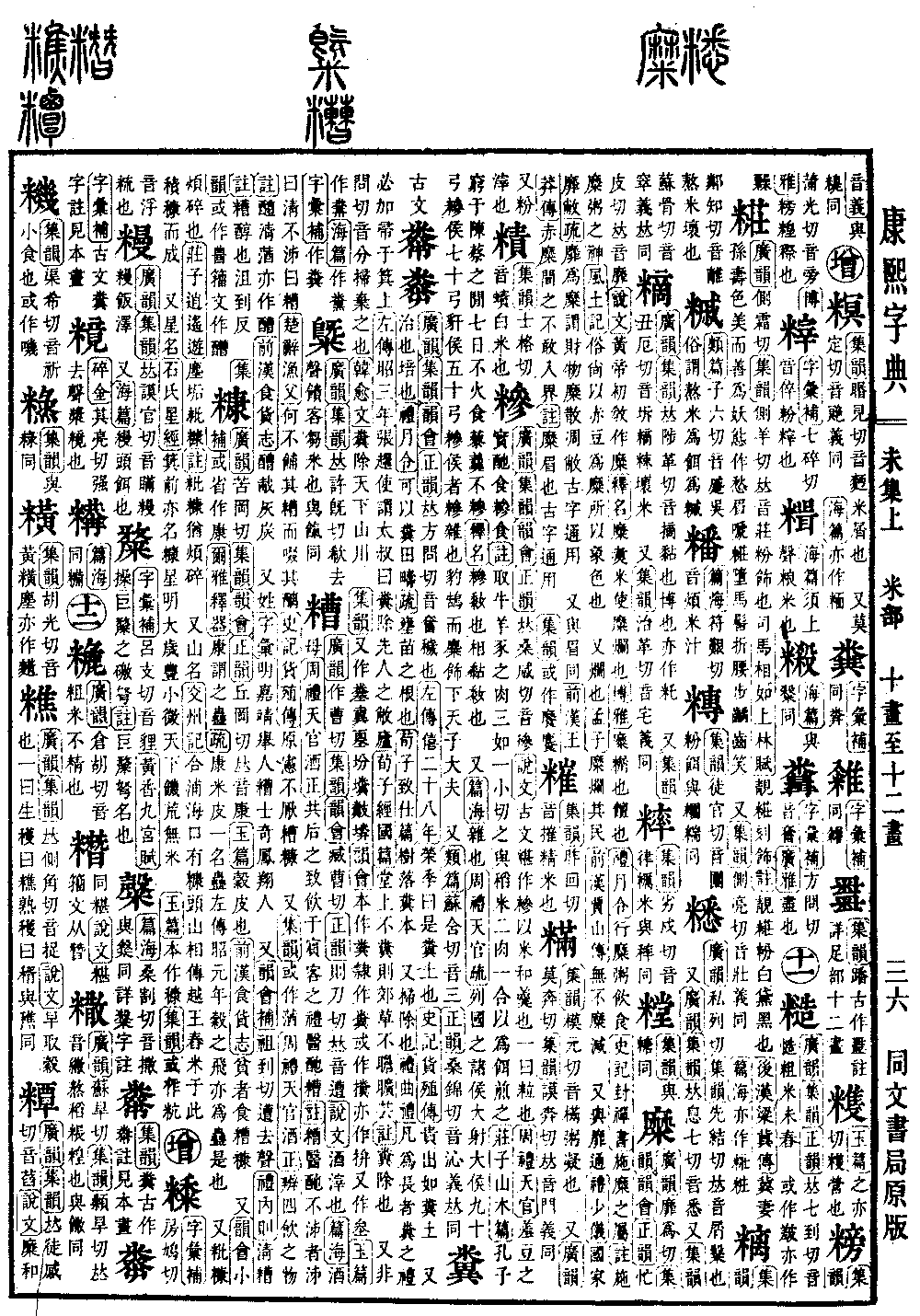
Wei Collection, Upper Volume
Radical: Rice (mǐ)
糟
Kangxi strokes: 17
Page 912, Entry 30
Pronounced zao
According to the Explanatory Dictionary of Chinese Characters (Shuowen), it refers to wine dregs.
In the Comprehensive Collection of Characters (Pianhai), it is defined as the mother of wine.
In the Rites of Zhou (Zhouli), Heaven Official, Wine Administrator: To provide the wine for the rituals offered by the queen to guests, medical dregs are used. The commentary states that dregs refers to medical wine that has not been strained. Strained wine is called clear, while unstrained is called dregs.
In the Songs of Chu (Chuci), The Fisherman: Why not eat the dregs and sip the thin wine?
In the Records of the Grand Historian (Shiji), Biographies of Money-makers: Yuan Xian did not disdain dregs and husks.
Also, according to the Collection of Rhymes (Jiyun), sometimes written in a variant form.
In the Rites of Zhou (Zhouli), Heaven Official, Wine Administrator: Distinguish the items of the four drinks. The commentary states that sweet wine is clear. Sometimes also written in a variant form (zāo).
In the Book of Han (Qianhan), Treatise on Food and Money: Dregs, salted meat, ashes, and charcoal.
Also a surname.
According to the Collection of Characters (Zihui), during the Jiajing period of the Ming dynasty, there was a provincial graduate named Zao Shiqi, a native of Fengxiang.
Also, according to the Supplement to the Collection of Rhymes (Yunhui bu), pronounced zao (falling tone).
In the Book of Rites (Liji), Inner Quarters: Pure dregs. The commentary states that dregs refers to rich, thick wine.
According to the Collection of Rhymes (Jiyun), sometimes written in a variant form. The ancient script form is written as. The origin of the character is defined as the component for grain (qū) below the component for wine (yǒu).