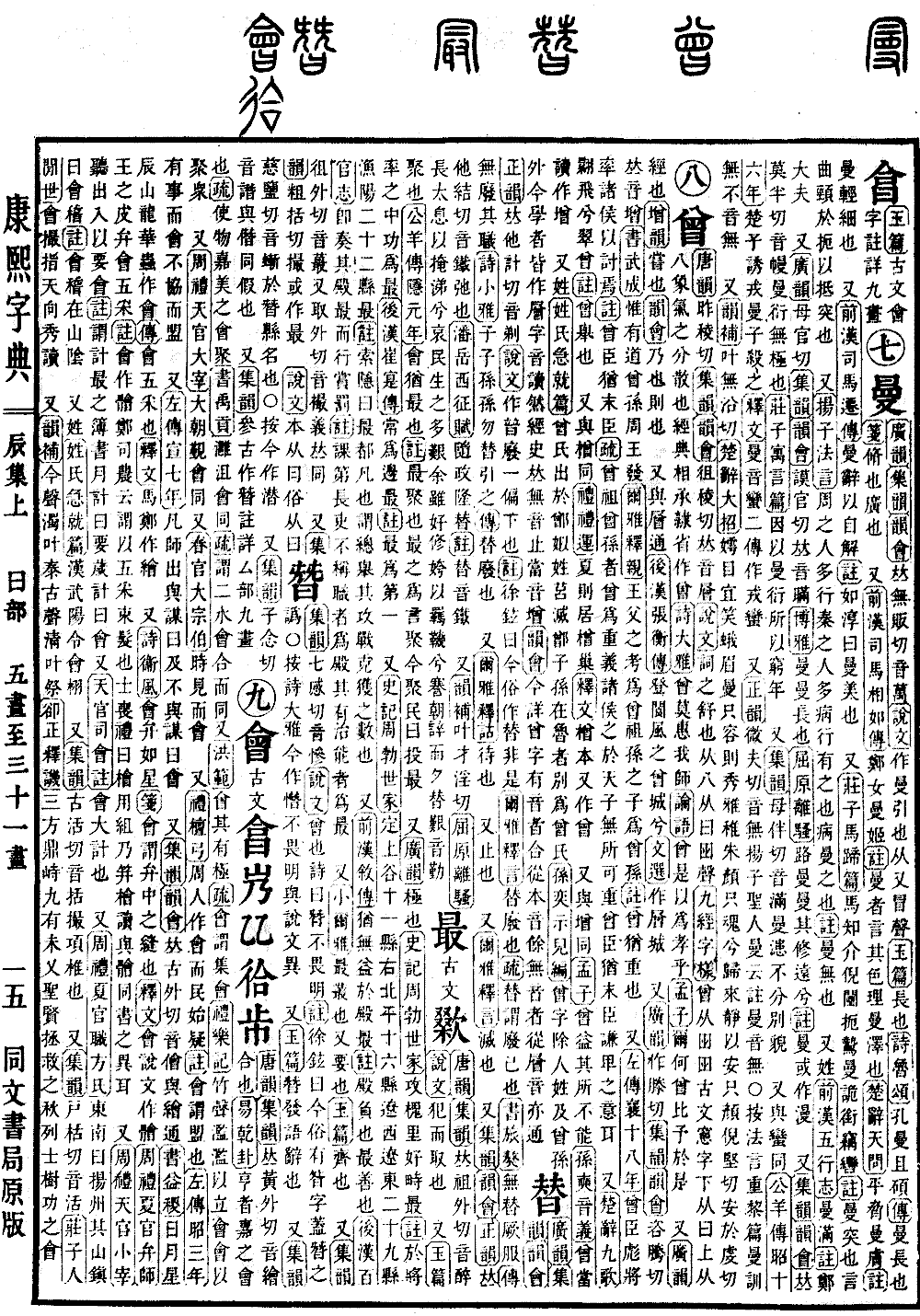
Chen Collection, Upper Volume
Radical: Say (yuē)
Kangxi Strokes: 11
Page 503, Entry 02
Pronounced wan (falling tone).
Shuowen Jiezi (Shuowen): Written as man. To draw out. Composed of the radical for again/hand with the sound component mao.
Yupian: Long.
Book of Odes (Shijing), Odes of Lu (Lusong): Very long and large.
Commentary: Man means long.
Sub-commentary: It means to cultivate and to be vast.
Also: History of the Former Han (Qian Han Shu), Biography of Sima Xiangru: Maidens of Zheng and beautiful ladies.
Note: Man refers to the luster and smoothness of their complexion.
Songs of Chu (Chuci), Heavenly Questions (Tianwen): Flat ribs and smooth skin.
Note: Man means light and fine.
Also: History of the Former Han, Biography of Sima Qian: Beautiful words to justify oneself.
Note: Ru Chun said: Man means beautiful.
Also: Zhuangzi, Horse Hooves: The horse knows how to turn its head to chafe and break the bridle.
Note: Man means to butt, referring to bending the neck against the bridle to butt forward.
Also: Yangzi, Model Sayings (Fayan): The people of Zhou have much conduct, the people of Qin have much illness. Conduct exists, and illness is a lack of it.
Note: Man means to have none.
Also a surname: History of the Former Han, Treatise on the Five Elements: Man Man.
Note: An official of Zheng.
Also: Pronounced man (flat tone).
Guangya: Man man means long.
Songs of Chu (Chuci), Encountering Sorrow (Lisao): The road is long and far away.
Note: Man is sometimes written as man (to spread).
Also: Pronounced man (falling tone).
Man yan means infinite.
Zhuangzi, Allegorical Words: Because of this, it is infinite, which is why it exhausts the years.
Also: Pronounced man (rising tone).
Man huan means indistinct or not clearly differentiated.
Also: Same as the word for barbarian (man).
Gongyang Commentary, Year 16 of Duke Zhao: The Viscount of Chu lured the Manzi of the Rong and killed him.
Explanation of Texts: Man is pronounced like the word for barbarian. Two other commentaries write it as Rong Man (barbarian).
Also: Pronounced wu (rising tone).
Yangzi: The sage says nothing.
Note: Man is pronounced wu (nothing). However, in Model Sayings, Chapter of Chongli, man is defined as nothing, and is not pronounced as the word for nothing.
Also: Rhyme Supplement (Yunbu): Rhymes with the sound wu (level tone).
Songs of Chu, Great Summons: With beautiful eyes that suit smiling, and moth-eyebrows that are long and graceful. The appearance is elegant and refined, with a youthful red face. O soul, return! Be still and find peace.