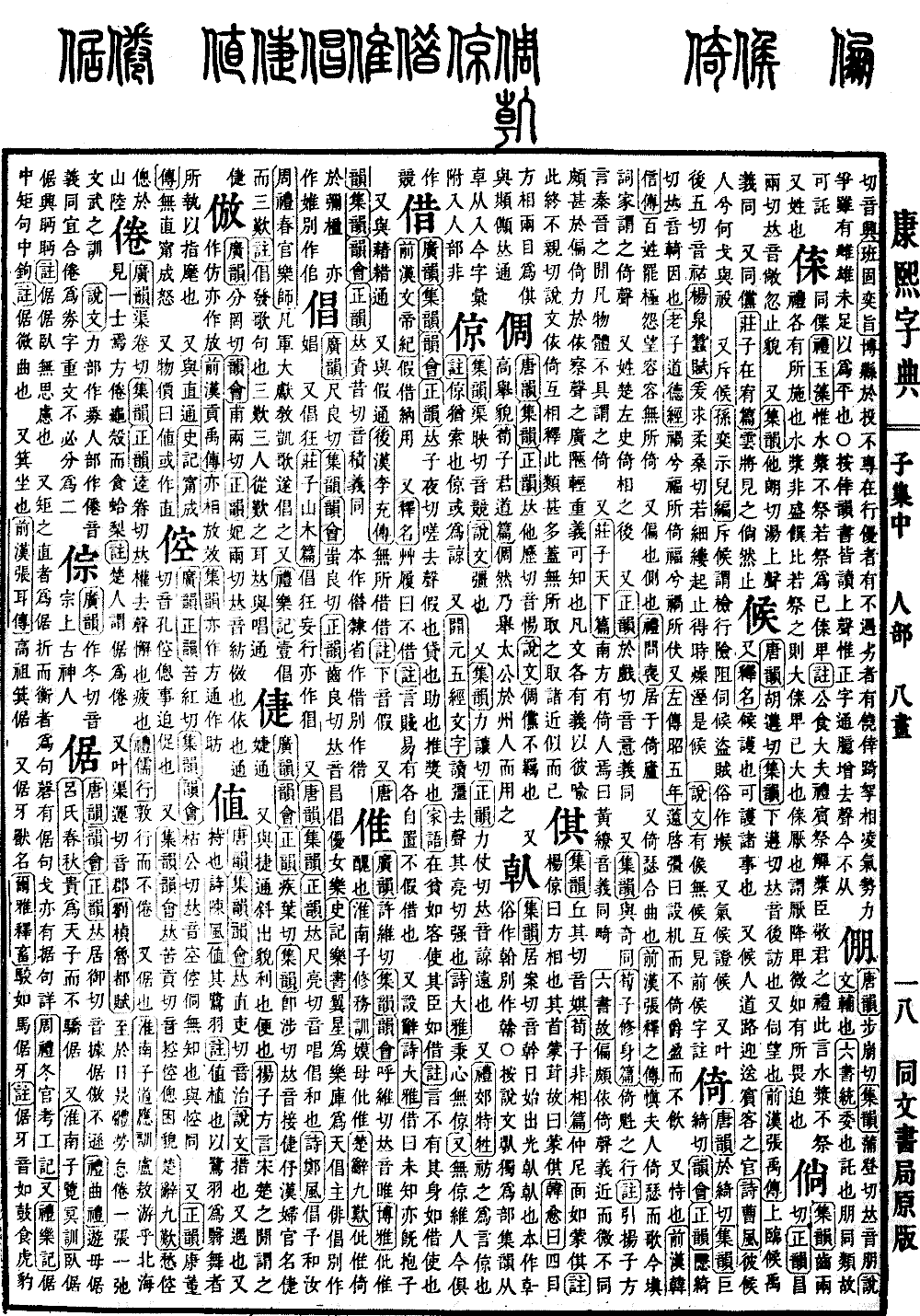
Zi Collection, Middle Volume. Radical: Person (rén). Character: jiè. Kangxi Stroke Count: 10. Page: 108, Position: 10. According to the Guangyun (Guǎngyùn), Jiyun (Jíyùn), Yunhui (Yùnhuì), and Zhengyun (Zhèngyùn), the character is pronounced with the fanqie zǐ yè qiè, which corresponds to the departing tone of the character jiē. The meanings include to borrow, to lend, to help, or to recommend and support. Being in poverty is like being a guest, and employing one's own subordinates is like borrowing them — School Sayings of Confucius (Kǒngzǐ Jiāyǔ). The commentary notes that this refers to not regarding oneself as a private possession, but rather as if borrowed for service. Adopting and employing by means of borrowing — Book of Han (Qiánhànshū). Additionally, straw sandals are called bùjiè. Because straw sandals are cheap and easy to obtain, people prepare their own and have no need to borrow from others — Explaining Names (Shìmíng). It is also used as a hypothetical term. Suppose he is ignorant, yet he is already holding a child — Classic of Poetry (Shījīng). Furthermore, it is interchangeable with the characters jí and jí. It is also interchangeable with the character jiǎ. Having nothing to rely upon — Book of the Later Han (Hòuhànshū). The commentary notes that the character jiè mentioned therein is pronounced as jiǎ. Additionally, according to the Tangyun (Tángyùn), Jiyun, Yunhui, and Zhengyun, the character uses the fanqie zī xī qiè and is pronounced as jī. The meaning is the same. The original form was written as a variant character, simplified in clerical script as jiè, and also written as the variant form jiè. Textual Research: Regarding the entry in Explaining Names stating straw sandals are called bùjiè. The original annotation said that because they are cheap and easy to obtain and everyone prepares their own, they are not borrowed. This has been carefully amended according to the original text to: Straw sandals are called bùjiè. Explaining Names states that because straw sandals are cheap and easy to obtain, people prepare their own and do not borrow from others.