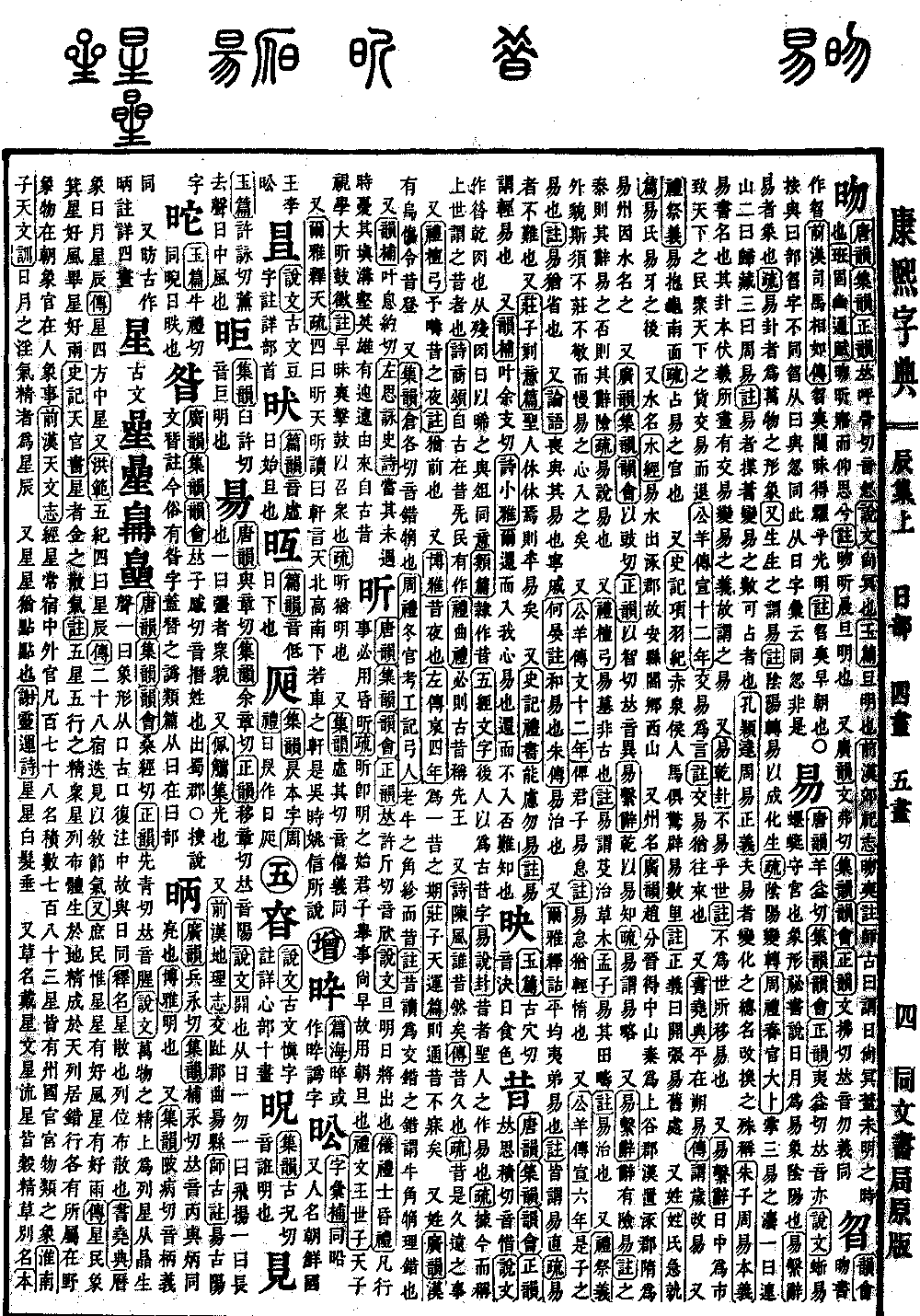
Chen Collection, Upper Volume
Radical: Sun (rì)
Page 492, Entry 21
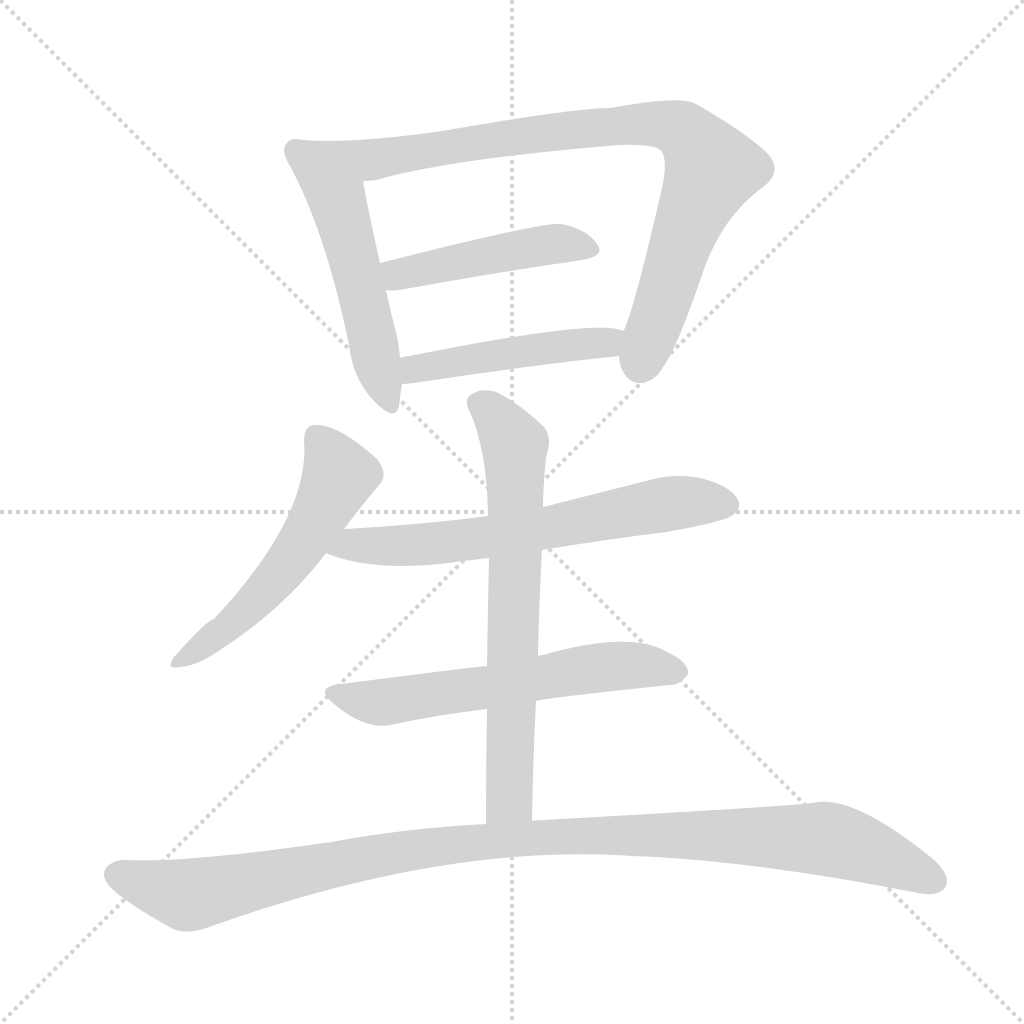
Ancient character forms were written as variant form (xīng) or variant form (xīng).
According to Tang Rhyme (Tangyun), Collection Rhyme (Jiyun), and Rhyme Meeting (Yunhui), the pronunciation is xīng; according to Correct Rhymes (Zhengyun), the pronunciation is xīng; the sound is the same as xīng.
Explaining Graphs and Analyzing Characters (Shuowen Jiezi) defines: Stars are the essence of the myriad things, which rise to become the aligned celestial bodies. The character structure uses Crystal (jīng) as the radical and Life (shēng) as the phonetic component. Another interpretation holds that it is a pictograph using the component Mouth (kǒu). In ancient forms, a dot was added within Mouth, which is why it resembles the character for Sun (rì).
Explanations of Names (Shiming) defines: Stars (xīng) means to disperse; they are arranged and distributed across the sky.
Book of Documents (Shangshu), Canon of Yao (Yaodian) records: Observe and calculate the movements of the sun, moon, and stars.
Commentary: Star refers to the constellations of the four directions and the center.
Also, Book of Documents (Shangshu), Great Plan (Hongfan) records: Of the five methods of recording time, the fourth is the stars.
Commentary: The twenty-eight lunar mansions appear in rotation to determine the order of the solar terms.
It also records: The common people are like the stars; some stars favor the wind, others favor the rain.
Commentary: The stars symbolize the people; the Winnowing Basket (jī) constellation favors wind, and the Net (bì) constellation favors rain.
Records of the Grand Historian (Shiji), Treatise on the Celestial Offices (Tianguanshu) records: Stars are formed from the dispersion of metal essence.
Commentary: The five planets are the essence of the five phases; the myriad stars are distributed and arranged. Their physical forms arise from the earth, while their essence is perfected in the heavens. Distributed and aligned, each has its proper place. In the wilderness, they symbolize the myriad things; in the imperial court, they symbolize government offices; among the people, they symbolize human affairs.
History of the Former Han (Qianhanshu), Treatise on Astronomy (Tianwenzhi) records: The constant stars and common constellations, including those inside and outside the central region, consist of one hundred seventy-eight names and a total of seven hundred eighty-three stars, all of which correspond to provinces, states, government offices, palaces, and categories of things.
Huainanzi, Treatise on Astronomy (Tianwenxun) records: The surplus essence of the sun and moon forms the stars.
Also, the reduplicated form xīngxīng describes something small or dot-like.
A poem by Xie Lingyun writes: Sparse white hairs hang down.
It also refers to a type of herb. Daisy-star, literary-star, and shooting-star are all aliases for the pipewort (gǔjīngcǎo).
Compendium of Materia Medica (Bencao Gangmu) records: This herb grows in grain fields; the tops of its stems have small white flowers, resembling scattered stars.
Also serves as a surname.
Guangyun cites the Family Biography of the Yang Clan (Yangshi Jiachuan) to record: Yang Xu, the Prefect of Nanyang, married the daughter of Xing Zhong from Jibei.