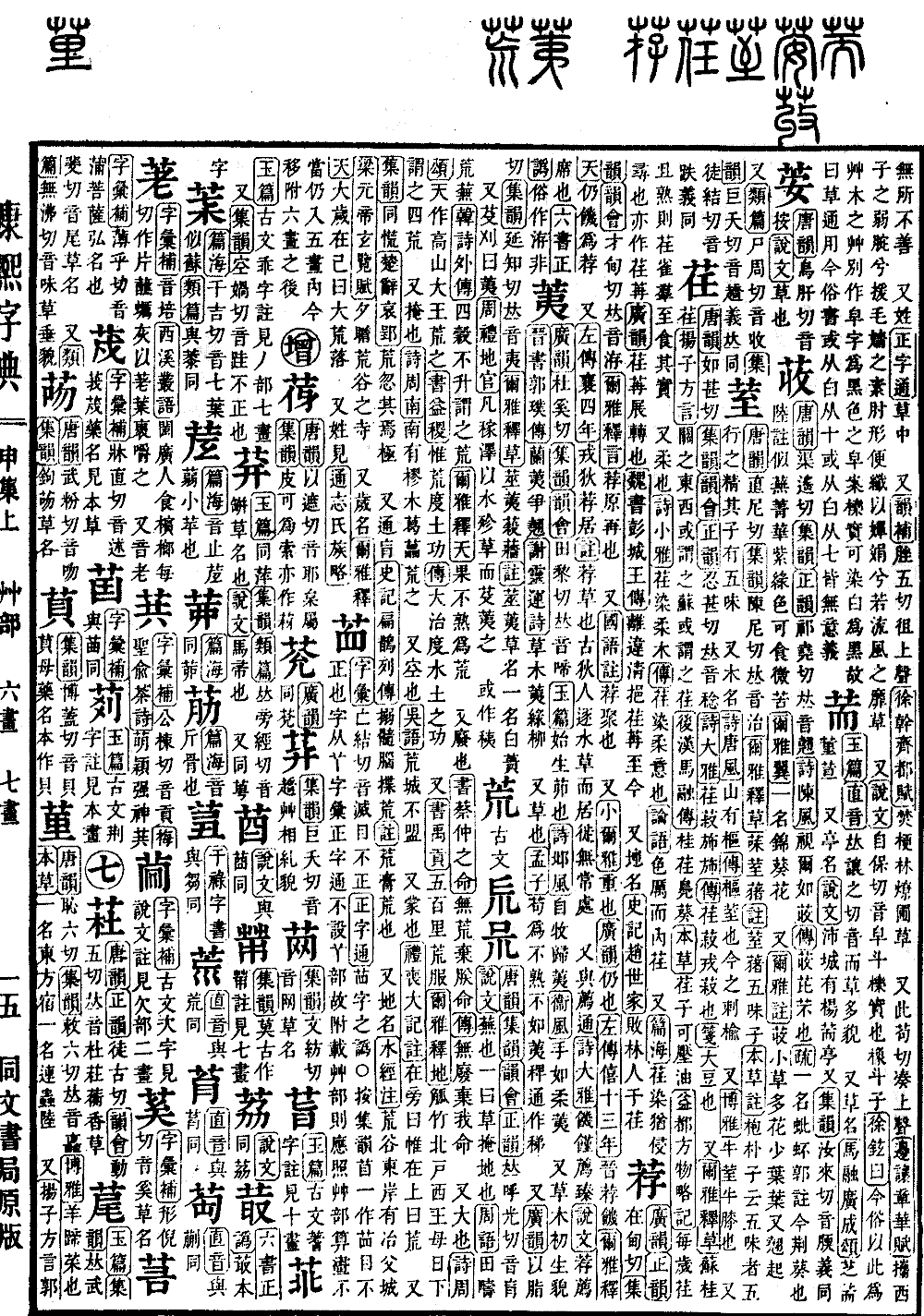
Shen Collection, Upper Volume
Radical: Grass (cǎo)
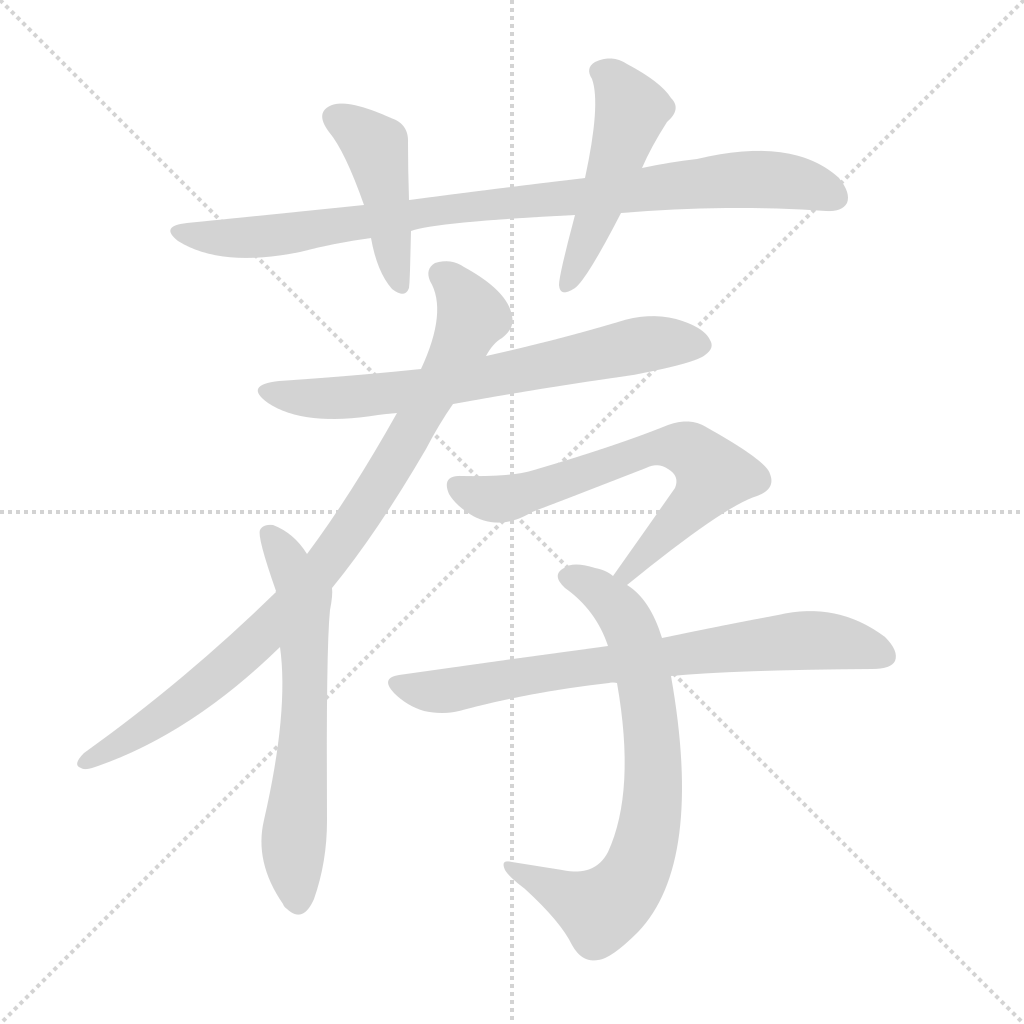
Jian
Kangxi Stroke Count: 19
Page 1031, Entry 06
Pronounced jian (falling tone).
Erya (Erya): Shi yan, signifies twice or repeated. Also, according to the commentary on the Discourses of the States (Guoyu), jian signifies to accumulate. Furthermore, according to the Xiao Erya (Xiao Erya), it signifies to be heavy. According to the Guangyun (Guangyun), it signifies to continue. According to the Zuo Commentary (Zuo zhuan), 13th year of Duke Xi, Jin experienced repeated famines. According to the Erya (Erya): Shi tian, a famine that follows another is called jian. Also, according to the Zuo Commentary (Zuo zhuan), 4th year of Duke Xiang, the Rong and Di peoples resided in jian. The commentary states: jian signifies grass, meaning the Di people followed the water and grass to reside, moving without a permanent location. It is also used interchangeably with jian (to recommend). According to the Book of Odes (Shijing), Greater Odes: Famines and scarcities arrived repeatedly. According to the Shuowen Jiezi (Shuowen), jian signifies a grass mat. According to the Liushu Zheng'e (Liushu zheng'e), the common form jian is incorrect.
Textual research: In the Zuo Commentary (Zuo zhuan), 4th year of Duke Xiang, it is written: the Rong and Di peoples resided in jian. The commentary states: jian signifies grass, meaning the Di people followed the water and grass to reside. Following the original text, the word gu (ancient) has been changed to yan (speech).