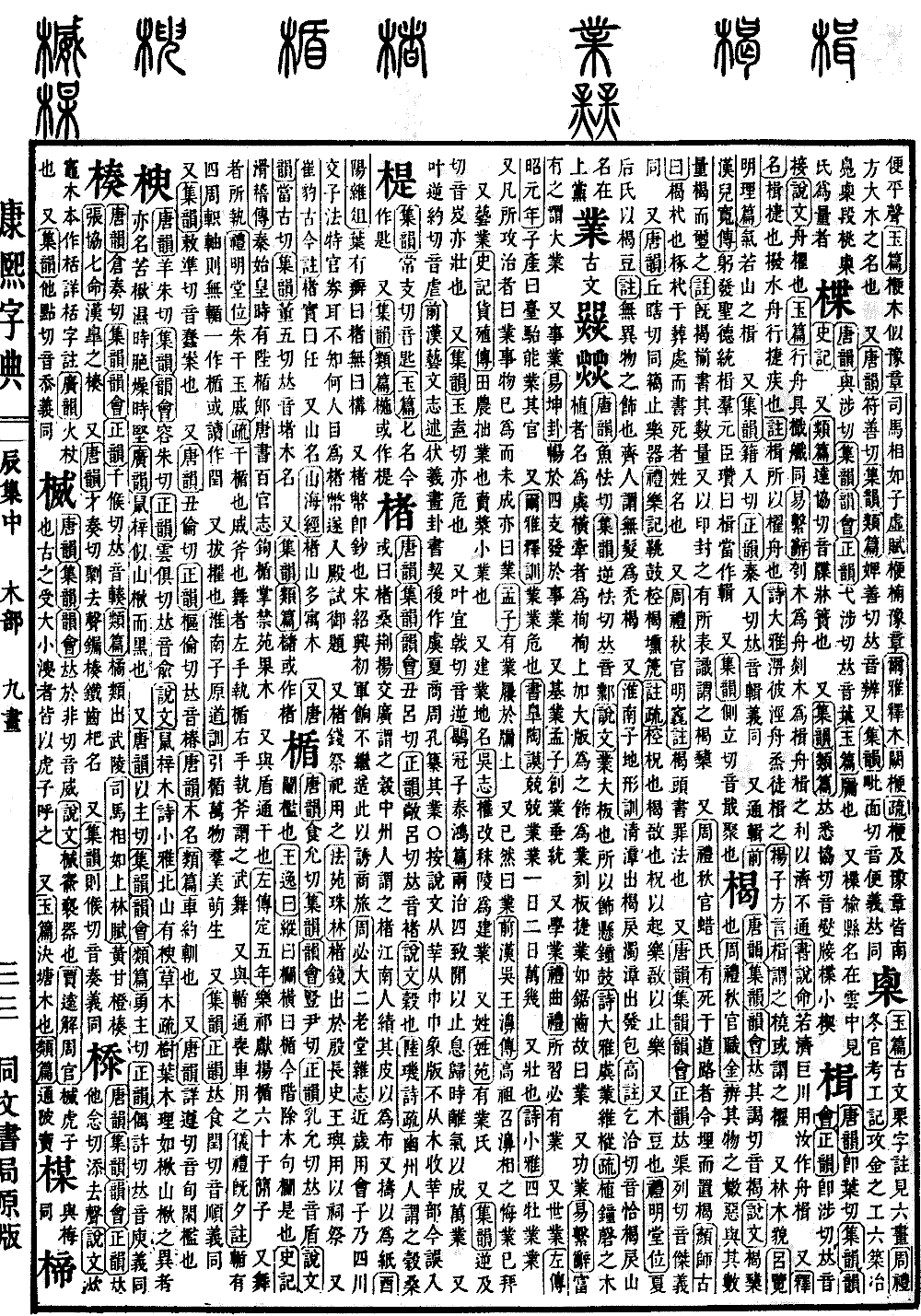
Chen Collection, Middle Volume
Radical: Tree (mù)
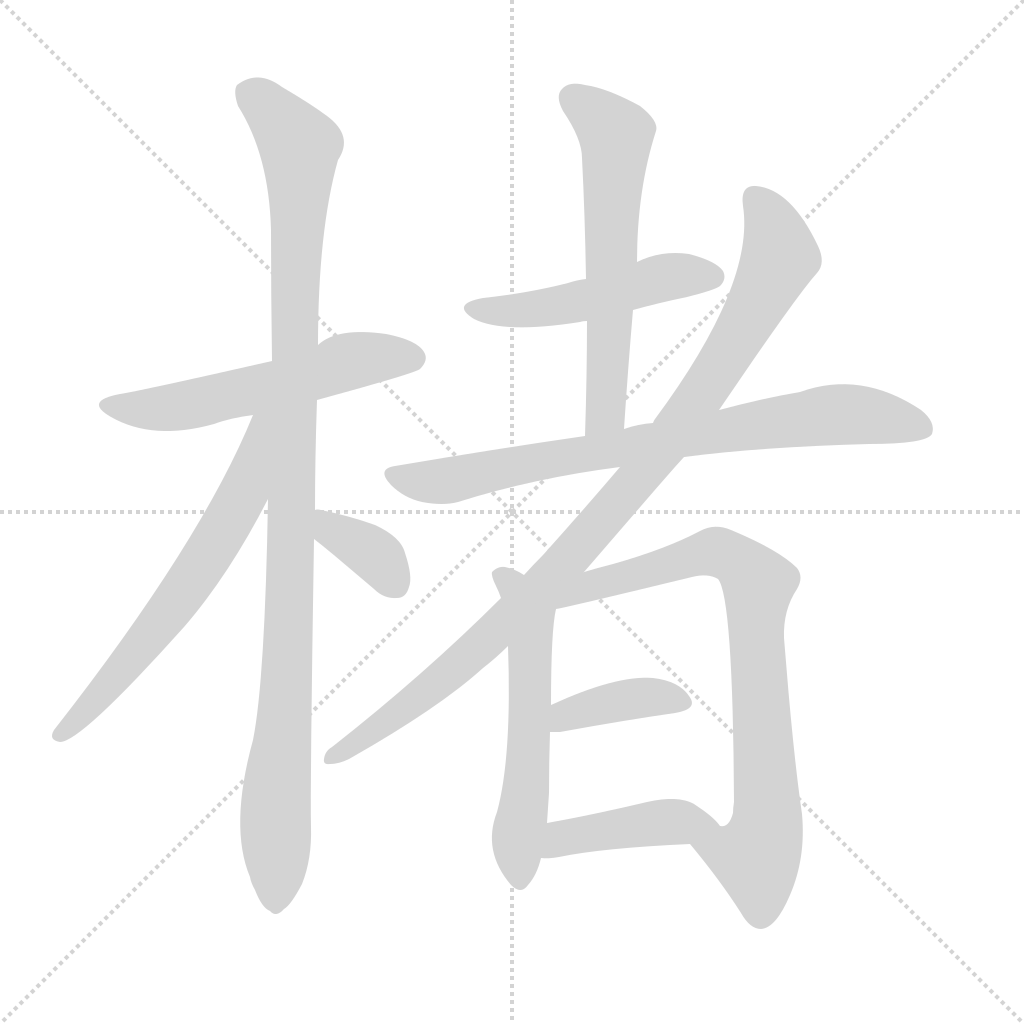
Chu
Kangxi strokes: 13
Page 541, Entry 09
According to Tang Rhymes (Tangyun), Collected Rhymes (Jiyun), and Rhyme Compendium (Yunhui), pronounced chu (rising tone). According to Correct Rhymes (Zhengyun), pronounced chu (rising tone).
In Explaining Graphs and Analyzing Characters (Shuowen), it refers to the paper mulberry tree. Lu Ji, in his Commentary on the Book of Odes (Shijing), states that people in Youzhou call it valley mulberry, while others call it paper mulberry. In the regions of Jing, Yang, Jiao, and Guang, it is called valley, and in the Central Plains, it is called chu. People in the Jiangnan region weave its bark into cloth and also pound it to make paper.
In Miscellaneous Morsels from Youyang (Youyang Zazu), it is noted that if the leaves have lobes, it is called chu; if not, it is called gou.
Chu currency refers to banknotes. Early in the Shaoxing reign of the Song dynasty, when military provisions were insufficient, these were created to entice merchants and travelers.
In Zhou Bida’s Erlaotang Magazine, it is written that the recent use of huizi currency follows the jiaozi method of Sichuan and is merely an official bond. It is unknown who first labeled it as chu currency, a term that eventually appeared in the imperial examination questions.
Chu money refers to paper offerings used in ancestral sacrifices. In the Forest of Gems in the Garden of the Law (Fayuan Zhulin), it is stated that chu money originated with the historiographer Wang Yu of the Yin dynasty, who used it for sacrificial rites.
According to Cui Bao’s Notes on Ancient and Modern Matters (Gujin Zhu), the fruit of the chu tree is called ren.
There is also a mountain by this name. In the Classic of Mountains and Seas (Shanhaijing), it is noted that Mount Chu abounds in yu wood.
According to Tang Rhymes (Tangyun), pronounced du (rising tone). According to Collected Rhymes (Jiyun) and Categorized Texts (Leipian), it is also written as zhu. The name of a tree.