Xu Collection, Upper Volume
Radical: Metal (jīn)
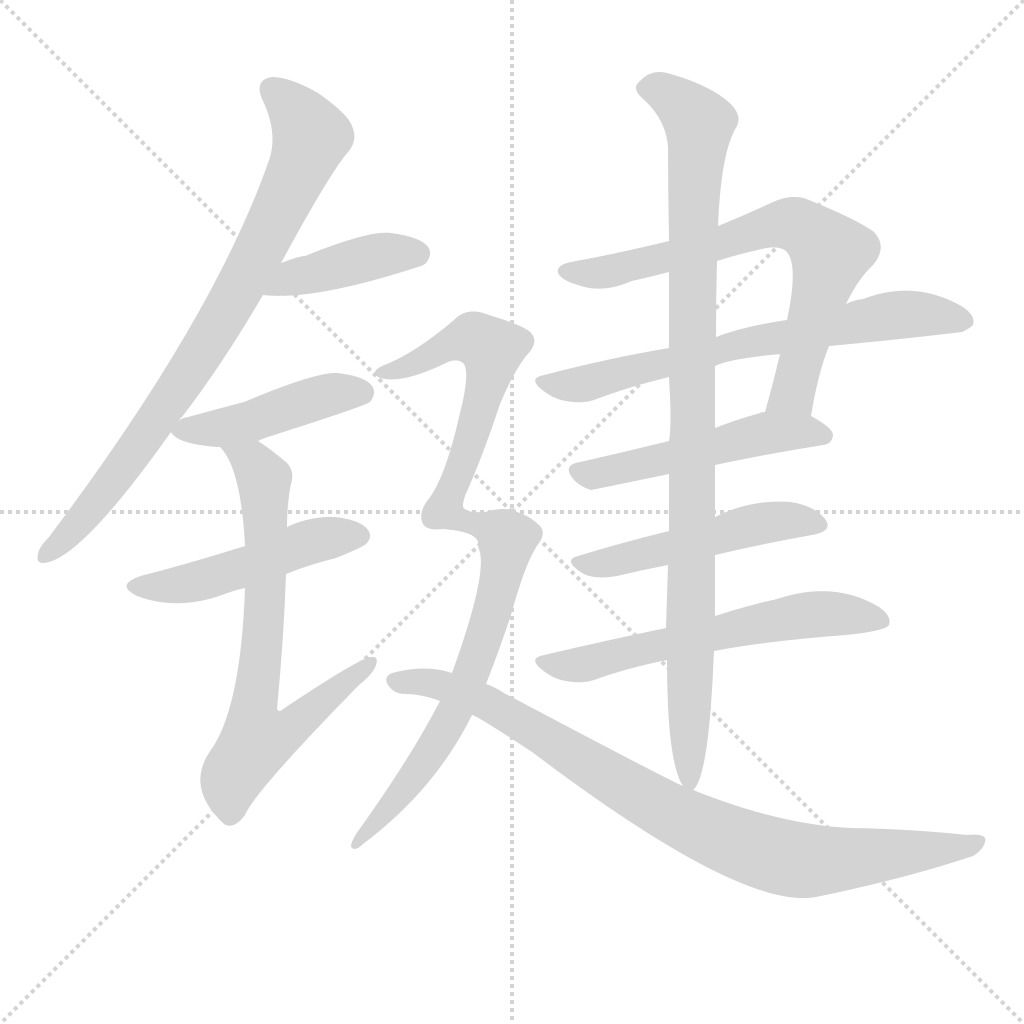
Key
Kangxi stroke count: 17
Page 1315, Entry 01
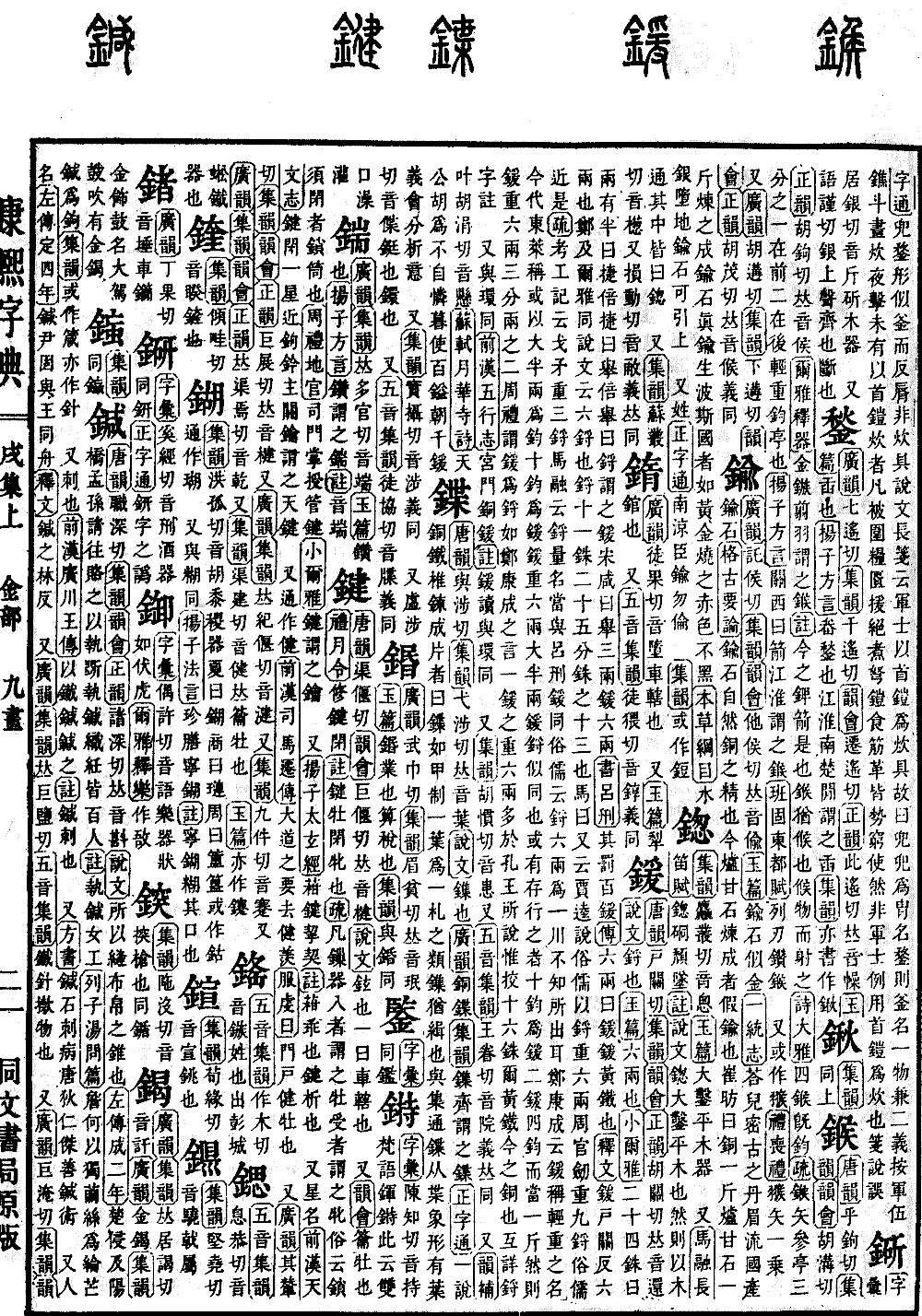
Pronounced jiàn. According to the Shuowen Jiezi, it refers to the ring on a tripod. It also refers to the lynchpin of a carriage wheel. According to the Rhyme Compendium (Yunhui), it refers to the bolt of a lock. In the Book of Rites (Liji), specifically the Monthly Ordinances (Yueling) chapter, it is mentioned to repair the bolts and locks. The commentary notes that the bolt is the male part and the lock is the female part. The sub-commentary states that for all locking devices, the part that enters is called the male, and the part that receives it is called the female; common parlance refers to these as lock cylinders. In the Rites of Zhou (Zhouli), under the Earth Offices, the Gate Keeper is in charge of granting access to keys and bolts. In the Minor Erya (Xiao Erya), the bolt is referred to as a key. Also, in the Taixuanjing by Yang Xiong, it mentions the bolt separates and splits. Additionally, it is the name of a star. In the Book of Han (Hanshu), Treatise on Astronomy, the Heavenly Bolt star is near the Gounian star, governing locks and keys. It is also used interchangeably with the character meaning robust. In the Book of Han, Biography of Sima Qian, it discusses the essentials of the Great Way to manage desires. The commentator Fu Qian states this refers to the male bolt of a door. Also pronounced jiàn. Also pronounced jiàn. Also pronounced jiǎn. Also pronounced gān. Also pronounced jiàn. It refers to the bolt of a lock. According to the Yupian, it is also written as a variant form.