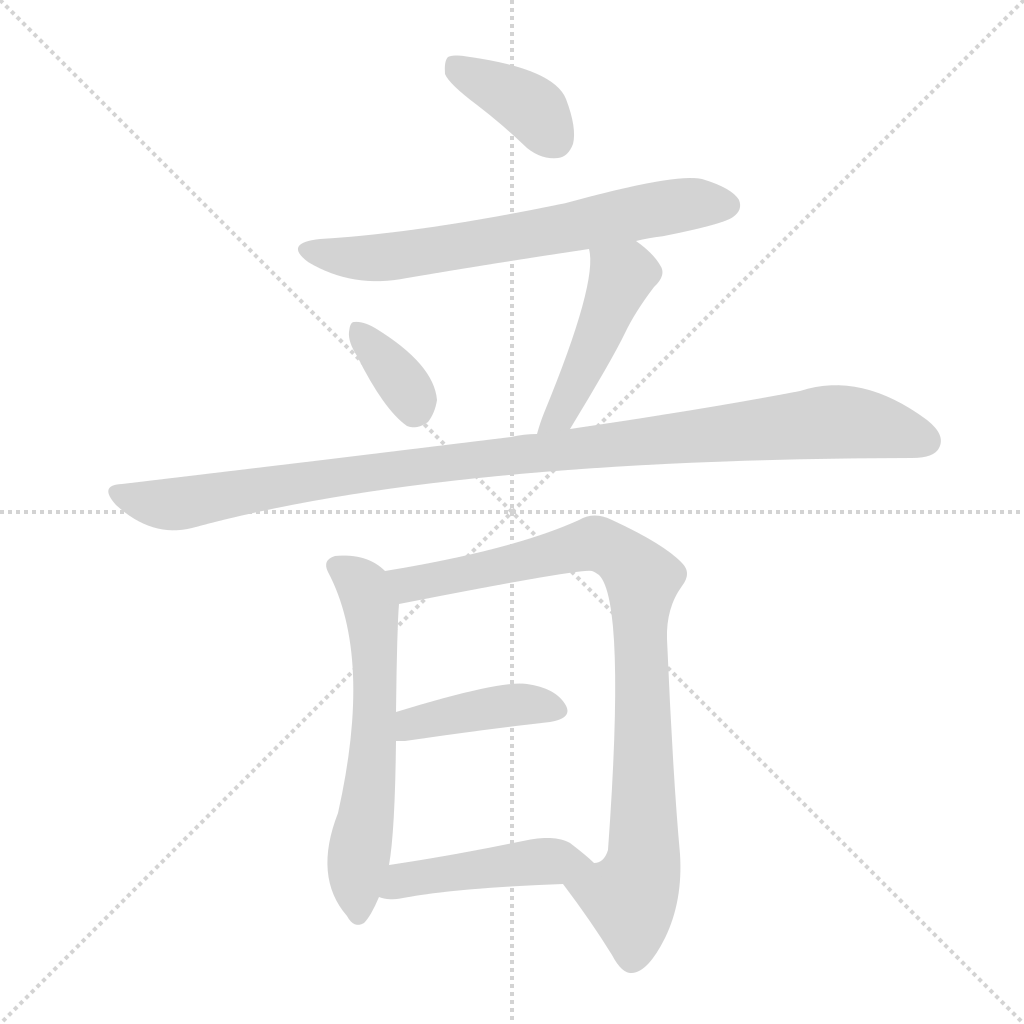
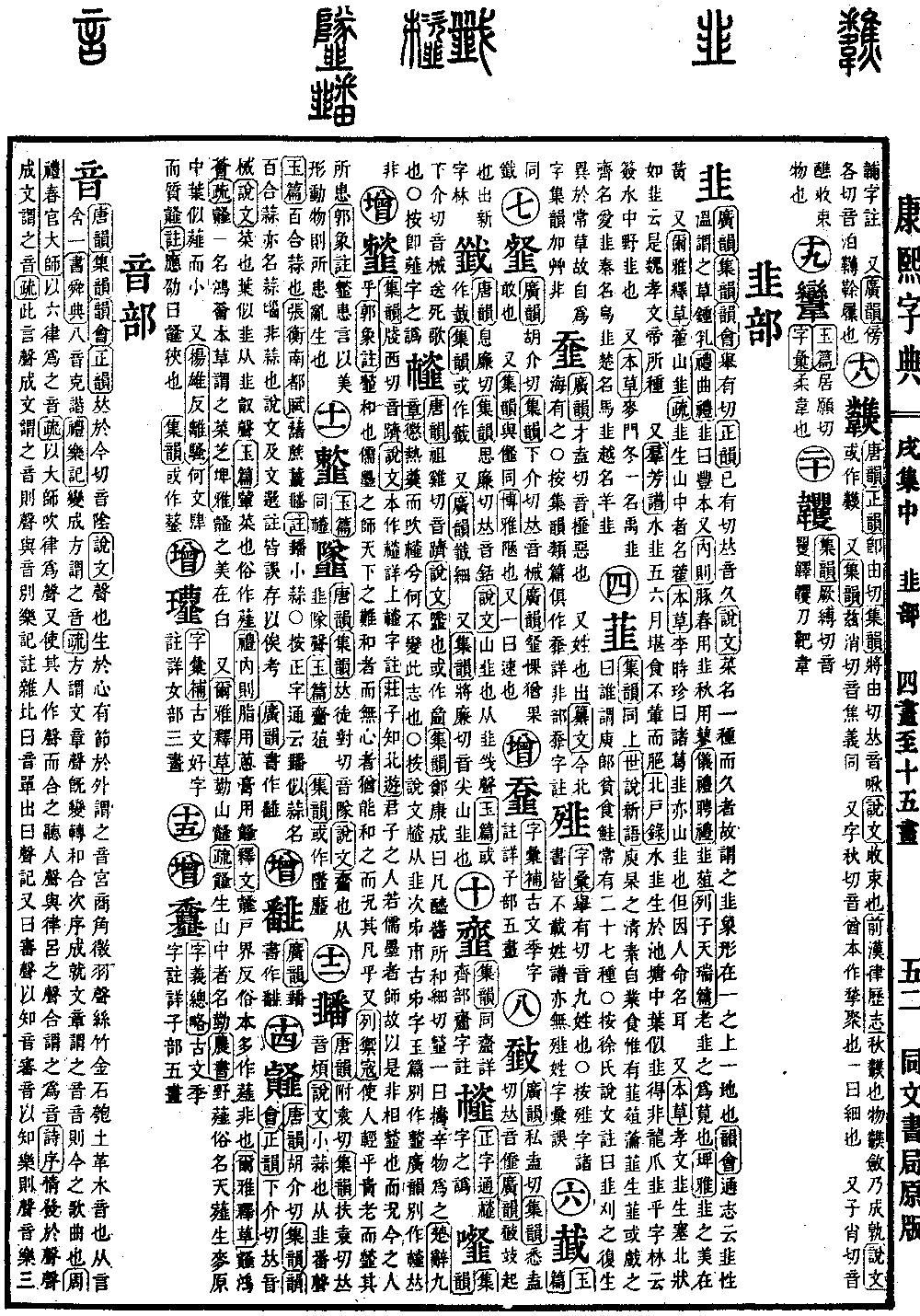
Xu Collection, Middle Volume
Radical: Sound (yīn)
Kangxi Strokes: 9
Page 1396, Entry 25
Pronounced yīn.
Shuowen Jiezi (Explanation of Writing and Analysis of Characters): Sound. Born from the heart, with external articulation, it is called sound. Gong, shang, jue, zhi, and yu are [types of] sound. Silk, bamboo, metal, stone, gourd, earthenware, leather, and wood are [sources of] sound. Composed of the radical for speech, containing the symbol for one.
Book of History (Shangshu): The eight sounds are in harmony.
Book of Rites (Liji): Transformation into patterns is called sound.
Commentary: Patterns refer to literary composition. When sounds are transformed and harmonized, following an order to form a composition, it is called sound. Sound is what we now call song.
Rites of Zhou (Zhouli): Use the six pitch pipes to create sound.
Commentary: The grand master blows the pitch pipes to determine the pitch, and then has people produce sounds to harmonize with them; when the human voice matches the sound of the pitch pipes, it is called sound.
Preface to the Book of Odes (Shijing): When emotions are expressed through sound, and the sound forms patterns, it is called sound.
Commentary: This states that sound forming patterns is called sound, which explains the difference between sound and musical sound. The commentary to the Record of Music (Yueji) states: Intertwined combinations are called sound, while a single occurrence is called sound. The Record of Music further states: By examining sound one can understand musical sound; by examining musical sound one can understand music. Therefore, sound, musical sound, and music are three different things. It is because sound changes that it becomes musical sound, and because musical sound is harmonious that it becomes music, hence the use of three separate names. Relatively speaking, they are distinct, but generally speaking, they can be used interchangeably. When Jizha heard the singing of the Qin Odes, he said: This is what is called the sound of Huaxia. The Gongyang Commentary states: When the tax system of taking one-tenth was implemented, songs of praise arose; here, sound refers to musical sound. Further on, it mentions the music of a well-governed era; here, musical sound refers to music. This indicates that sound, musical sound, and music can be used interchangeably.
Also, Book of Changes (Yijing): The sound of a bird rising to heaven.
Book of Rites (Liji): The chicken is called the sound of a bird.
Also a surname. See the Surname Garden (Xingyuan).
Also pronounced yìn. Used interchangeably with the character for shade.
Zuo Commentary (Zuozhuan): When a deer dies, it does not choose a place of shade.
Du Yu Commentary: Sound refers to a place of shade. It is an ancient loan character. According to the commentary, it is a loan because the ancient character shared the same sound and could be borrowed; furthermore, the Explanation of Sounds (Shiwen) records the pronunciation as yìn (falling tone), not the level tone; the pronunciation provided in the Correct Rhymes (Zhengyun) is incorrect.
Textual Research: Preface to the Book of Odes (Shijing): Sound forming patterns is called sound. Commentary: Jizha heard the singing of Qin and said: This is called the sound of Huaxia. [Correction]: According to the original text, Jizha has been corrected to Jizha.