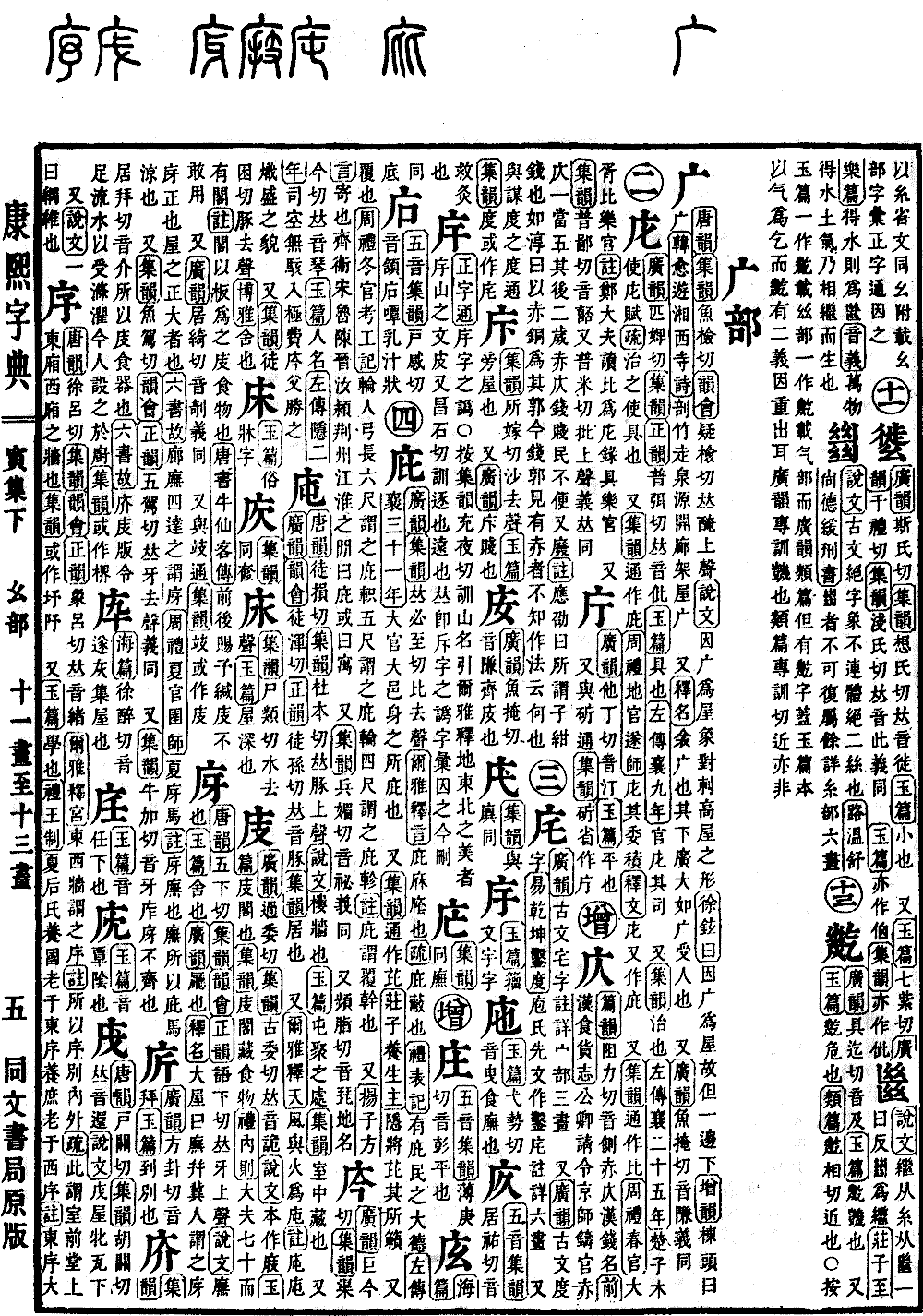
Yin Collection, Lower Volume
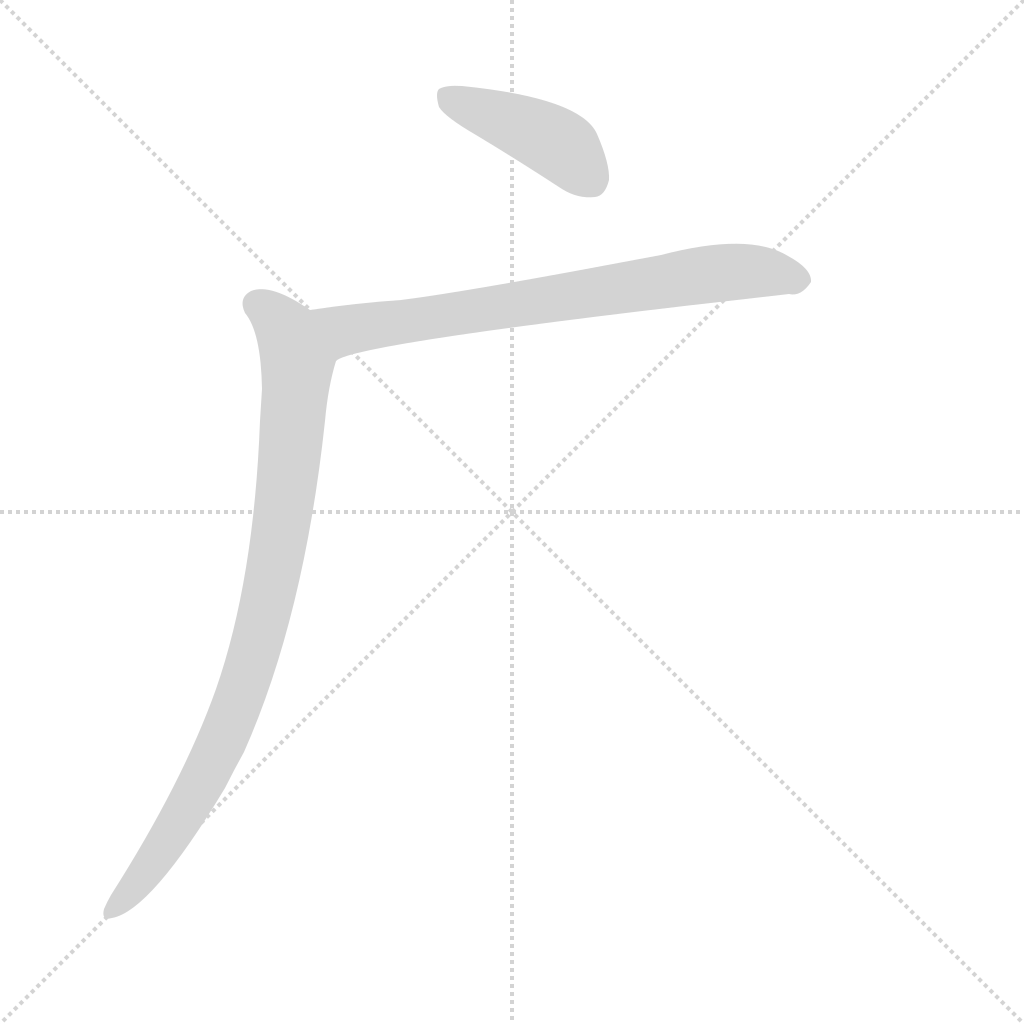
Radical: Wide (guǎng)
Kangxi Strokes: 15
Page 343, Entry 05
Pronounced yan (rising tone).
Explaining (Shuowen Jiezi): To build a house leaning against a cliff. The shape of the character resembles tall buildings facing one another.
Xu Xuan says: Because the structure relies on a cliff, the eaves hang down only on one side.
Additional Rhymes (Zengyun): Refers to the top of a roof ridge as guǎng.
Han Yu, Poem on Visiting the Xiangxi Temple: Splitting bamboo to lead the spring source, opening corridors and erecting roof eaves.
Also, Explanations of Names (Shiming): A quilt is called qin, which carries the meaning of guǎng. Its lower portion is wide and ample, just as guǎng is capable of containing a person.
Also, Extensive Rhymes (Guangyun): Pronounced yan (rising tone), with the same meaning.
Pronounced guang (rising tone).
Explaining (Shuowen Jiezi): The great roof of a palace hall.
Also, Jade Chapters (Yupian): guǎng means large.
Extensive Rhymes (Guangyun): guǎng means wide or vast.
Book of Changes (Yijing), Appended Remarks: Its vastness and greatness can correspond with heaven and earth.
Commentary: Greatness is used to match heaven, and vastness is used to match the earth.
Also used as a prefecture name.
Book of Tang (Tangshu), Treatise on Geography: Guangzhou was established in the Lingnan circuit.
Also used as a surname.
Genealogy of Surnames (Xingpu): Originating from Danyang, descendants of Guang Chengzi; in the Song Dynasty there was a person named Guang Han.
Also, Jade Chapters (Yupian): Pronounced kuang (departing tone).
Rites of Zhou (Zhouli), Earth Offices, Grand Minister of Instruction: Fully understand the vastness and the numerical range of the Nine Provinces.
Commentary: Ma Rong says: The east-west direction is called guǎng, while the north-south direction is called lun.
Explication of Texts (Shiwen): guǎng, pronounced kuang.
Also used as a name for a chariot.
Rites of Zhou (Zhouli), Spring Offices, Chariot Attendant: The chariot division.
Annotation: Chariot units used in horizontal tactical formations.
Explication of Texts (Shiwen): guǎng, pronounced kuang.
Zuo Tradition (Zuozhuan), Year 28 of Duke Xi: The western and eastern chariot divisions.
Commentary: The State of Chu had left and right chariot divisions, likely the names of their war chariots.
Year 2 of Duke Xuan: Divided into two divisions.
Annotation: Fifteen war chariots are referred to as one division.
Also, Investigation of Characters (Zhengzitong): Pronounced kuang.
Xunzi, Section on Kings and Hegemons: Why is the monarch not broad-minded?
Annotation: guǎng means the appearance of being broad and at ease.
Also interchangeable with the character kuang.
Book of Former Han (Qianhan), Treatise on the Five Elements: Military expeditions exceeding their allotted time are called guǎng.
Also pronounced guang, with the same sound as guang.
Approximation of Terms (Erya), Explaining Animals: A horse with swirling hair on its back is called que-guang.
Commentary: In Bole's method of evaluating horses, a horse with a swirl on its back is called que-guang.
Pronunciation and Meaning: guǎng, pronounced guang.
Also, Supplement to Rhymes (Yunbu): Rhymes with the sound gu.
Book of Rites (Liji), Record of Music: Speaking of this ancient music, the advances and retreats were uniform, the tones were centered and broad, the stringed, gourd, sheng, and huang instruments were all synchronized with the rhythm of the drums and clappers, beginning with elegant melodies and ending with martial ones.