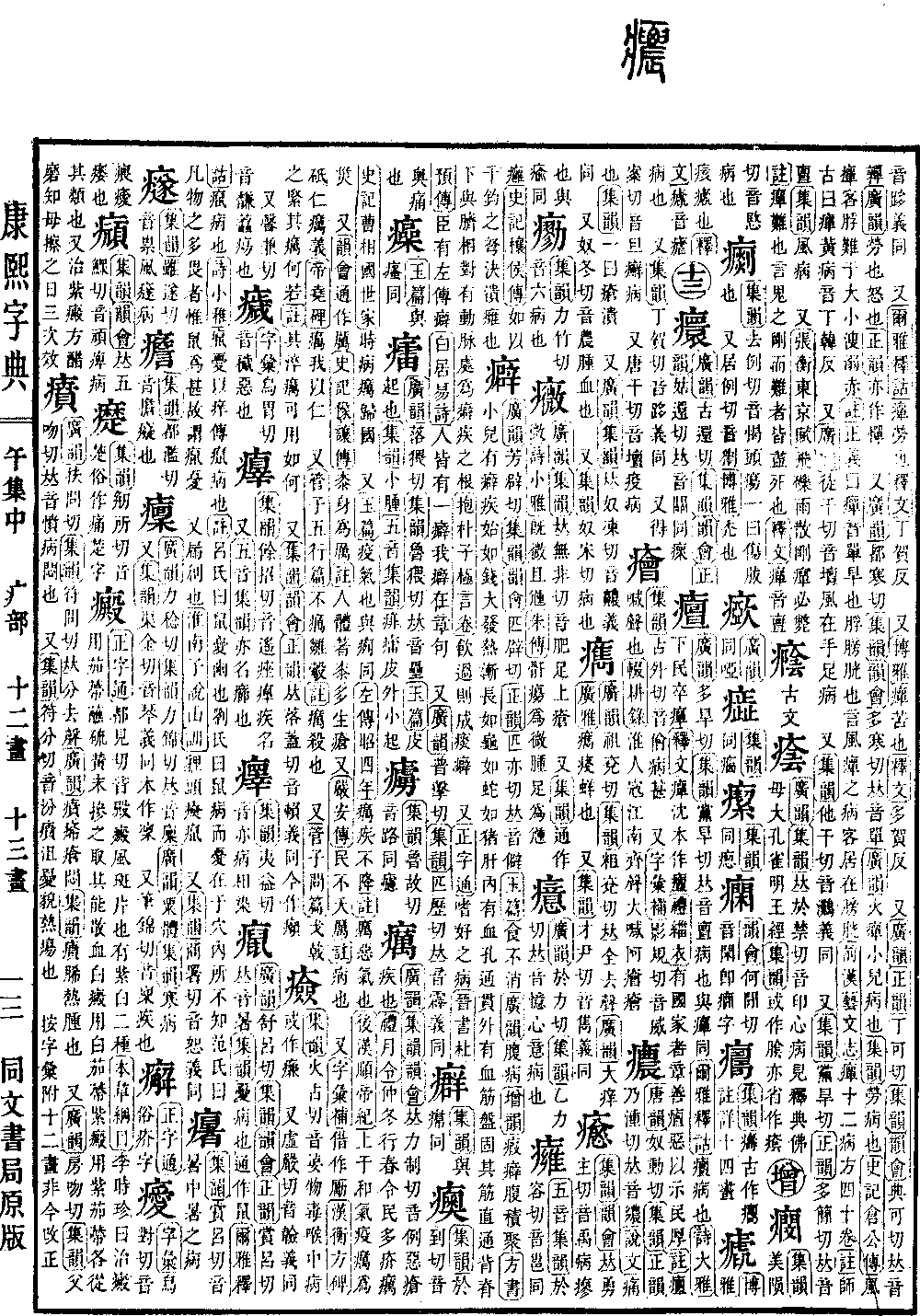
Wu Collection, Middle Volume
Radical: Sickness (bìng)
Entry: 18 strokes
Page 781, Entry 06
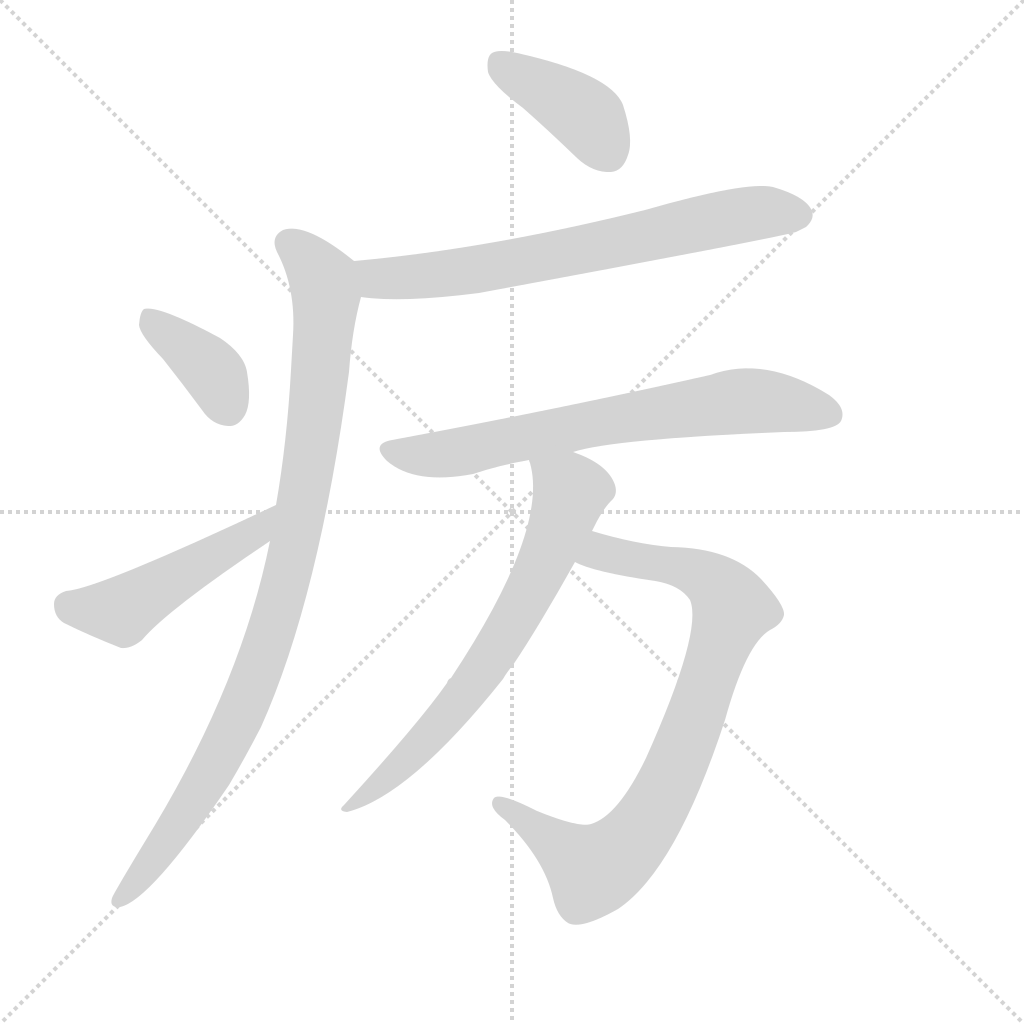
According to The Extensive Dictionary (Guangyun) and The Collected Rhymes (Jiyun), and The Rhyme Anthology (Yunhui), the pronunciation is li (falling tone). It refers to malignant sores or disease.
Book of Rites (Liji), Monthly Ordinances: In the middle of winter, if the ordinances of spring are carried out, the people will suffer much from scabies and pestilence.
Records of the Grand Historian (Shiji), Biography of Chancellor Cao: At that time, he returned to his state due to illness and pestilence.
Also, according to The Jade Encyclopedia (Yupian), it refers to epidemic qi. It is the same as the variant form.
Zuo Tradition (Zuozhuan), Fourth Year of Duke Zhao: If pestilential diseases do not descend.
Commentary: Pestilence means malignant qi.
Book of the Later Han (Houhanshu), Annals of Emperor Shun: If the upper reaches disturb the harmonious qi, epidemic pestilence will become a disaster.
Also, according to The Rhyme Anthology (Yunhui), it is also commonly written as li (falling tone).
Records of the Grand Historian (Shiji), Biography of Yu Rang: He coated his body with lacquer to become afflicted with sores.
Commentary: When the human body is coated with lacquer, it often develops sores.
Also, Biography of Yan An: The people did not die young from disease.
Commentary: It means illness.
Also, according to Supplement to the Collection of Characters (Zihuibu), it is borrowed to mean encouragement.
Han Dynasty, Stele of Heng Fang: To hone benevolence and encourage righteousness.
Emperor Yao: To encourage me with benevolence.
Also, Guanzi, Five Elements Chapter: Do not kill the chicks or grains.
Commentary: Pestilence here means to kill.
Also, Guanzi, Questions Chapter: Regarding the sharpness of the halberds and spears, how is their tempering?
Commentary: It refers to how the tempering and sharpening can be used.
Also, according to The Collected Rhymes (Jiyun), The Rhyme Anthology (Yunhui), and The Correct Rhymes (Zhengyun), the pronunciation is lai (falling tone). The meaning is the same. It is now written as lai (falling tone).