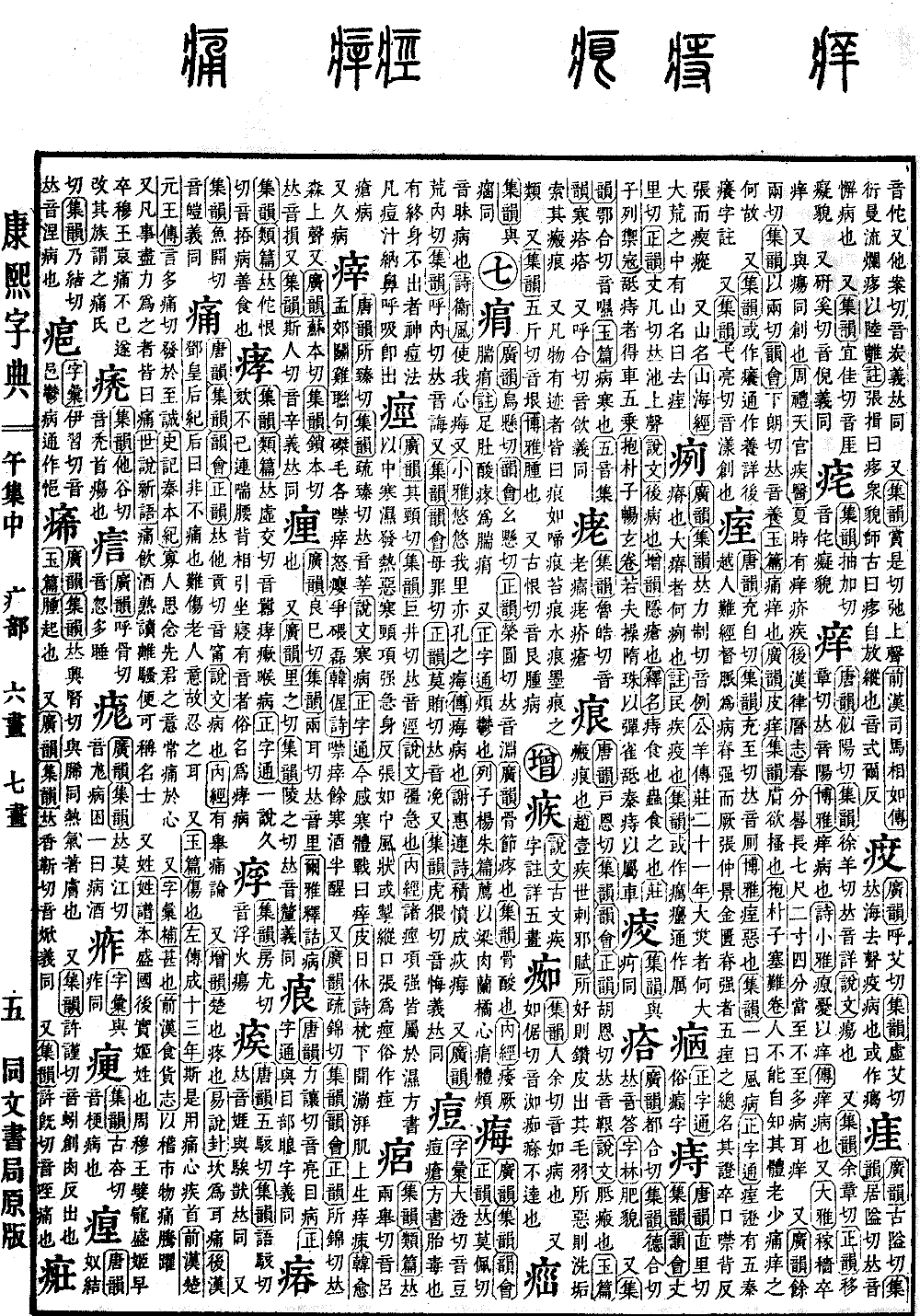
Wu Collection, Middle Volume
Radical: Sickness (bì)
Yang; Kangxi stroke count: 11; Page 773, Entry 04
Pronounced xiang. Shuo Wen Jie Zi (Explicating Graphs and Explaining Characters) defines it as a sore.
Pronounced yang. Guang Ya (Expanded Glossaries) defines it as illness.
Book of Odes (Shijing), Xiao Ya: Worrying makes one ill. The commentary states that illness is the meaning.
Also in the Daya section: The harvest is entirely sickly.
Also equivalent to the character for a sore (yang). A wound.
Book of Rites of Zhou (Zhouli), Offices of Heaven, Physician of Diseases: In the summer, there are itch and scabies illnesses.
Book of the Later Han (Hou Hanshu), Treatise on Harmonics and Calendrical Astronomy: At the spring equinox, the shadow is seven feet two and four-tenths inches long; if it does not arrive when it should, there is much illness and itching.
Pronounced yang (rising tone).
Yu Pian (Jade Chapters): The sensation of pain and itching.
Guang Ya: Skin itching.
Ji Yun (Rhyme Collection): The desire to scratch the skin.
Baopuzi (Master Who Embraces Simplicity), Volume on Refuting Difficulties: People cannot know the reasons for the pain and itching of their own bodies, whether young or old.
Also written as a variant form. Frequently used interchangeably with the character for nourish (yang). Refer to the subsequent note on the character yang.
Pronounced yang (falling tone). A wound.