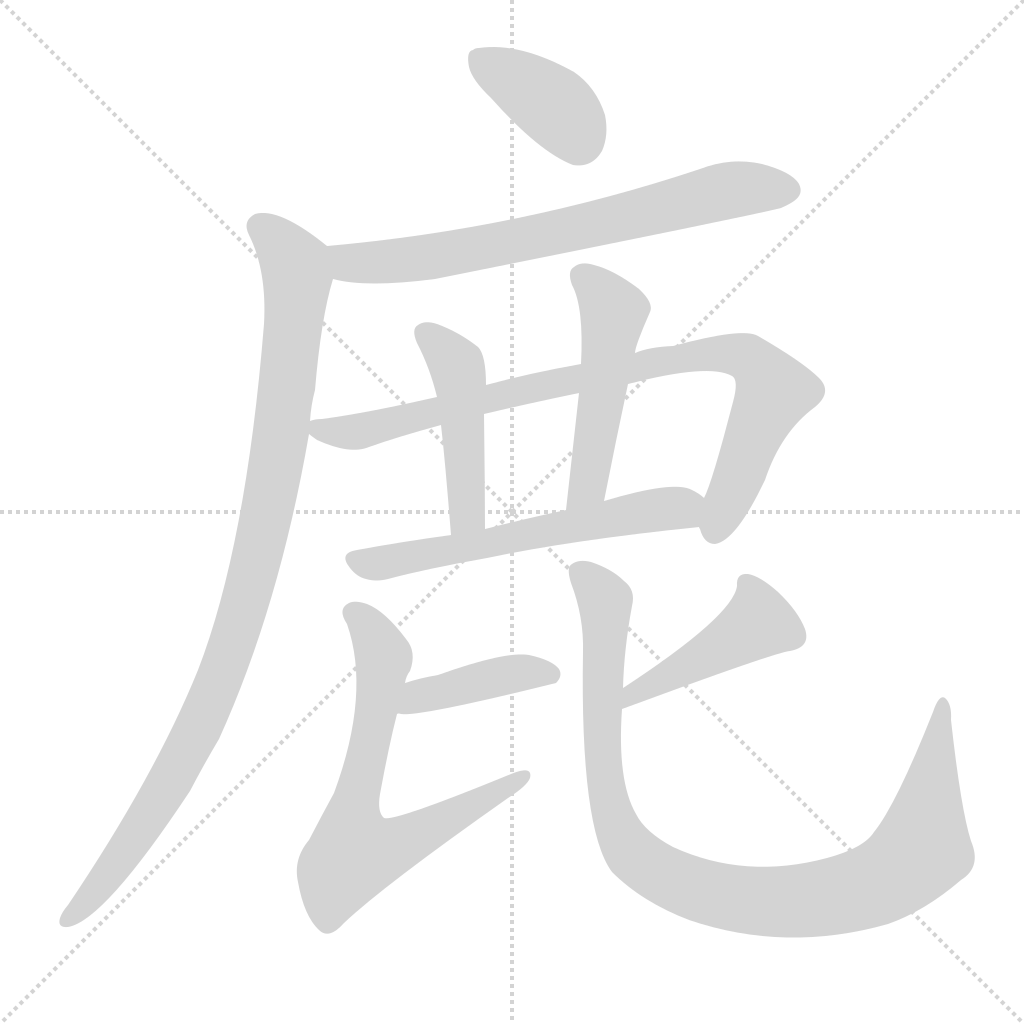
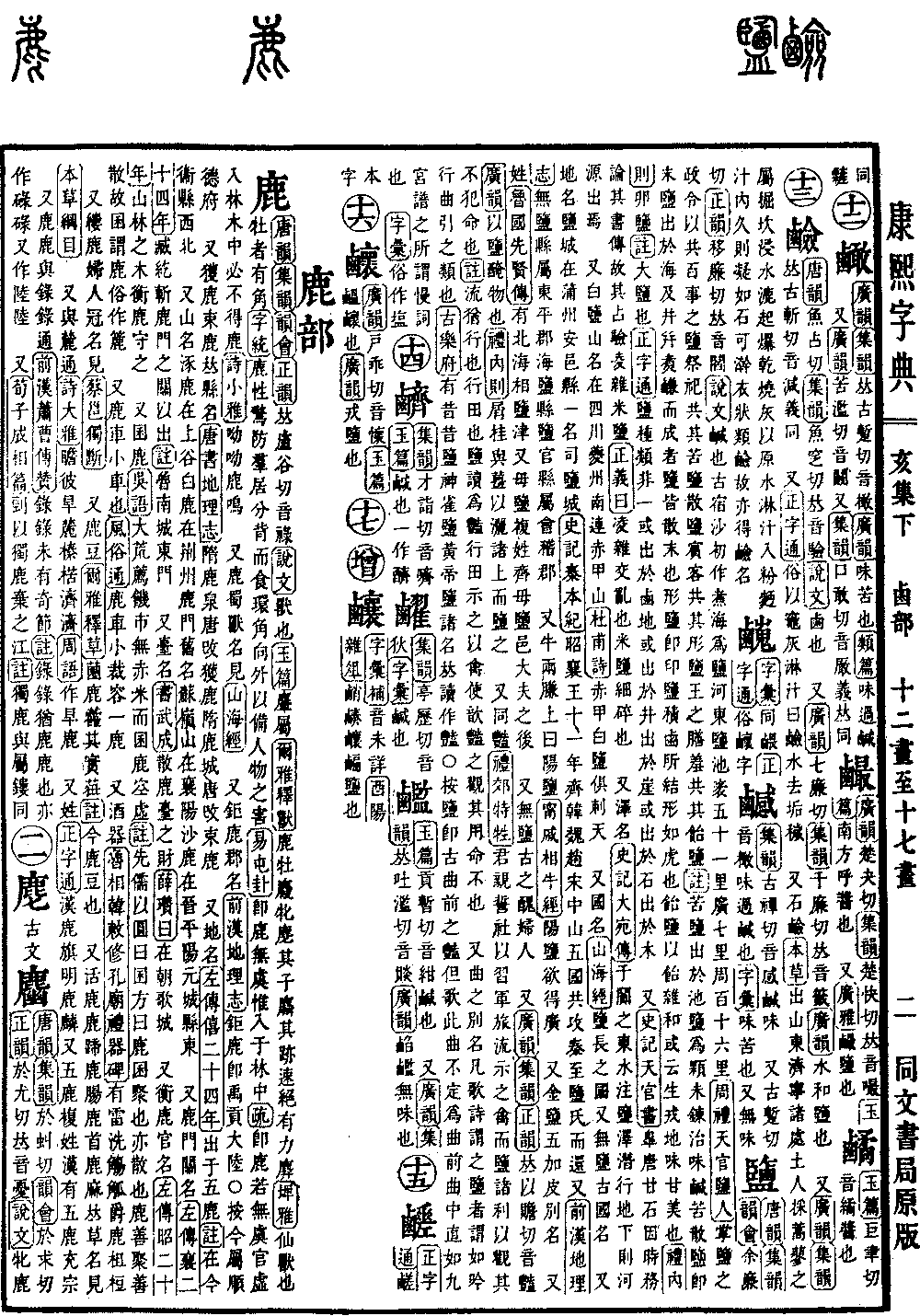
Hai Collection, Lower Volume, Radical: Deer (lù), Kangxi Stroke Count: 11, Page 1508, Entry 14
Tang Yun, Jiyun, Yunhui, Zhengyun: Pronounced lu (falling tone).
Shuowen Jiezi (Explanation of Simple and Compound Characters): An animal.
Yupian (Jade Chapters): A type of deer (zhang).
Erya (Approaching Elegance), Interpretation of Beasts: The male deer is called jia, the female deer is called you, the young deer is called mi, its footprints are called su, and the exceptionally strong and powerful one is called.
Piya (Amplification of Elegant Names): It is a divine animal. Male deer have antlers.
Zitong (Compendium of Characters): The deer is naturally alert and defensive; they live in groups, eating back-to-back with their antlers pointed outward to protect against humans and other animals.
Book of Changes (Yijing), Tun Hexagram: To chase wild deer without the guidance of an official in charge of the forests only leads to entering the mountain forests in vain.
Commentary: To chase wild deer without the help of a forest official, one enters the woods in vain and will certainly not catch the deer.
Book of Odes (Shijing), Lesser Odes: The deer cry out in harmony.
There is also an animal called lushu. See Classic of Mountains and Seas (Shanhaijing).
There is also a prefecture called Julu.
History of the Former Han (Qian Hanshu), Treatise on Geography: Julu is the Dalu mentioned in the Tribute of Yu (Yu Gong). It currently belongs to Shunde Prefecture.
There are also Huolu and Shulu, which are names of districts.
Book of Tang (Tangshu), Treatise on Geography: During the Sui dynasty, it was called Luquan, and renamed Huolu in the Tang dynasty. During the Sui dynasty, it was called Lucheng, and renamed Shulu in the Tang dynasty.
There are also place names.
Zuo Tradition (Zuo Zhuan), 24th year of Duke Xi: Emerging from Wulu.
Commentary: Located northwest of the current Wei County.
There are also mountain names. Zhuolu is in Shanggu. Bailu is in Jingzhou. Lumen, formerly known as Suling Mountain, is in Xiangyang. Shalu is east of Yuancheng County in Pingyang, Jin.
There is also Lumen, which is the name of a mountain pass.
Zuo Tradition (Zuo Zhuan), 24th year of Duke Xiang: Zang Wuzhong chopped through the bolt of the Lumen Gate and escaped.
Commentary: The east gate of the south city of the State of Lu.
There is also the name of a platform.
Book of Documents (Shangshu), Wucheng: Distributing the wealth of Lutai.
Xue Zan's Commentary: Located in Zhaoge City.
There is also Henglu, which is a title for an official.
Zuo Tradition (Zuo Zhuan), 20th year of Duke Zhao: The trees of the mountain forests are guarded by the Henglu official.
There is also qunlu.
Discourses of Wu (Wuyu): Great famine led to starvation, with no coarse rice in the market and empty granaries.
Commentary: Earlier scholars believed that round ones are called qun and square ones are called lu. Qun means to gather, but it also has the meaning of dispersing. Deer are skilled at both gathering and dispersing. Therefore, qun is also called lu. Commonly written as lu (a variant character for a basket).
There is also the luche, which is a small cart.
Fengsu Tong (Comprehensive Meaning of Customs): The luche is small and can only hold one deer.
There is also a wine vessel.
Ritual Vessels of the Confucius Temple repaired by Lu Minister Han Chi: Contains lei (wine vessel), xi (washing vessel), shang (goblet), gu (beaker), jue (wine cup), lu (sacrificial vessel), and ju (food vessel).
There is also lulu, which is the name of a woman's head ornament. See Cai Yong's Duduan (Sole Judgment).
There is also ludou (deer bean).
Erya (Approaching Elegance), Interpretation of Plants: The plant is called lu, and its fruit is called xu.
Commentary: This is the modern ludou.
There are also huolu, luti, luchang, lushou, and luma, which are names of herbs. See Compendium of Materia Medica (Bencao Gangmu).
Also interchangeable with lu (mountain foot).
Book of Odes (Shijing), Greater Odes: Watching the foothills of those dry mountains, the hazel and hawthorn trees are flourishing.
Discourses of Zhou (Zhouyu): Written as hanlu.
There is also a surname.
Zhengzitong (Guide to Correct Characters): During the Han dynasty, there was Lu Qi; during the Ming dynasty, there was Lu Lin.
There is also Wulu, which is a compound surname. During the Han dynasty, there was Wulu Chongzong.
There is also lulu, which is interchangeable with lulu (mediocre).
History of the Former Han (Qian Hanshu), Biography of Xiao and Cao: Lulu, having no distinct integrity.
Commentary: Lulu is like lulu. Also written as lulu. Also written as lulu.
Also in Xunzi, Chengxiang Chapter: Using a Dulu sword to commit suicide, the body was abandoned in the river.
Commentary: Dulu is the same as shulu.